Universe Today
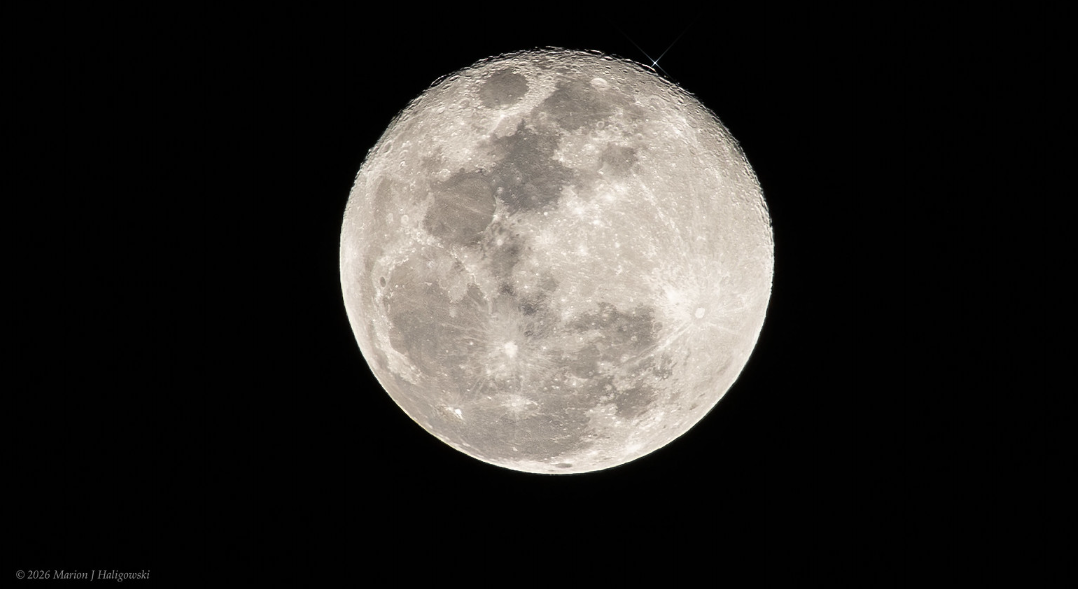
*If skies are clear, observers across the Americas have a chance to spot a fine lunar occultation of the bright star Regulus Saturday night. *
Much of visual astronomy requires nothing more than clear skies, keen eyes, and patience. If you’re out skywatching Saturday evening and live in North or South America, watch for the waxing gibbous Moon pairing with Regulus at dusk. And for a privileged region, the Moon will actually blot out the star. This is one of the best-placed lunar occultations of a bright star for 2026.
The event sees the +70% illuminated, waxing gibbous Moon occult (passes in front of) the +1st magnitude star Regulus (Alpha Leonis) for eastern North America, the Caribbean, southern Central and northeastern South America on the evening of Saturday, April 25th (around 1:19 Universal Time on the 26th).
In the contiguous United States (CONUS), the farther south and east you are, the better the event will be, as Regulus will ingress behind the leading dark limb of the Moon under darker twilight skies, post sunset. Regions southward across the Caribbean and South America will see the event in its entirety under dark skies.
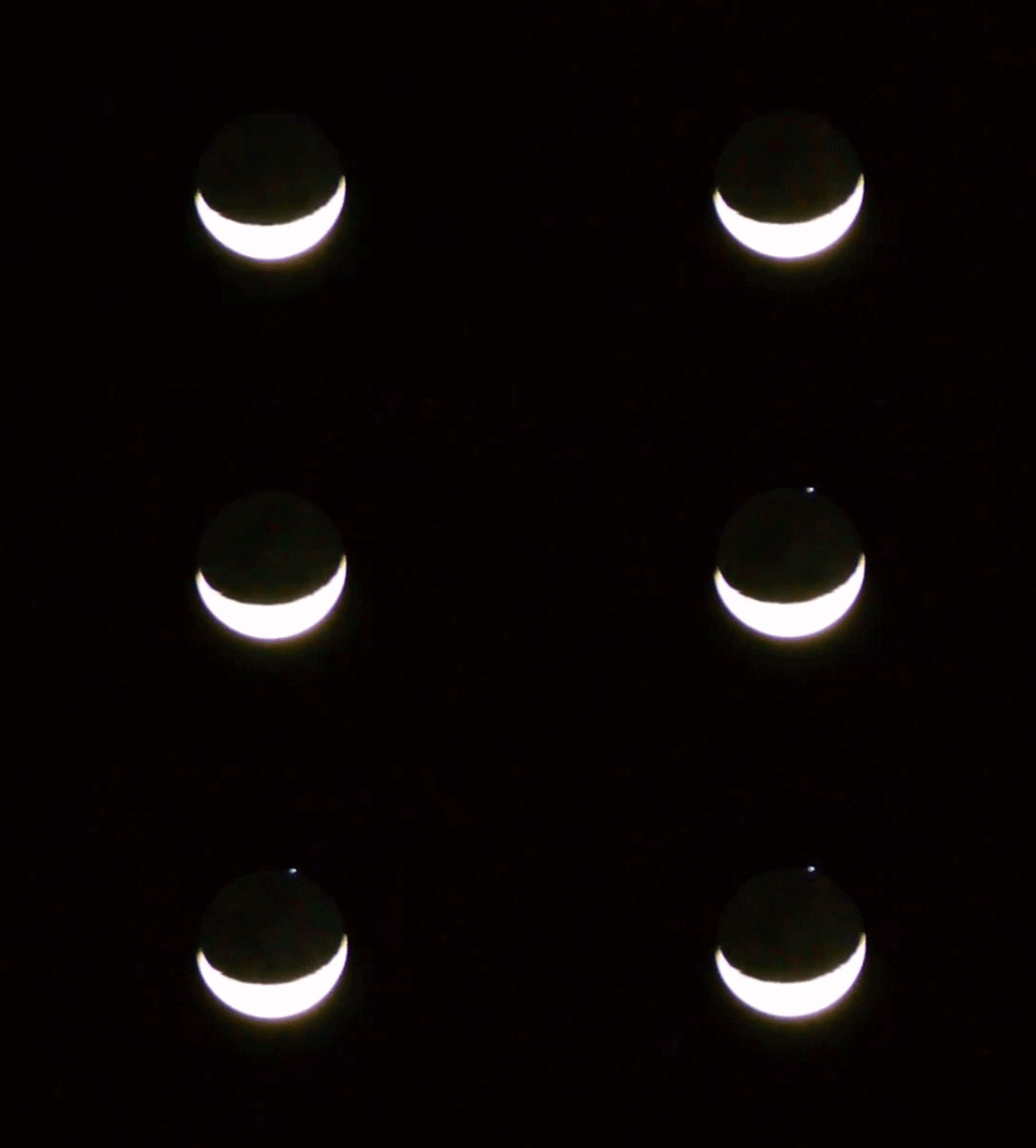 Egress of Regulus from behind the waning crescent Moon from October 15th, 2017. Credit: Dave Dickinson.
The area west of the U.S. East Coast to the Mississippi River has dicier prospects, with Regulus hiding behind the Moon before sunset, then reemerging at dusk. West of the Mississippi sees the entire event transpire under daytime skies.
The International Occultation Timing Association IOTA has ingress and egress times for select sites in the occultation footprint.
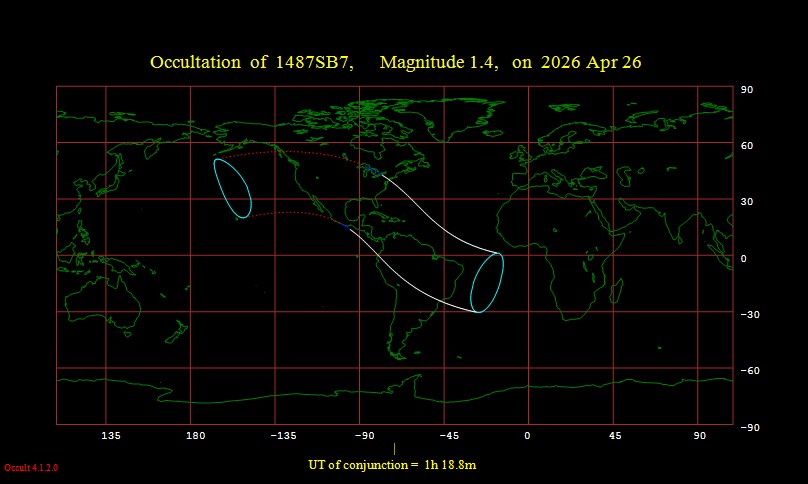 The occultation footprint for Saturday night's lunar occultation of Regulus. The solid lines denote where the event transpires after dusk, while the blue lines bracket twilight regions, and the dashed lines outline where the occultation occurs under daytime skies. Credit: Occult 4.2/IOTA
When it comes to lunar occultations, the graze line where the Moon’s limb just nicks the star is the place to be. It can be quite dramatic to watch the star wink on and off as it plays hide-and-seek with the lunar mountains and valleys in quick succession. This can even provide useful information to help map the jagged profile of the lunar limb. Saturday night sees the northern graze line for the Regulus event cross upstate New York diagonally from Lake Ontario to Long Island.
Can you spot Regulus, in the daytime? First magnitude is right on the edge of what might be possible with binoculars or a small telescope under superb conditions and a deep blue sky. The nearby Moon makes Saturday night a good time to try this rare feat of visual athletics.
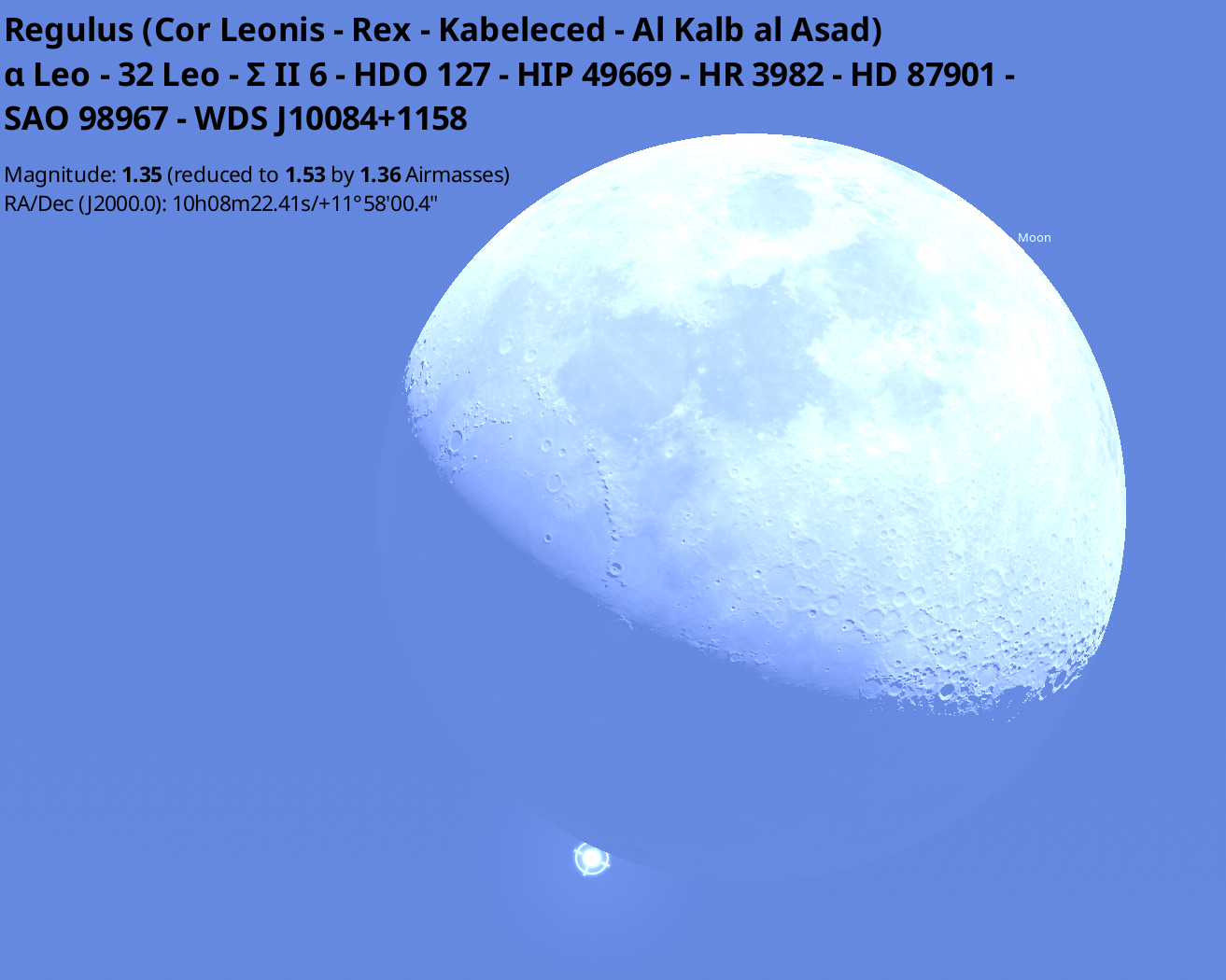 The Moon covers Regulus under daytime skies. Credit: Stellarium.
Occultations can also help tease out elusive faint companion stars as the two wink out in a quick step-wise fashion. In the case of Regulus, the main-sequence primary star is suspected of possessing a small white dwarf companion in a tight 0.35 AU, 40 day orbit, putting it at just 0.015” from its primary.
Observers have followed occultations all the way back to antiquity. Such ‘star and crescent’ pairings have even made their way onto the flags of several sovereign nations. The Moon visits Regulus on a roughly nine year cycle, with the current period running out until December 28th, 2026.
Regulus is the lucida or brightest star in the constellation Leo the Lion, and is located about 77 light-years distant. The Moon can also occult Aldebaran, Spica and Antares. The Moon could also occult the bright star Pollux until 117 AD, after which celestial motion carried the star out of the Moon’s path.
Along with eclipses, recorded observations of occultations also provide a good chronological peg for historians. Located very near the ecliptic plane, Regulus even turns up in eclipse images on occasion, as it did during the recent August 17th, 2017 eclipse:
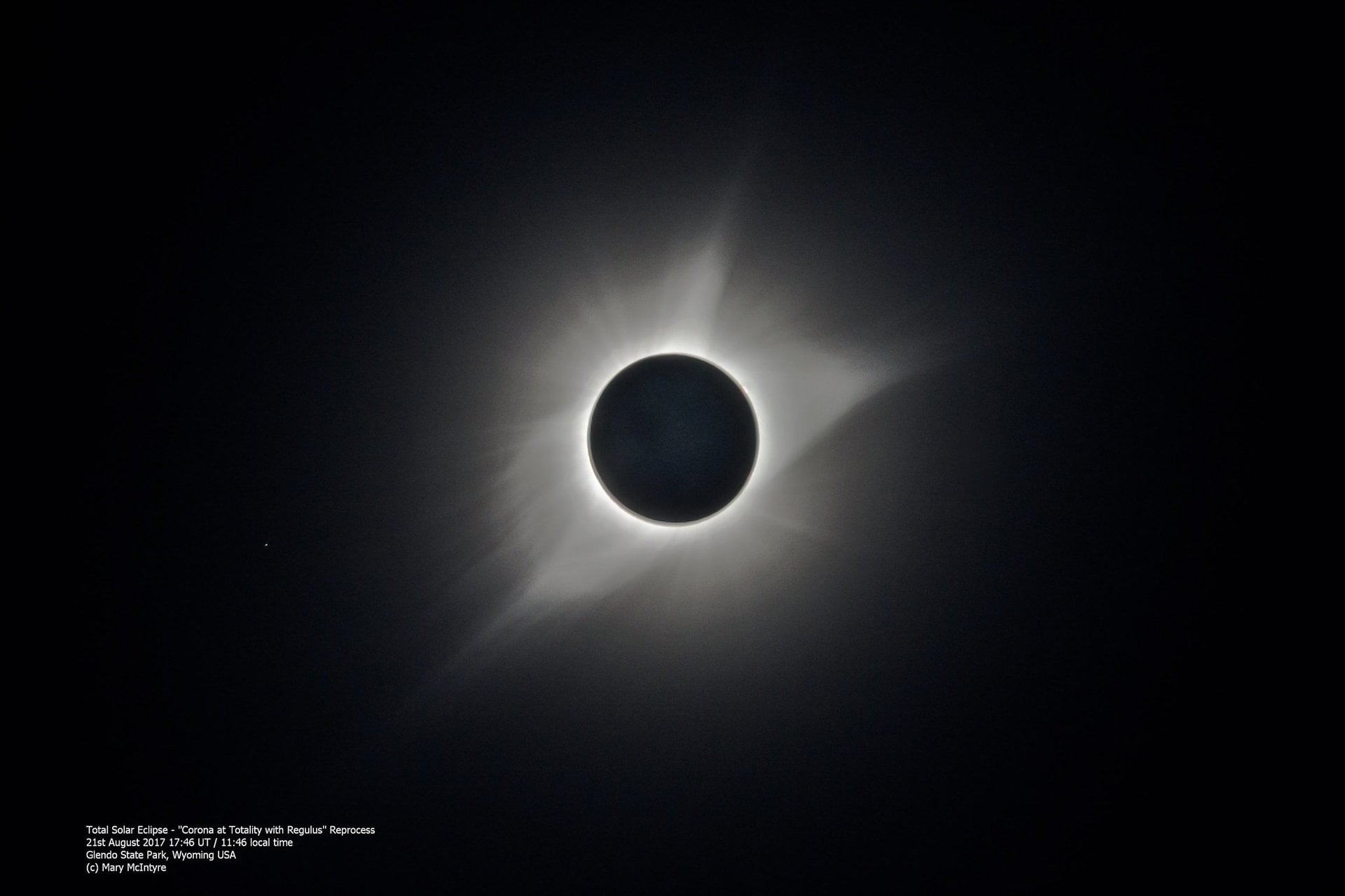 Solar totality with Regulus nearby. Credit: Mary McIntyre FRAS
Follow that Moon, as it reaches Full phase on May 1st, setting us up for a May ‘Blue Moon,’ in the sense of a calendar month possessing two Full Moons.
And the celestial gears of the sky continue to turn. Don’t miss Saturday night’s lunar occultation of Regulus. It’s an easy event to observe and record, and a fun way to connect with those old astronomers of yore.