Universe Today
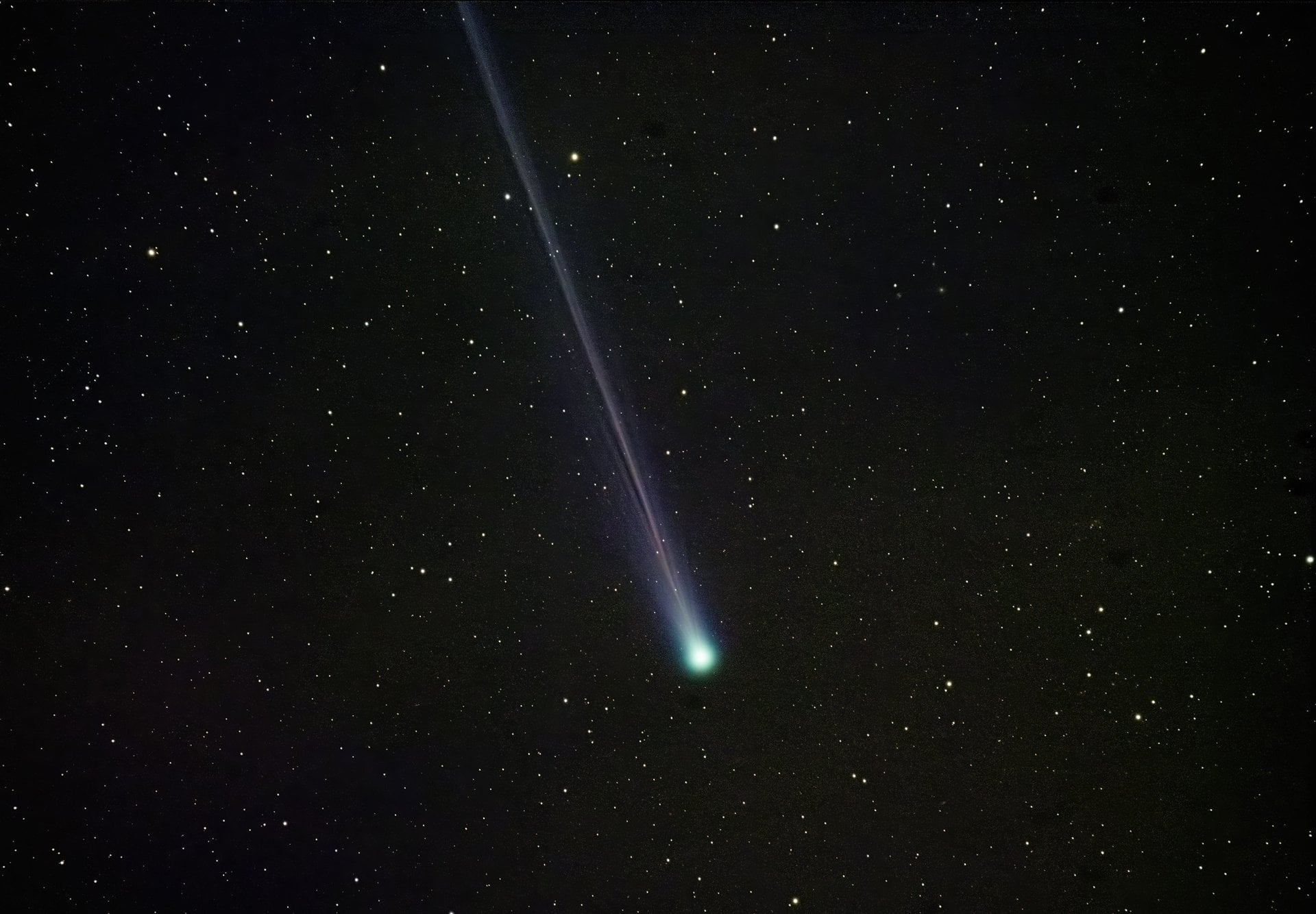
Comet R3 Pan-STARRS is about to put on its climatic perihelion act.
We’re one comet down, and one to go for spring season 2026. We recently wrote about prospects for sungrazer C/2026 A1 MAPS and comet C/2025 R3 Pan-STARRS in April 2026. While the bad news is, Comet A1 MAPS disintegrated like so many sungrazers before it during its blistering close perihelion passage on April 4th, comet R3 Pan-STARRS put on an amazing dawn showing for early rising astrophotographers.
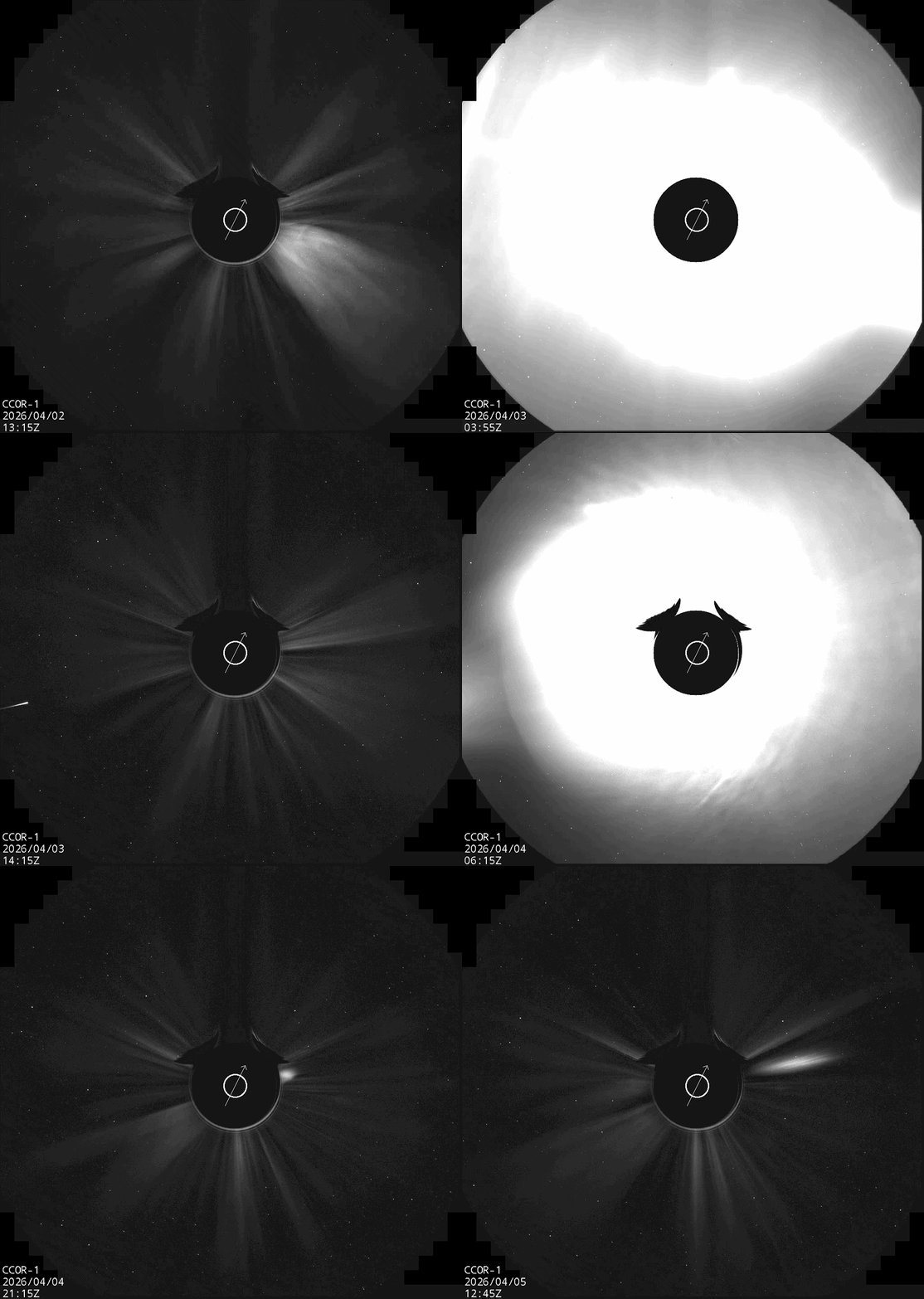 The demise of comet R3 Pan-STARRS, as witnessed by the CCOR-1 imager aboard GOES-19. Credit: NOAA.
Comet R3 Pan-STARRS is developing nicely, and currently shines at magnitude +4.3. If we’re lucky, comet R3 PanSTARRS might just touch negative magnitudes, or at least top out at magnitude 0 when it passes perihelion this weekend. Unfortunately, the comet also passes just four degrees from the Sun as seen from our Earthly vantage point on April 25th.
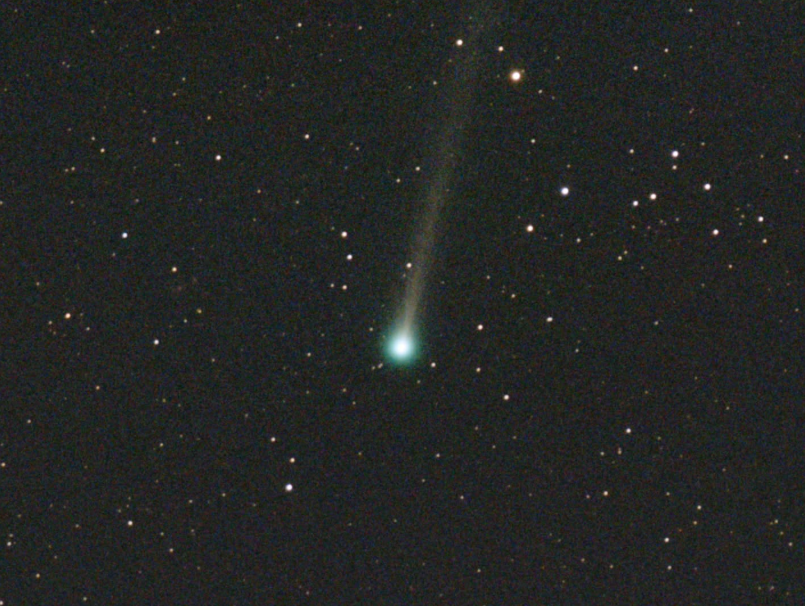 Comet R3 Pan-STARRS from the morning of April 9th. Credit: Dave Dickinson (Dwarf Mini smartscope, stack of 100 images).
We’ve seen some great captures on comet R3 Pan-STARRS from readers over the past week. The window to see the comet was a short one, as it lingered low in the dawn sky about an hour before sunrise for mid-northern latitude observers.
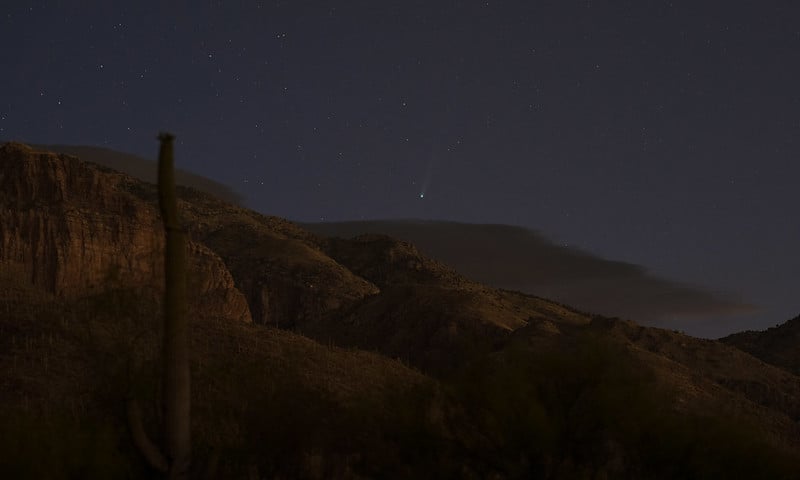 Comet R3 Pan-STARRS at dawn over Tucson, Arizona on the morning of April 17th. Credit: Eliot Herman.
Discovered on September 8th, 2025 by the prolific Pan-STARRS sky survey, the comet just made our roundup of top comets to watch for in 2026, late last year. On a 170,000 year orbit inbound, the comet is actually heading towards our general direction along our line of sight before reaching perihelion just outside the orbit of Mercury and looping back out of the solar system, away from our fair planet.
The comet has shown off a needle-thin dust tail, with a coma glowing green with cyanogen gas. It’s also been knocking on naked eye visibility the last few mornings, before the encroaching dawn swallows it up for good. The comet reaches perihelion on Sunday, April 19th at 0.499 Astronomical Units (AU), 75 million kilometers from the Sun. The good news is, we’ll still get to follow the comet through perihelion, thanks to modern space-based technology.
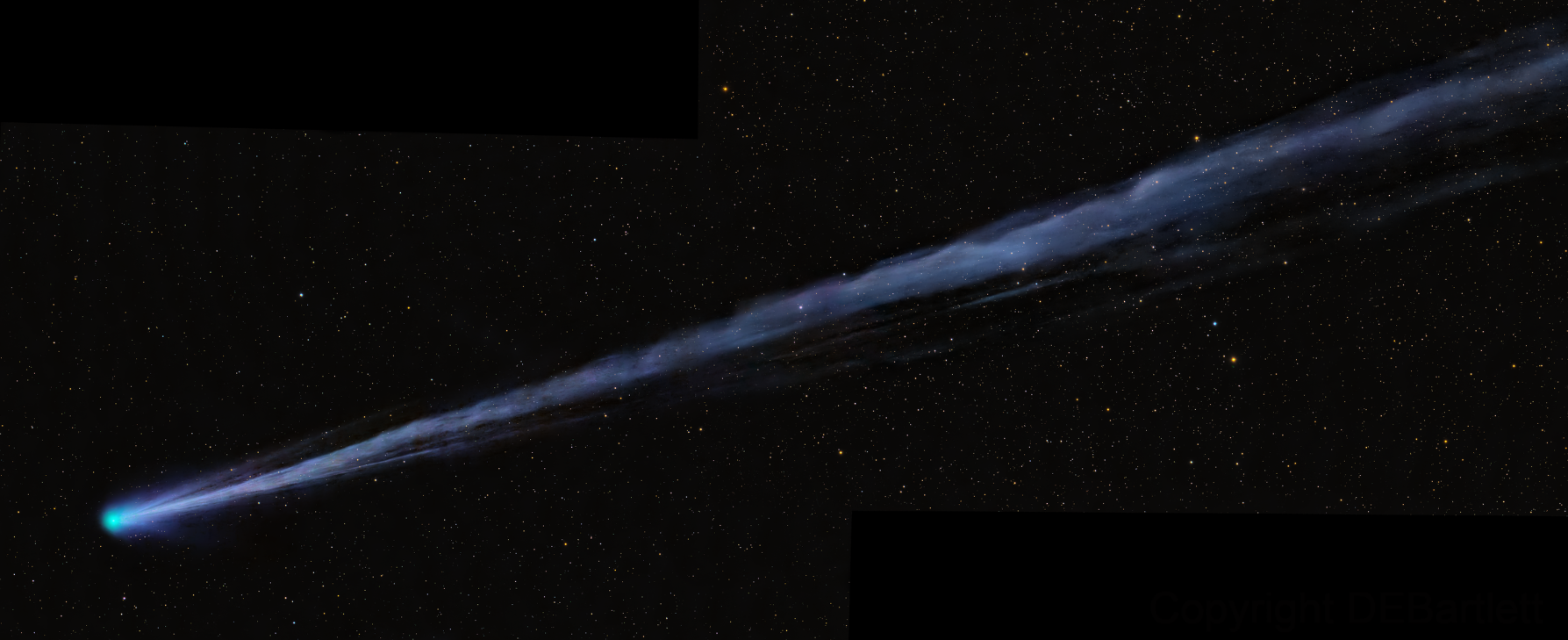 A wide-field mosaic from April 14th, showing the amazing full length tail of Comet R3 Pan-STARRS. Credit: Dan Bartlett.
As mentioned previous, that closest approach to the Sun for the comet is just exterior to Mercury’s orbit, meaning the survival prospects for comet R3 Pan-STARRS are pretty good. The comet then makes its closest Earth approach a week later on April 26th at 0.523 AU from Earth.
We see the comet's orbit cross edge-on from our Earthly vantage point on April 29th. The joint NASA/ESA Solar Heliospheric Observatory SOHO should give us an amazing view of the comet’s perihelion evolution. The comet crosses the wide view of its LASCO C3 imager from April 23rd to the 25th. Remember, the dust tail of a comet is swept back from its coma by the solar wind, meaning the tail of Comet R3 Pan-STARRS will lead the way from it, preceding ahead of the comet after perihelion.
SOHO is an amazing resource, and to date, has discovered 5,204 sungrazing comets from its Sun-Earth L1 vantage point in well over a quarter century of operation.
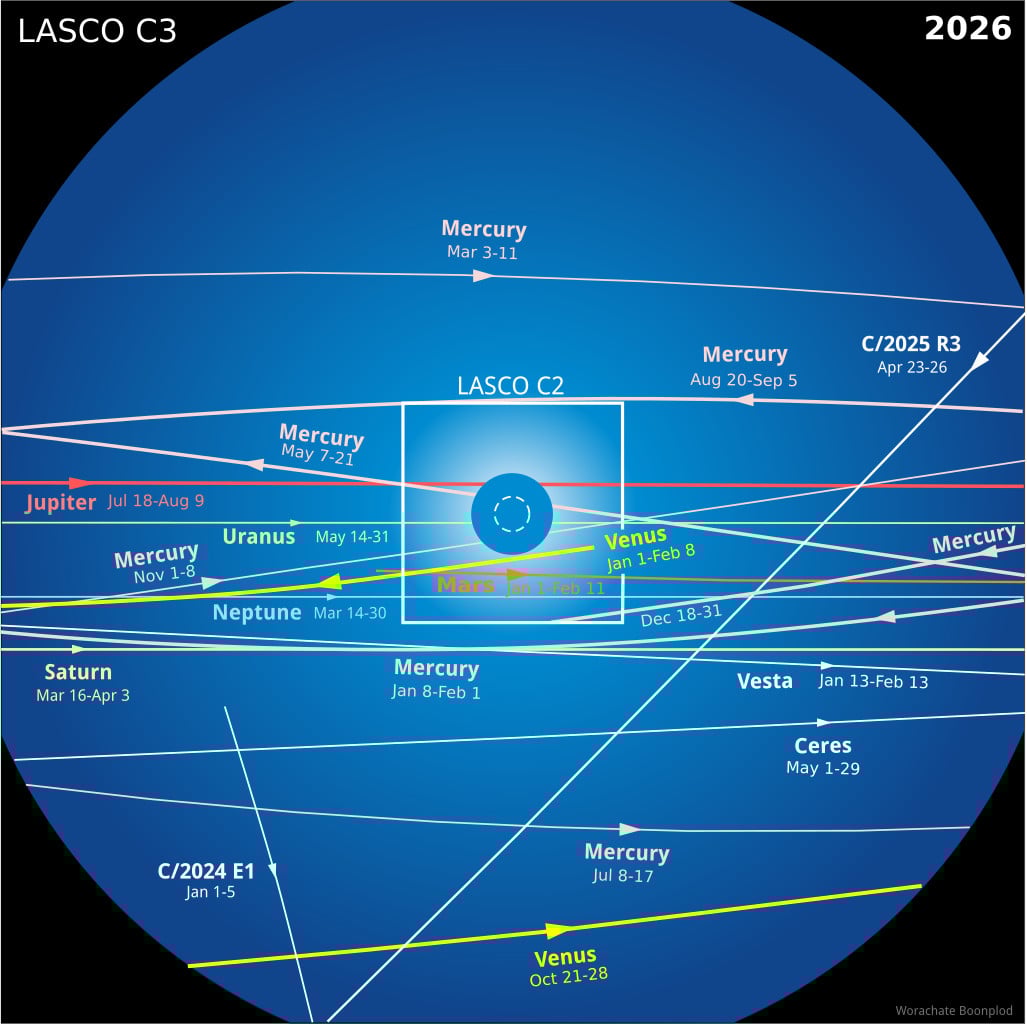 The course of Comet R3 Pan-STARRS through SOHO's LASCO C3 field of view, along with planetary transits for 2026. Credit: SOHO/Worachate Boonplod.
Another newcomer on the solar chronograph scene worth watching is the CCOR-1 (Compact Chronograph) imager aboard NOAA’s GOES-19 satellite. This next generation chronograph is unique, in that the Earth and Moon occasionally photo-bomb its view from its vantage point in geostationary orbit.
Unfortunately, dusk prospects for the comet post perihelion are tricky on its trek back out of the solar system. The comet runs along a path through the constellations Eridanus into Orion and past the bright star Sirius in May through June. This time of the year, this course draws a line almost parallel to the horizon for observers based along mid-northern latitudes at dusk. The farther south you are, the better prospects you’ll have to pick out comet R3 Pan-STARRS out of the murk and against a dark evening sky. Note that the comet passes just two degrees from the great Orion Nebula (Messier 42) on May 11th (photo-op!).
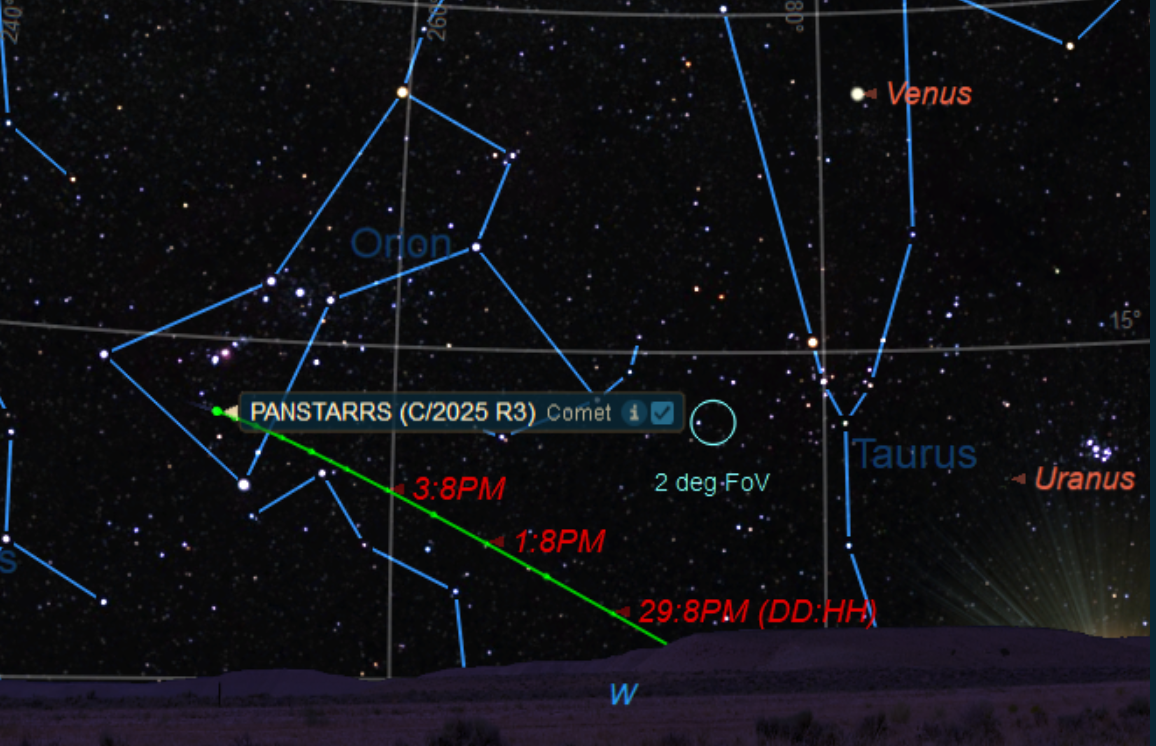 The late April/early May path of Comet R3 Pan-STARRS through the evening sky. credit: Starry Night.
Comet R3 Pan-STARRS spends the remainder of the year and into 2027 looping its way through the constellation Lepus the Hare en route to ejection from our solar system outbound, fated to become someone else’s very own ‘interstellar comet’.
Be sure to watch the developing celestial story of comet R3 Pan-STARRS, as it reaches perihelion this weekend and departs the inner solar system for good.