 Universe Today
The last few days we’ve been covering a series of papers by Dr. Slava Turyshev of NASA’s Jet Propulsion Laboratory about the constraints surrounding the use of orbital data centers in space. One that has come up repeatedly is weight, and the solar panels used to power these data centers contribute a significant portion of that weight. So why not go with an alternative power source? Nuclear energy in space applications is having a bit of a moment currently – maybe it could provide the power needed for the orbital data center revolution? According to another paper from Dr. Turyshev, released as a preprint on arXiv, it all depends on the mission requirements.
One major problem with using solar panels for orbital data centers is the Sun doesn’t always shine in their orbit. During some seasons, each orbital pass will result in the satellite crossing over the Earth’s shadow for up to 21 minutes. And given that the orbits these data centers are on happen around 15 times each day, that means in a 24-hour day, the satellite spends around 5 hours and 13 minutes in the Earth's shadow.
To combat this problem, engineers turn to an obvious solution – batteries. But they are notorious for being heavy, and according to Dr. Turyshev’s calculations, providing enough storage capacity to combat a 21-minute stretch with no power, would require a 1 MW data center cluster to haul 6.46 metric tons of batteries into orbit. Combine that with the needed solar panels and radiators to get rid of waste heat as infrared light, and you end up with a total mass of 43 metric tons for a 1 MW cluster, even before counting any actual computing hardware.
Fraser talks about the potential of a nuclear reactor in space.A fission reactor would eliminate the need for solar wings, as well as batteries. However, it doesn’t really deal well with the other physical constraint on these systems – waste heat. While it eliminates the heat generated by the solar panels themselves, it introduces another engineering problem – getting rid of the heat at two different temperatures.
Running a nuclear fission reactor at 25% efficiency (which is pretty standard for thermal electrical conversion) would produce about 3 megawatts of conversion waste heat for every one megawatt of energy generated, meaning a one-megawatt computing cluster creates nearly four megawatts of ultra-hot waste heat from its power conversion machinery alone. This waste heat would be at around 700 Kelvin – more than double the maximum temperature that processors on the data centers need to be kept below in order not to fry themselves. While this higher-temperature heat can be radiated away with a relatively compact radiator, it would have to be separate from the thermal sinks cooling the processors below their 320 Kelvin ideal temperature. Ultimately, a nuclear-powered cluster would only need around 6% less low temperature radiator area than a fully solar-powered version.
Despite that, after adding all the mass of the reactor, radiation shielding, power converters, and all the other necessary equipment to run a nuclear reactor, fission originally looks like a winner. Compared to today’s standard solar panels, a compact fission reactor is around ten metric tons lighter per megawatt. And since weight is money in space, that sounds like a win.
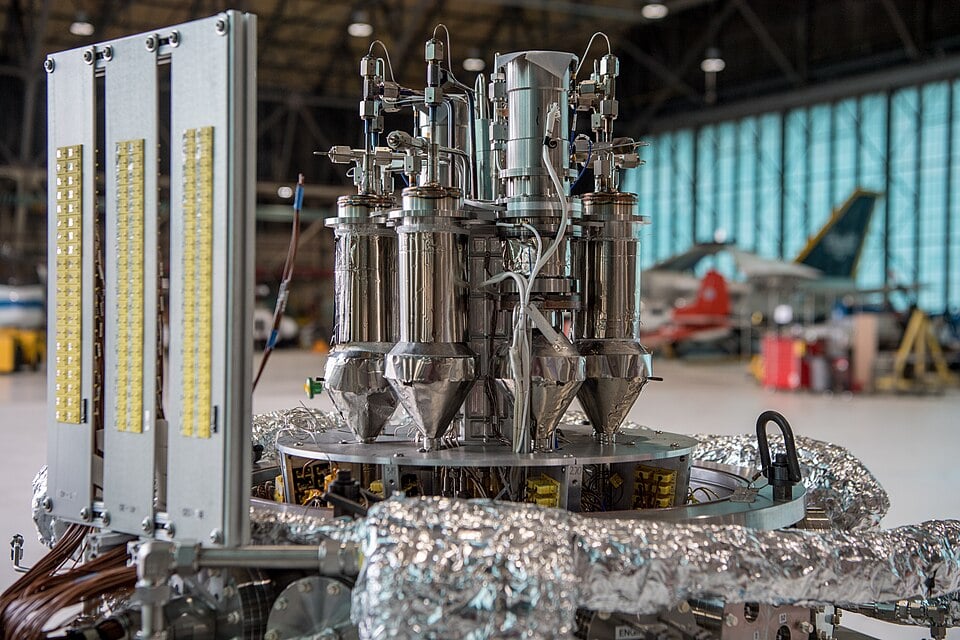
Fraser talks about the new nuclear reactor NASA will use for future Mars missions.However, there are several caveats to that. First, lighter, next-generation solar arrays are coming along quickly, whose increased efficiency could eliminate nuclear’s advantage entirely. Or the engineers could boost the satellite’s orbit up to 1,450 kilometers, where the Earth’s shadow problem completely goes away and the satellite can consistently bathe in sunlight – admittedly ignoring the potential space debris and trapped radiation problems this causes, as well as the need for higher power communications equipment.
Nuclear suffers from another disadvantage - radiation. Data centers in space already suffer from stray cosmic rays flipping bits unexpectedly. Putting one next to an active nuclear reactor subjects them to random gamma rays and neutrons as well. While this could be lessened a bit by putting the reactor on a long boom – physically separating it from the server racks and placing a dense “shadow shield” near the reactor to block radiation from reaching the computers, that would require extra weight in the form of cabling and the boom itself, eliminating more of nuclear’s original weight advantage.
Despite all these trade-offs, there does appear to be a situation where running a hybrid of both solar and nuclear is the best option. If a mission requires a data center to survive a 24-hour failure of its main power system while keeping 20% emergency power active for safe-mode operation, an 80/20 nuclear/solar split weighs in at around 36 metric tons, around a third of the weight of either as a standalone option due to the weight of batteries needed to meet those mission requirements. But to be clear, without that power maintenance constraint, either system in a standalone configuration wins out on weight.
Fraser talks aobut the advantages and disadvantages of orbital data centers.Ultimately, Dr. Turyshev thinks the financial picture is dependent on the lifespan of the nuclear reactor. Another disadvantage of a nuclear-powered satellite is it can’t just burn up in the atmosphere at the end of its life – it has to be boosted to a “graveyard” orbit at around 2,000 km, where a spent reactor would stay indefinitely. But, if a reactor lasts ten years, Dr. Turyshev calculates that it would save around $190 per kilowatt-year in launch costs, whereas if it lasts for only two years (as many experimental space-based reactors are designed to), then that flips to a $783 per kilowatt-year deficit.
What the paper doesn’t tackle is the social aspect of whether the general public would support putting potentially tens of thousands of small nuclear reactors into orbit. Just this week, NASA and the U.S. Department of Energy locked in the mission architecture for a nuclear-powered reactor known as Space Reactor-1 Freedom to power the propulsion system of a future Mars mission, so there’s at least some support for it (or at least the government thinks there is). But as more and more data centers are launched, how to power them with the best trade-off of weight vs cost vs safety vs capability will remain an ongoing debate.
Learn More:
S.G. Turyshev - Power-Architecture Crossovers in Orbital Computing: Thermal, Radiation, and Lifetime Constraints
UT - The Physics Wall Facing Orbital AI Data Centers
UT - Robots, Not Astronauts, Will Have to Fix Space Data Centers
UT - NASA Lays Out Ambitious Plans for Moon Base and Nuclear Mars Mission