 Universe Today
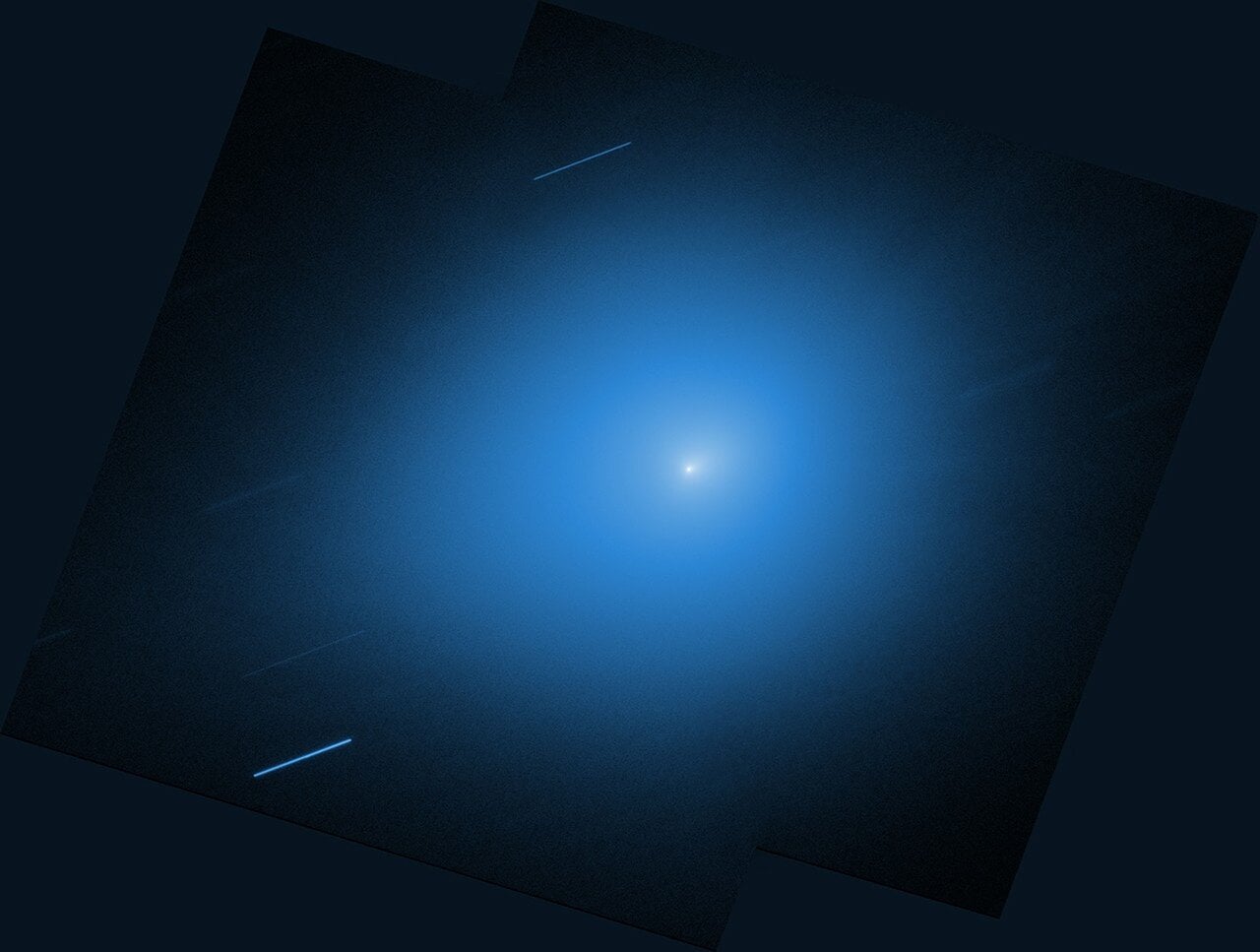
Targets of opportunity sometimes happen in astronomy, and we got a major one when the third interstellar object, 3I/ATLAS, was discovered in July 2025. And it just so happens that in the intervening years between the last known interstellar visitor (2I/Borisov in 2019), we got a major upgrade in our observational capabilities with the launch of the James Webb Space Telescope (JWST). A new paper from a team of researchers led by Dr. Silvia Protopapa of NASA’s Goddard Space Flight Center and the Southwest Research Institute, and published in The Astrophysical Journal Letters, details JWST’s findings on the water ice content of this most recent visitor from beyond our solar system.
Typically, water ice is pretty easy to spot for astronomers. In infrared, which is JWST’s specialty, it absorbs light very clearly at 1.5, 2.0, and 3.0 microns in wavelength. We’ve known that for years, and have seen evidence of it in regular comets based strictly on our solar system, such as Hartley 2.
But when JWST looked at 3I/ATLAS, it clearly showed the 3.0 micron absorption line, but the 1.5 and 2.0 ones were surprisingly weak or absent. It also featured a blue near-infrared continuum slope across 1.15–2.50 microns that wasn’t typical of the other comets zooming around our solar system. These discrepancies led some observers to question whether 3I/ATLAS actually contained any water ice at all, but the new paper with higher resolution observations quickly put paid to that idea.
Fraser talks about the orbital mechanics of 3I/ATLASTo prove that it does, indeed, contain water ice, the research team modeled how light scatters through “mixed” particles that contain both water and dust. This lined up much more closely with the observed spectral lines of 3I/ATLAS, proving that, instead of pure water ice with a clear pattern, the ice is locked up into microscopic grains that blend water and dark rocky minerals, such as pyroxene and carbon.
Light can only travel so far through these aggregates before hitting some dust, causing a shortened optical pathway. That, in turn, mutes the absorption features at the 1.5 and 2.0 micron level, while the longer 3.0 micron wavelength is still able to pass straight through. The tiny grains also scatter shorter wavelengths more effectively, which explains the general blue hue that JWST saw.
In fact, JWST observed this interstellar visitor at three different times during its journey through our solar system, starting when it was about 3.31 astronomical units (AU) out from perihelion all the way through when it was about 5.65 AU past perihelion. And the differences in 3I/ATLAS’s spectra were noticeable at each stage. After perihelion, the grains of ice and dust appeared to include a second population of larger, micron-sized, ice-rich aggregates.
Fraser talks about what would happen if we could catch an interstellar object.Also, after perihelion the researchers noticed a new optical effect known as a Fresnel reflection near 3.1 microns, which indicated that there was also “crystalline” water ice in 3I/ATLAS. This differs from the normal, disorganized type of ice normally seen, as its water molecules arrange themselves in neat crystalline lattices rather than in a jumble. According to the paper, these layers were only visible after perihelion either because the Sun itself warmed the surface layers causing them to reconfigure into a crystal, or the solar energy caused the outer dust to blast away, revealing cleaner underlying crystalline structures that were previously hidden.
But perhaps the most interesting part of the paper was the parallels it was able to draw with our own solar system. The infrared patterns of 3I/ATLAS match certain types of Trans-Neptunian Objects (TNOs) in our own solar system. These balls of ice and rock are the planetary leftovers that float out beyond Neptune in the Kuiper belt, and JWST has already spent plenty of time staring at them. Previously, researchers had seen the same 3.0 micron absorption pattern without the 1.5 and 2.0 micron features, but had thought those patterns might be attributable to complex hydrocarbons or organics. Turns out it might just have been dusty ice all along, at least according to the new paper.
It’s unclear whether there will ever be another opportunity like this in JWST’s operational lifetime. But there’s still plenty left to understand about our most recent interstellar visitor. As more and more scientists continue to analyze the data that was collected during 3I/ATLAS’s sojourn through our system, there’s undoubtedly more to be discovered about our latest interstellar visitor, and especially how it can explain more about our own solar system.
Learn More:
SwRI - SwRI-led study uses Webb to compare interstellar comet 3I/ATLAS with icy bodies in our solar system