 Universe Today
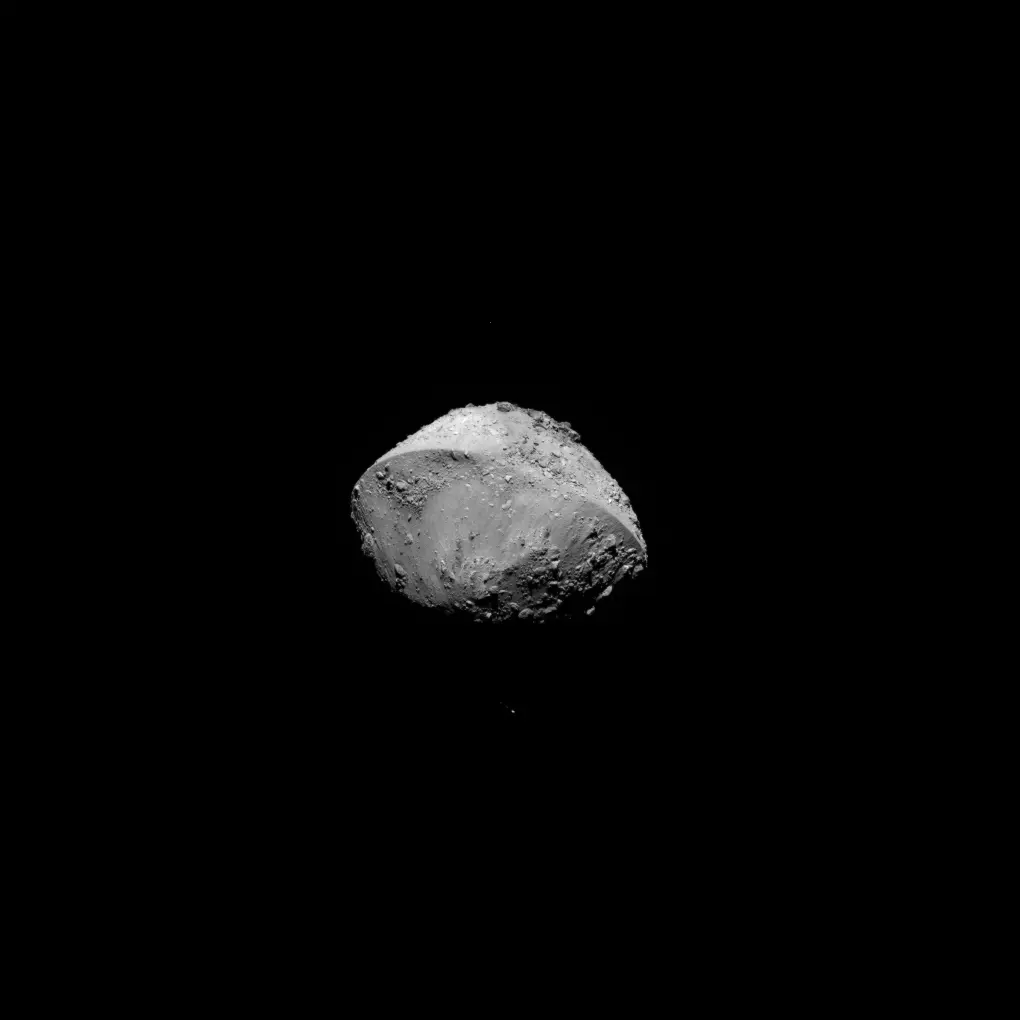
Around four years ago, humanity intentionally hit an asteroid. The Double Asteroid Redirection Test (DART) was by pretty much all measures a resounding success when it struck the asteroid moonlet Dimorphos going more than 22,000 kilometers per hour. However, we still don’t know just how much of a success it actually was - DART was a one-way mission with no real way to track the results of the impact close up. Enter Hera, the European Space Agency (ESA) mission that recently arrived in the binary asteroid system. Now, in a press release, ESA has provided some of the best pictures of the binary system since that fateful day four years ago.
The lack of accurate measurement isn’t for lack of trying. Ground-based observatories have been watching 151m wide Dimorphos and its parent asteroid, 780m wide Didymos very closely over the last four years. They could tell that Dimorphos slowed its orbit around its larger companion by about 33 minutes. But some scientists were surprised by the magnitude of the change in orbit, based on the theoretical math done before the mission.
To help clear up any ambiguity about the math underlying this planetary defense mission, Hera is equipped with three main imaging tools. Its standard “eyes” are the Asteroid Framing cameras, which handle both black-and-white photography and navigation. The press release showcases an image from this system showing Didymos from roughly 28.5km away, with features down to roughly 2.7m per pixel.
Fraser talks about Hera's final insertion into the binary asteroid system.In the image, you can clearly see the “spinning top” shape of the larger asteroid in the pair. Didymos spins at a relatively rapid speed for its size, completing a rotation every 2.2 hours. That energy is strong enough to pull boulders and gravel towards the middle of the asteroid, causing a build-up of material that makes it look fatter in the middle than at its poles.
However, seeing an asteroid in black in white isn’t as scientifically useful as seeing it in “color”. That is what Hera’s second imaging system, the HyperScout H instrument, is designed to do. It monitors the asteroid over 25 different color bands. With that information, HyperScout H can absorb and reflect light with different unique patterns - essentially it can spectroscopy. Comparing the results to lab experiments on meteorite samples on Earth will help determine what Didymos and its smaller companion are actually made up of.
But why stop at simple hyperspectral imaging when you can also have heat vision? The Thermal Infrared Imager (TIRI), supplied to ESA by Japan’s Aerospace Exploration Agency (JAXA) gives Hera “Superman-like” heat vision according to the press release. TIRI maps the temperature of the surface of the asteroids, and since solid rock dissipates heat much more slowly than porous or fragmented rock, it will also give a good indication of how solid Didymos really is.
Fraser talks about some of the results of the DART test.Crucially, Dimorphos itself, the actual subject of the original DART test, is surprisingly absent from many of the pictures in this first round of releases. In the visible light images, Dimorphos is tucked almost entirely into the shadow of Didymos, appearing as a tiny sunlit spec beneath Didymos in one of the images. But with TIRI’s “Superman” view, the entire 151m wide asteroid is clearly in focus, glowing a shade of cool purple in the infrared. Cameras aren’t the only thing Hera is carrying either. It will eventually launch two CubeSats, Juventus and Milan, to study the asteroid binary very closely. They will use ground-penetrating radar and even touch down on the surface of Dimorphos in an effort to understand what itstruly made of.
But ultimately the overarching purpose of the mission is to get a better idea of how effectively we can move an asteroid out of the way if we need to. DART appeared to be a success on the surface. Understanding what really happened to Dimorphos is what Hera, with all its cameras and companion spacecraft, was literally designed for. And we’re just at the earliest phases of that process. The next step is a major release of even sharper images planned for a live event at the Berlin Museum of Natural History on November 25th. Asteroid watchers, and space enthusiasts more generally, should mark their calendars for our first high-resolution view of one of the biggest impacts we’ve had on another body in the solar system to date.
Learn More:
Hera surveying asteroids with superhuman vision
UT - ESA's Hera Mission Targets Binary Asteroid Pair in November
UT - Hera Probe Sees Asteroid Pair Separately for First Time
UT - Rebooting a Spacecraft, 140 Million Kilometres From Home.