 Universe Today
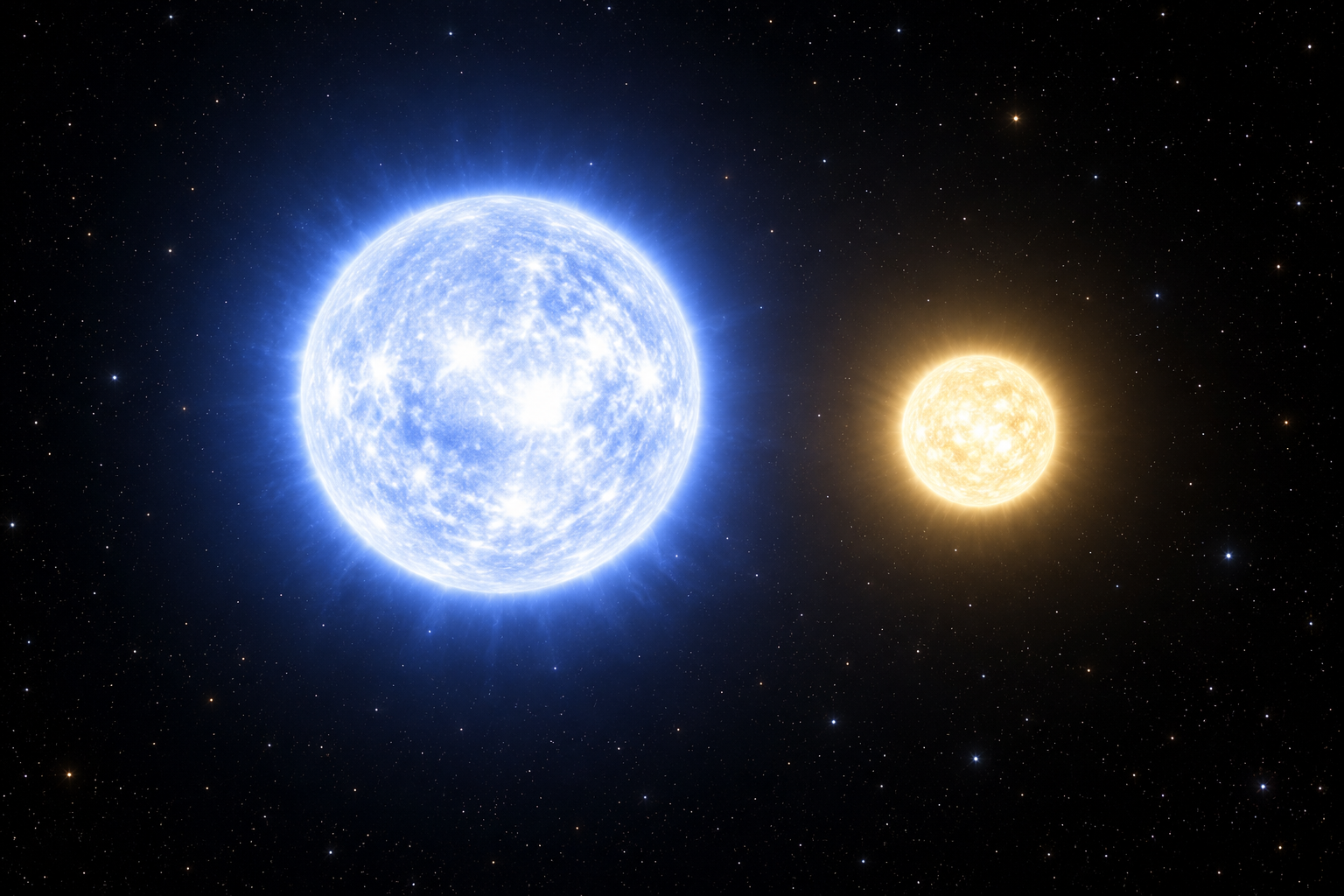
When observatories like the James Webb Space Telescope (JWST) conduct observation campaigns, they often start by observing star fields to calibrate their instruments. These stars must have precisely characterized spectra so that their radiant energy (or fluxes) can be measured accurately. However, some stars that appear as single objects have a binary companion that has not been resolved, altering their predicted stellar flux. In fact, a star that is used for JWST calibration (HD 158485), which was thought to be an A-type star, has been identified as a binary system.
The discovery was made by a team from the Xinjiang Astronomical Observatory of the Chinese Academy of Sciences (CAS), who found the binary while reviewing long-term observations from NASA's Transiting Exoplanet Survey Satellite (TESS). Their study, published in The Astrophysical Journal Letters, provides the first orbital solution and dynamical mass ratio for the system. HD 158485 is an example of a pulsating, variable, or Delta (δ) Scuti star, which experiences brightness changes at a regular frequency (typically every 18 minutes to 8 hours)
From the TESS data, the team noticed that HD 158485 was pulsing in six distinct rhythms, otherwise known as δ Scuti pulsation modes. They further noticed that these pulses fell into two groups with opposing light-travel-time variations, meaning that the light from these pulses reached Earth at different times. This could only be explained by the presence of a binary companion. The team used the variation between the two signals to trace the star's orbital motion with HD 158485, which showed that they orbit each other every 382.8 days.
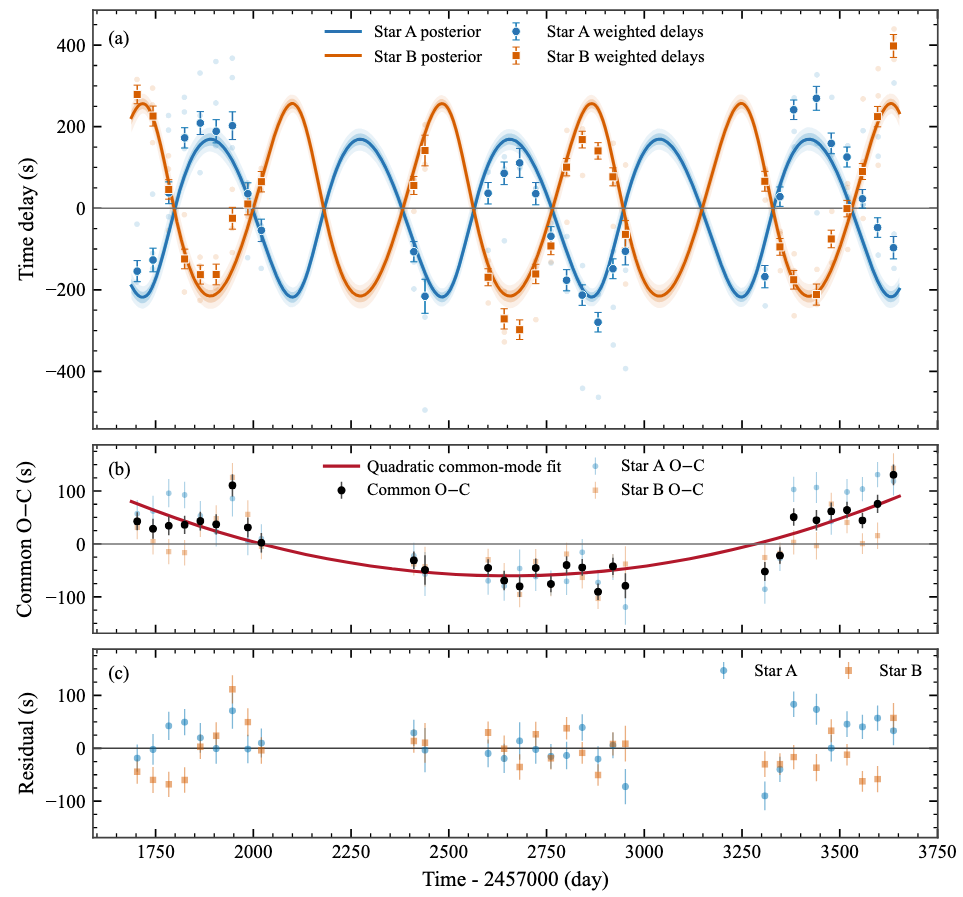 Pulsation timing results for HD 158485. The two groups of pulsation modes show opposite time delays, revealing the orbital motion of both stars. Credit: Chenglong, LV et al. (2026).
The data also allowed them to constrain the orbital parameters and the star's mass. According to their calculations, the companion has an eccentricity of 0.242, indicating a moderately elongated, closed elliptical orbit, and is about 80% as massive as its primary - making it a likely F-type (yellow-white) main-sequence star. Their findings are independently confirmed by an orbital model built from earlier TESS data, which accurately predicted the timing variations that were detected by a separate observation campaign.
The team further compared a two-star atmosphere model with a conventional single-star model using the system's mass ratio, which showed a flux difference of about 1.6% between one and five micrometers (μm), and 2.5% between five and 28 μm. These findings could have significant implications where JWST calibration is concerned. While they do not represent a measured error, they do show how mistaking a binary system for a single star can shift predicted fluxes, thus throwing off readings.
In essence, the team's results show that stellar pulsations can reveal binaries that conventional observations leave unresolved. It also underscores the need to account for hidden stellar companions when evaluating calibration standards for our instruments.
Further Reading: Chinese Academy of Sciences