 Universe Today
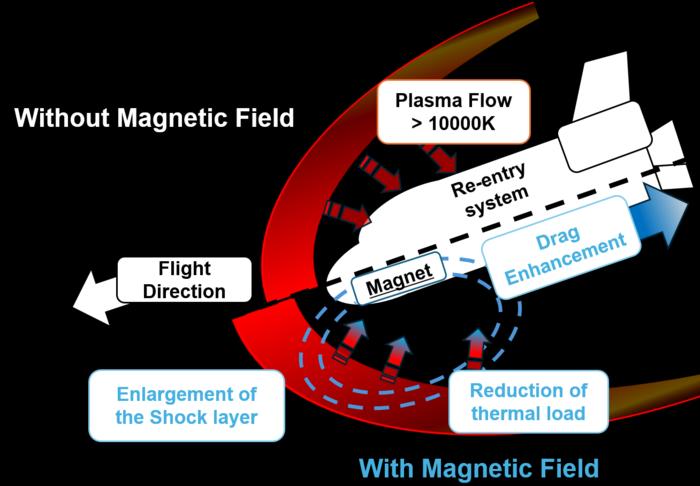
Spacecraft famously have small bits of them disintegrate on reentry. That’s by design, as it is one of the easiest solutions to absorbing the incredible amounts of energy they experience. However, it also results in long turn around times while these heat shields are repaired, and the shields themselves act as “dead weight” limiting payload capacity. With the increased focus on reusable rockets, and the emphasis on payload capacity, engineers have been looking for alternative solutions to the reentry problem - and the one of the most promising is known as magnetohydrodynamic (MHD) braking. A new paper from researchers at the Tokyo Metropolitan University describes a new test setup that should help designers of these advanced braking systems truly capture what their system is doing upon reentry.
First, let’s understand how MHD systems actually work. When a spacecraft is reentering Earth’s atmosphere, the air in front of it turns into a type of glowing, weakly ionized plasma. Simply put, MHD brakes use a magnetic field from inside the spacecraft to push against this plasma. Using a phenomenon known as the Lorentz Force, this magnetic field provides an invisible magnetic cushion between the plasma and the vehicle, which in turn does two crucial things. First, it reduces the heat experienced by the spacecraft’s heat shield, and second, it increases the vehicle's aerodynamic drag, effectively slowing it down.
This sounds great in theory, but testing it in practice is difficult to say the least. One of the bottlenecks in practice came from a critical component of the system - permanent neodymium magnets. Their magnetic strength caps out around 0.8 Tesla, which sounds like a lot, but when dealing with high speed forces isn’t quite enough oomph to matter. Additionally, their rigid shapes mean they’re not very good at adapting to different spacecraft geometries, making them less effective for some types of designs.
Fraser discusses another potential solution to reentry for reusable rockets - “sweating” heat shields.Enter the Pulse Forming Network (PFN). This is an electrical circuit made up of alternating capacitors and inductors that can store and then discharge a large amount of energy in a short amount of time. Despite providing a whole ton of power for a very short amount of time, PFNs don’t require their own cooling systems since they only run for a fraction of a second.
To test their new magnetic set up, the researchers built an 8-m long expansion tube facility, which they called MX-6.0 that fires shockwaves similar to what a reentering spacecraft would experience, hitting up to 7.7km/s. But a test chamber is only useful if it has a thing to test, so they built two 20mm test modules with different magnetic characteristics to see how those shapes would function in that environment.
Model 1 was a blunt cylinder with a gentle nose curve feature that produced a magnetic flux density (a metric of magnetic field strength) of around 1.24 Teslas - 50% more than the maximum output of a neodymium magnet. Model 2 was based on the MUSES-C asteroid sample return spacecraft, and used a similar sized coil to produce a 1.58 Tesla magnetic field.
Fraser talks about how weird fluids can get in space.When placed inside the chamber, the PFN successfully synchronized with the incoming shockwave pulses and created a standing magnetic field that lasted for between 110 and 148 microseconds. That might not sound like a long time, but it was more than double the effective test time of the experimental setup.
High speed cameras set up around the setup captured notable improvements in the two model’s functionality. Model 1 experienced a growth in the glowing shock emission region by 15.7%, while Model 2 had its thickness grow by 16.2%. Since those thicknesses are tied directly to the amount of barrier / aerodynamic drag, those increases are tied directly to the performance of a MHD system.
That being said, this idea was never intended to be used on a full scale spacecraft. This successful pilot was originally designed specifically for wind tunnel testing and it appears to do that job phenomenally. As engineers continue to work on MHD braking systems, more and more of them might be making a journey to Tokyo to put their systems through the rigors of a small test chamber with a very big magnetic presence.
Learn More:
TMU / EurekAlert - Magnetohydrodynamic (MHD) aerobraking for spacecraft on reentry.
T. Muramatsu et al - Quasi-Steady Magnetic Field Generated by Pulse Forming Network for Magnetohydrodynamic Aerobraking
UT - Foldable Solar Sails Could Help With Aerobraking and Atmospheric Reentry
UT - Integrating New Concepts for Entry, Descent and Landing for Future Human Missions to Mars

