 Universe Today
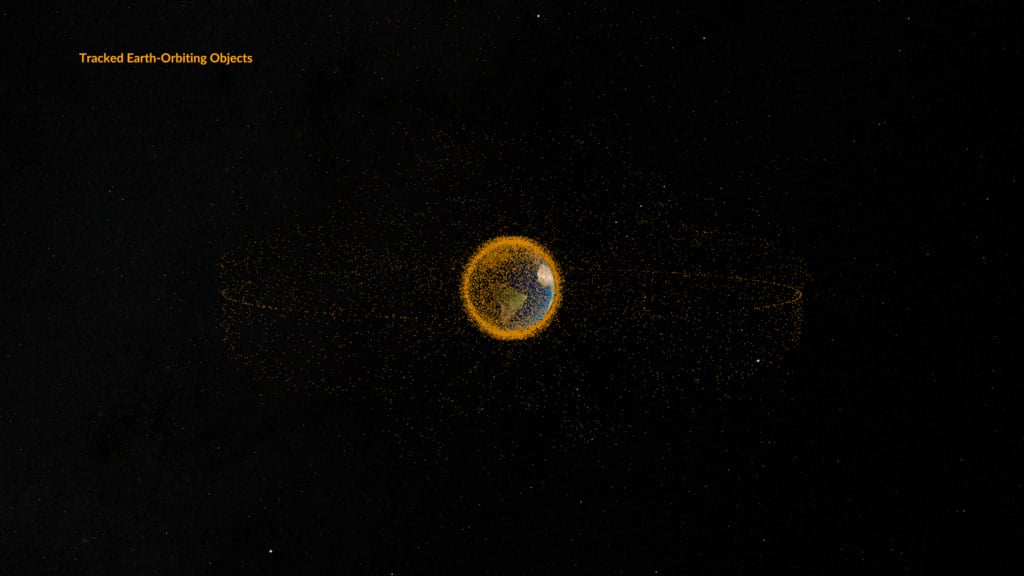
It seems the overwhelming majority of the time when we write about satellite megaconstellations, it’s as a warning. That’s not because they aren’t useful, but because they hold the potential to completely destroy our access to space if not managed properly, and possibly cause a whole bunch of Earth-based devastation as well. So it probably won’t come as a surprise when there is yet another paper from a leading expert on space debris pointing out the potential hazards of the latest crop of satellite megaconstellations - which is exactly what a new paper, available in pre-print on arXiv by Hugh G. Lewis of the University of Birmingham, does.
Kessler syndrome - named after Dr. Donald Kessler who first identified the problem and came up with early orbital stability models with Phillip Anz-Meador - has been a worry in the back of the mind of many a rocket scientist for decades. However, their classical model was based on relatively passive satellites - i.e. ones that don’t move out of the way to dodge close approaches. Which is exactly what modern-day satellites do, massively complicating the model.
The focus of Prof. Lewis’ paper is updating those frameworks to reflect how modern day satellite constellations actually act. The new framework accounts for active collision avoidance, continuous replenishment rates (i.e. defunct satellites get replaced in the constellation), and de-orbital drag profiles based on the geometry of the satellites themselves.
Fraser talks about whether there's a limit to how many satellites we can launch.But the paper goes deeper than just updating the framework - it actually analyzes a set of fourteen different planned or partially operational satellite constellations (along with two additional ones under specific assumptions). Perhaps more importantly, it places them into one of three categories - Exceeding Runaway Threshold, Exceed Unstable Threshold, and Below Thresholds (Sustainable). Constellations that are sustainable will eventually see their fragment population decline - those in the unstable camp will see them increase to a certain point and then hit an equilibrium. But those in the Runaway camp, unsurprisingly, see infinite fragment growth, essentially guaranteeing Kessler syndrome.
Of the constellations analyzed, more than half are above their unstable or runaway thresholds. To put it bluntly, that means, if all of these constellations were approved by regulators, and effectively launched with their current plans, there would be literally millions of satellites that would choke up numerous orbital paths, causing orbital gridlock and forcing humanity to revert back away from being a space-faring species.
Some of the more egregious violators, according to the paper, are SpaceX’s Starmind - its plan to put 1,000,000 AI data centers into orbit, and Blue Origin’s Project Sunrise, but also, interestingly, the Guowang constellation of around 13,000 satellites, planned and regulated by China. All three are above their infinite runaway threshold.
Fraser interviews Moriba Jah about whether we can avoid Kessler syndrome.Constellations that do well on the new metric include Starlink’s Mobile Satellite Service (consisting of 15,000 satellites) and Blue Origin’s TeraWave. In part that’s because they operate in a lower orbit with more atmospheric drag, reducing the amount of time debris will continue to circle the planet. However, even relatively small constellations, like the Eutelsat Next fleet of 528 planned satellites, exceed their unstable threshold simply because they operate at higher altitudes, which causes debris to take longer to orbit.
Perhaps even more terrifyingly, each of these assessments of the constellations were done in a vacuum. Semi-literally if you’re thinking about the higher altitudes of orbit, but figuratively in terms of not considering any other constellation when doing the calculations. Or, even more terrifyingly, not considering the tens of thousands of existing pieces of junk already in orbit which could have massive destructive potential if they hit these operating satellites. It also doesn’t include any unintended failures of the constellations themselves, which any engineer will tell you is not a reasonable assumption - and will only make things worse.
Lewis makes the argument that, since regulators only make space debris considerations based on the design of a single satellite while ignoring the impact of potentially millions of them operating in orbit, they are bound to ignore the potential dangers these satellite constellations pose to themselves and to humanity's future in space more generally. While we still have a platform to talk about it, we’ll continue to ring the alarm bell of getting our regulatory affairs in order before agreeing to launch so many satellites that we reach a tipping point. Time is running out before we do so, and despite the fact that papers like this make the danger even more glaringly obvious, we still don’t have a clear path to solving this potentially devastating problem.
Learn More:
H.G. Lewis - Critical Sizes of Satellite Constellations
UT - 2.8 Days to Disaster - Why We Are Running Out of Time in Low Earth Orbit
UT - Orbital Debris is Getting Out of Control
UT - Not Just Sitting Ducks. Maybe Satellites Could Dodge Almost all Space Junk

