 Universe Today
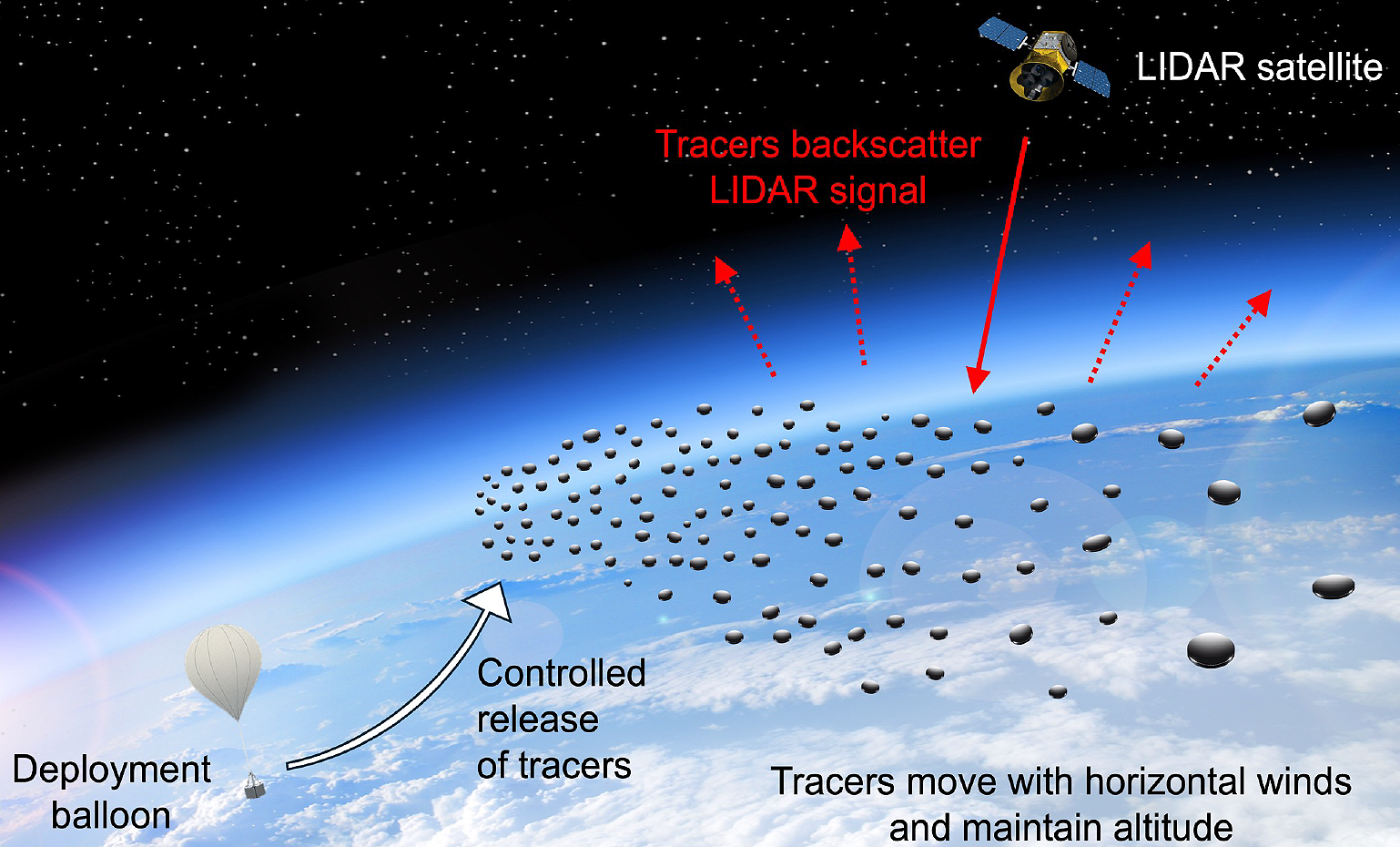
The atmospheric is a dynamic place, and just how well we understand that dynamism depends on what part of the atmosphere it is. Low altitudes can be reached by traditional balloons, with full suites of sensing equipment. Higher reaches are the domain of satellites, with their zippy orbits allowing them to travel through the less dense regions. But there a section scientists call the “ignorosphere”, between 30-100 kilometers up that still plays a major role in global climate dynamics, but which are only able to reach with temporary sounding rockets that only collect data for a few minutes before falling back to Earth. But a new technology from Benjamin Schafer of Rarefied Technologies that received a NASA Innovative Advanced Concepts (NIAC) grant hopes to solve that problem by inserting a fleet of sensors that can float in that area for months, while providing insight to these hard-to-capture long-term patterns that influence weather everywhere on the globe.
So how can a fleet of sensors float at atmospheric level that can pull down entire satellites but is too sparse for balloons to float in? They use something called the photophoretic effect. We’ve reported on the idea before, but for a brief overview, the photophoretic effect utilizes engineered materials that use sunlight and the limited amount of atmosphere to float precisely at the altitudes where its hard for satellites and balloons to tread.
The materials these sensors are made out of are designed to be transparent on the top and dark on the bottom, allowing sunlight to pass through them to reach the bottom, and crucially, create a temperature differential between the top and bottom parts of the sensor. This temperature differential causes gas particles that are hitting the hot bottom surface to bounce off with a greater kinetic energy than those hitting the top. And an imbalance of kinetic energy has another word commonly used in space exploration - thrust.
Fraser talks about another NIAC grant for photophoretic sensors!This effect doesn’t work well at sea level - the thick area creates too much drag. Nor does it work in a vacuum - there’s no gas molecules causing kinetic energy transfer. But in the sweet spot between 30-100km, this type of propulsion system works like magic. Engineers can also design them to intentionally degrade in the UV light so they are not definitely stuck in the mesosphere, eventually coming back down to Earth once their surfaces degrade enough to ensure they don’t just become another part of space debris.
Deployment of the sensors themselves is a relatively easy affair. A high-altitude balloon or sounding rocket carries the sensors to around 30 km altitude, whereupon they are released and autonomously rise, without any flight control, to around 90-100 km - their equilibrium altitude.
However, the probes themselves are too light to require the necessary sensor equipment and battery packs to actively transmit their own data. So the mission plans to use satellites that are in orbit above them to track them. And to do so, they will be specifically designed to reflect LIDAR light back at those satellites.
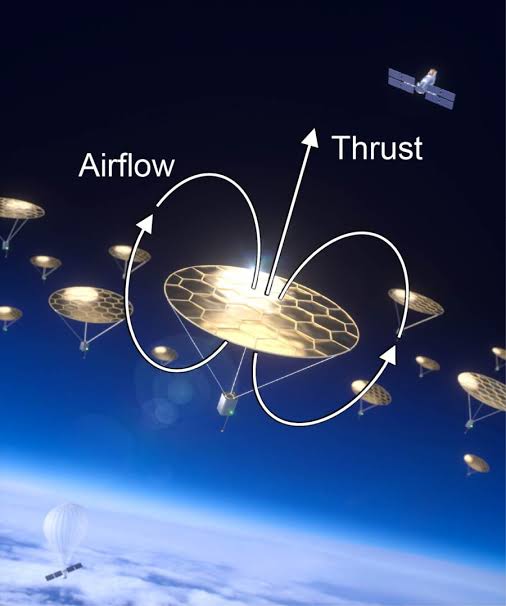 Illustration of how the photophoretic effect works. Credit - AIAA
While that might limit their ability to tracking wind flow patterns in the mesosphere, rather than directly taking chemical samples, it also drastically lowers the Size, Weight, Power, and Cost (SWaP-C), a key metric of space missions in terms of their viability. In exchange for launching some relatively inexpensive and lightweight sensors, we can get immediate feedback on ionospheric weather conditions at a level of sensitivity we’ve never had before.
There are still challenges though. Since the probes rely on sunlight for their temperature differential, they will start to lose altitude during the night, introducing some variability into their orbital pattern. Tracking thousands of these tiny sensor using LIDAR could also prove to be its own challenge, especially in terms of processing all the data that results from that.
But NIAC itself is intended for crazy ideas, and this mission certainly fits that category. The Phase I grant is a few hundred thousand dollars, with the hope that it will eventually move on to a Phase II in the coming years with a more definitively path towards making a fully fledged mission. For now though, the idea of sunlight powered floating sensors in the upper atmosphere is still just a dream, though one that has the potential of becoming reality.

