 Universe Today
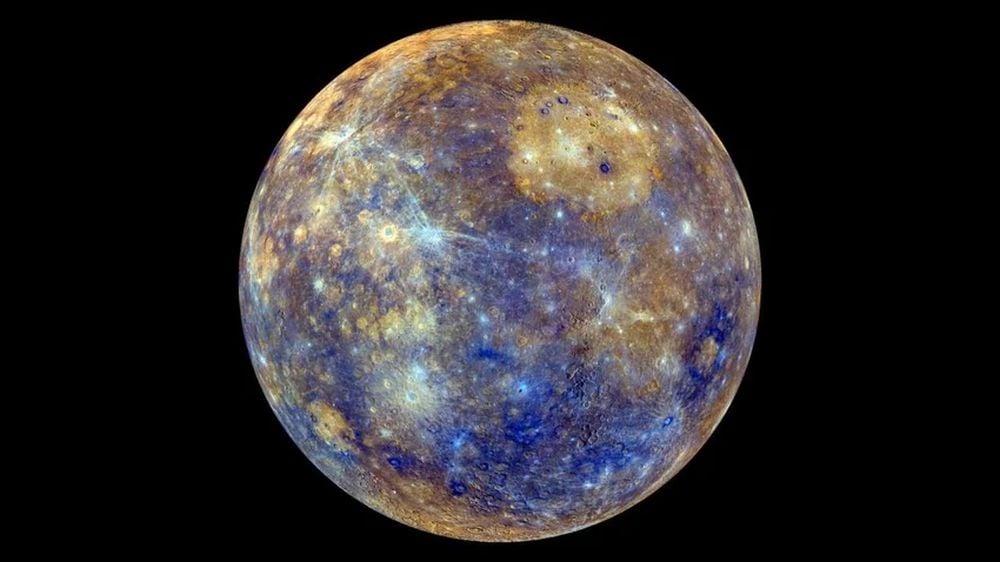
Mercury's surface is barren and covered in impact craters, and looks very much like the surface of a long dormant world. NASA's Messenger mission, which spanned from 2011 to 2015, showed us that Mercury's surface has vast lava plains more than one kilometer thick. It also showed us that, in among the craters, there are volcanic features called hollows, along with pyroclastic vents and reddish deposits called faculae. These are evidence of explosive eruptions driven by magma that's rich in volatiles. Mercury's lava plains and other volcanic features are from the past, between about 4.1 and 3.5 billion years ago.
Now, new evidence suggests that Mercury has been shaped by more powerful volcanism than thought. The research is titled "The SiO2 abundance on the surfaces of the Moon and Mercury," and it's published in the journal Planetary Research. The lead author is Christian Renggli, a research scientist at the Max Planck Institute for Solar System Research.
"The SiO2 abundance on rocky planetary surfaces is a key indicator for planetary crust composition and magmatic evolution," the researchers write. SiO2 (silica) content is one of the main ways that geologists understand volcanic rock. Its abundance reveals a lot about the volcanic processes that produced it. There's a link between silica content and magma viscosity that shapes planetary surfaces, including Mercury and the Moon.
In this work, the researchers started with the Moon and applied their findings to Mercury. They worked with the Christiansen Feature (CF), which is kind of like a wavelength transparency point in a mid-infrared spectrum that is specific to a mineral's composition and structure. The exact wavelength of that point changes with composition. So in this work, the CF changes depending on how much silica is in rock.
This can be used in remote sensing, to try to understand the silica content of other worlds, and to gain insight into their volcanic past.
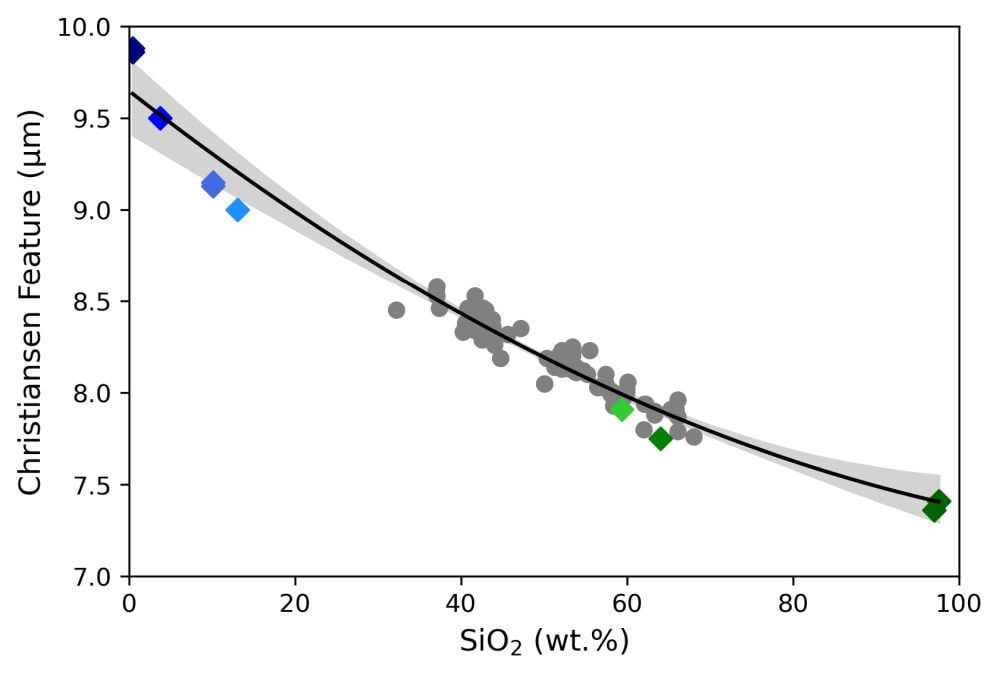 This figure shows how the Christiansen Feature shifts as SiO2 abundance changes. Image Credit: Renggli et al. 2026. Planetary Research.
The researchers first used the CF to map the Moon's global SiO2 surface content. The Moon predominantly has two types of surfaces, lunar highlands and mares, which are basaltic lava plains. Their remote-sensing map of silica content reproduced this bi-modal distribution, and also agreed with samples returned from the Moon. "The results reproduce the mare-highland bimodality and agree well with independent constraints from all lunar sample-return sites," the authors write.
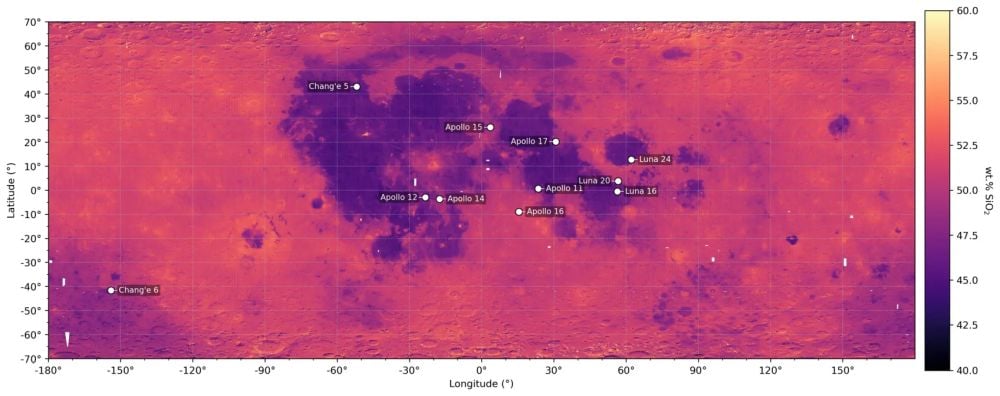 This is the first global map of the SiO2 content on the lunar surface. White dots mark landing sites where the Apollo, Luna, and Chang’e missions brought lunar samples back to Earth. The samples made it possible to verify the accuracy of the map. Image Credit: Renggli et al. 2026. Planetary Research
"The Moon is a kind of touchstone for us – and an important conceptual stepping stone on our way to Mercury," said Renggli.
These results showed that their CF remote sensing of silica was accurate. The next stage was to apply their method to a single measurement of CF on Mercury. "Finally, the new calibration allows the determination of SiO2 on the surface of Mercury," the researchers write. "Using an existing Earth-based CF measurement, we obtain a low abundance of ~37 wt.% SiO2."
This measurement shows that Mercury's surface contains up to 25% less SiO2 than thought, and that means it's volcanic history is different than thought.
“Our findings suggest that the volcanic rocks on Mercury formed from more deeply melted mantle material than previously assumed,” said lead author Renggli, who is also head of the Experimental Laboratory Magma Ocean research group at the MPS.
Under a young rocky planet's solid crust, SiO2 gradually accumulates in the molten mantle. It accumulates there because as the first rocks form in the cooling mantle, they don't extract very much SiO2 from the melted mantle. That means that, over time, as hot lava wells up to the planet's surface, it becomes richer in SiO2. So if the surface has small amounts of silica, then the interior temperature must be higher.
These results are just an indication that Mercury's volcanic past was different than thought. One of the weaknesses of using the CF point to determine SiO2 content is that the point can also change because of particle size, not just SiO2 content.
The problem with studying Mercury in such compositional detail is that no spacecraft has ever landed on it. No sample has ever been taken. Not only is its surface really hot, but the small planet moves very rapidly and is close to the Sun's overpowering gravity. That means that a spacecraft needs an enormous amount of fuel to land on it. A spacecraft actually needs more energy to reach Mercury than to reach Pluto.
This research has value looking ahead to an upcoming mission. In November, the ESA/JAXA BepiColombo spacecraft will reach Mercury and enter orbit. BepiColombo’s MERTIS instrument, which stands for Mercury Radiometer and Thermal Infrared Spectrometer, will examine the planet's surface. Its job is to map Mercury's composition, mineralogy, and thermal profile in the mid- to far-infrared wavelengths. MERTIS' data will be more accurate and high-resolution than existing data.
“Our study lays the groundwork for deriving the most accurate information possible about the silicon dioxide content of Mercury’s surface from BepiColombo’s measurements,” said Renggli.

