Universe Today
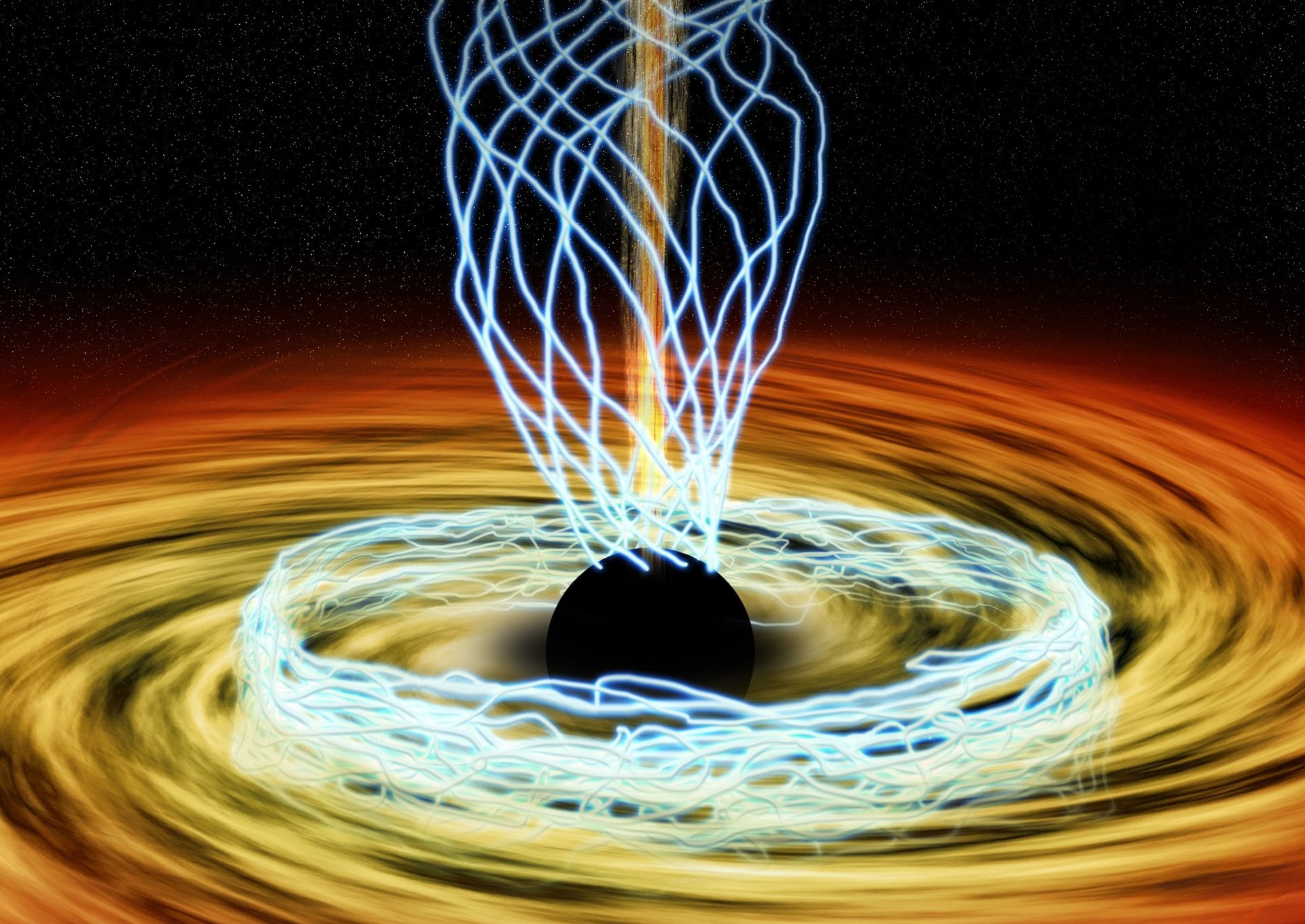
Galactic black holes are cosmic mitochondria, powerhouses of the Universe. Most of the energy these supermassive black holes produce is through the material surrounding them. Superheated plasma of their accretion disks interacting with tremendous magnetic fields. But there is a more direct way to extract energy from a black hole. It's known as the Penrose process, and a new study asks whether we could discover a signature of this process.
First proposed by Roger Penrose in 1969, the mechanism describes how you could extract energy directly from a rotating black hole, thus decreasing its total mass. This is different from the usual mechanism where black holes generate power as a by-product of consuming matter and increasing mass. It relies on a feature of rotating black holes known as the ergosphere.
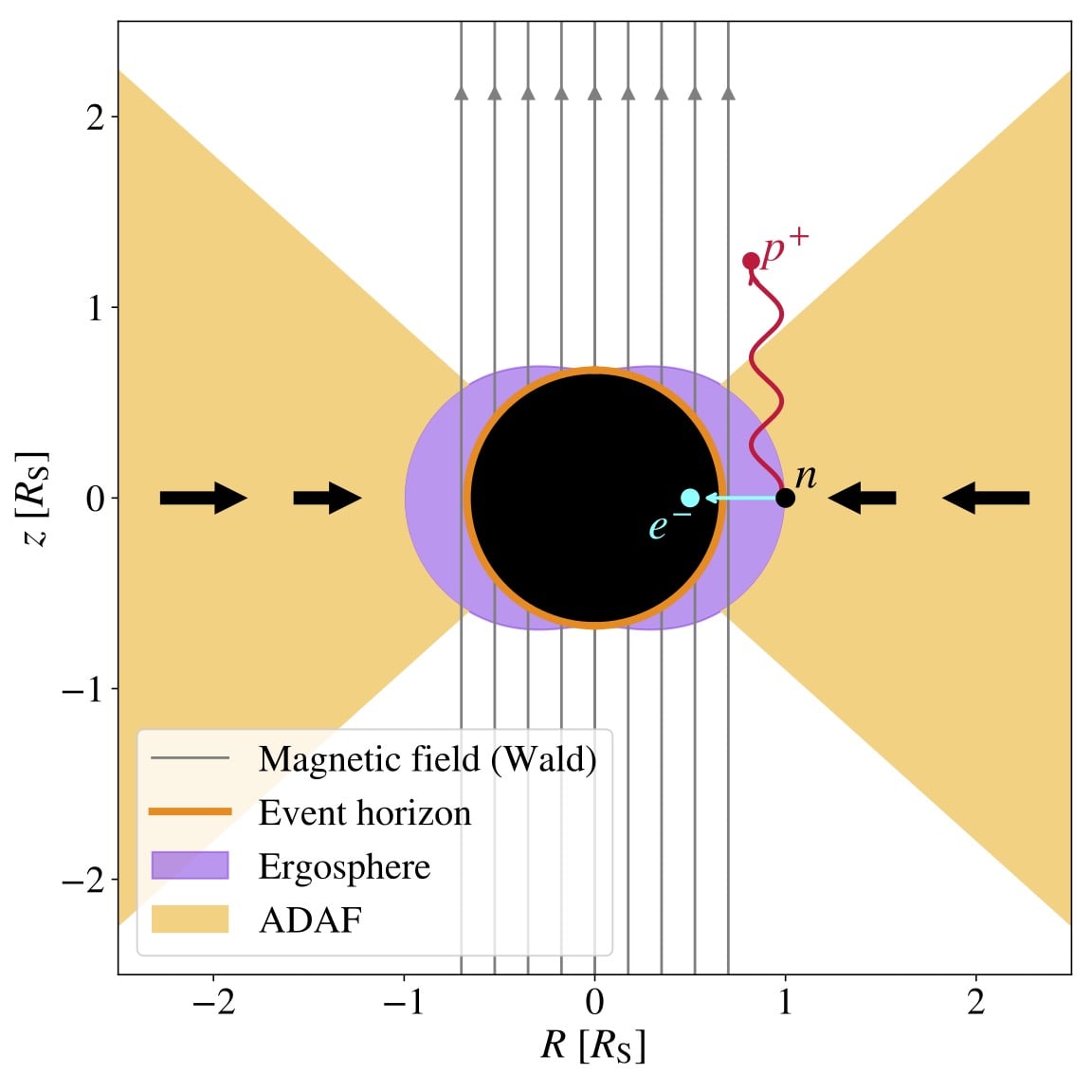 Schematic of how decaying particles can extract energy from a black hole. Credit: Cermeño, et al.
As a black hole rotates, it drags space around it. This frame dragging effect is most powerful very close to the black hole. The ergosphere is a region around the black hole where the frame dragging is so strong you can't counter it. Even if you had a spaceship capable of approaching the speed of light, you couldn't overcome the rotating frame. You will rotate around the black hole no matter what. Because of this, the timey-wimey effects of relativity get a little mucky-wucky.
So suppose you loaded up a spaceship with useless junk and entered the ergosphere of a black hole. As you are forced to orbit the black hole, you dump the trash, which is doomed to spiral into the black hole. But because of energy conservation, you get a boost of extra speed. So you can escape the black hole's grip with more energy than you started with. The black hole in turn absorbs the "negative" energy of the trash and loses mass. This simple version isn't particularly efficient, but variations that include an interaction with magnetic fields can be quite efficient. In theory the right kind of charged particles could gain an enormous energy kick.
This is the focus of a new work on the arXiv. Rather than a hypothetical spaceship, the authors consider a neutron within the ergosphere of Sag A*, the black hole at the center of the Milky Way. Neutrons have no net electric charge, but they can decay into a proton, electron, and neutrino. This decay serves the same purpose as dumping space trash. The neutron discards an electron to give the proton an energy kick. Since both the proton and electron are electrically charged, they interact with the magnetic field in the ergosphere, thus using the magnetic Penrose process (MPP).
Based on reasonable estimates for the trajectory of a neutron into the ergosphere, the team estimates that the MPP could generate protons with an energy in the PeV range. That's peta electron volts, which is a thousand times more powerful than the most energetic protons in the Large Hadron Collider. These protons would escape the ergosphere at near light speed and slam into gas molecules surrounding the black hole. This would produce intense gamma rays with a specific spectral signature. Additionally, since the neutron decay also produces a neutron, the MPP should generate high-energy neutrinos as well. This means astronomers could observe a multi-messenger signal of light and neutrinos from the process.
Unfortunately, both the gamma ray and neutrino signals are too faint to be observed with our current technology. But upgraded versions of the High-Altitude Water Cherenkov (HAWC) observatory and the new version of the IceCube Neutrino Observatory in Antarctica should detect them. This means that in the near future we might discover evidence of the Penrose process and proof that black holes can lose mass after all.
Reference: Cermeño, Marina, et al. "Sgr A* as a Galactic PeVatron: Multimessenger Signatures of the Magnetic Penrose Process." arXiv preprint arXiv:2609.04051 (2026).
Reference: Penrose, Roger, and Robert M. Floyd. "Extraction of rotational energy from a black hole." Nature Physical Science 229.6 (1971): 177-179.