 Universe Today
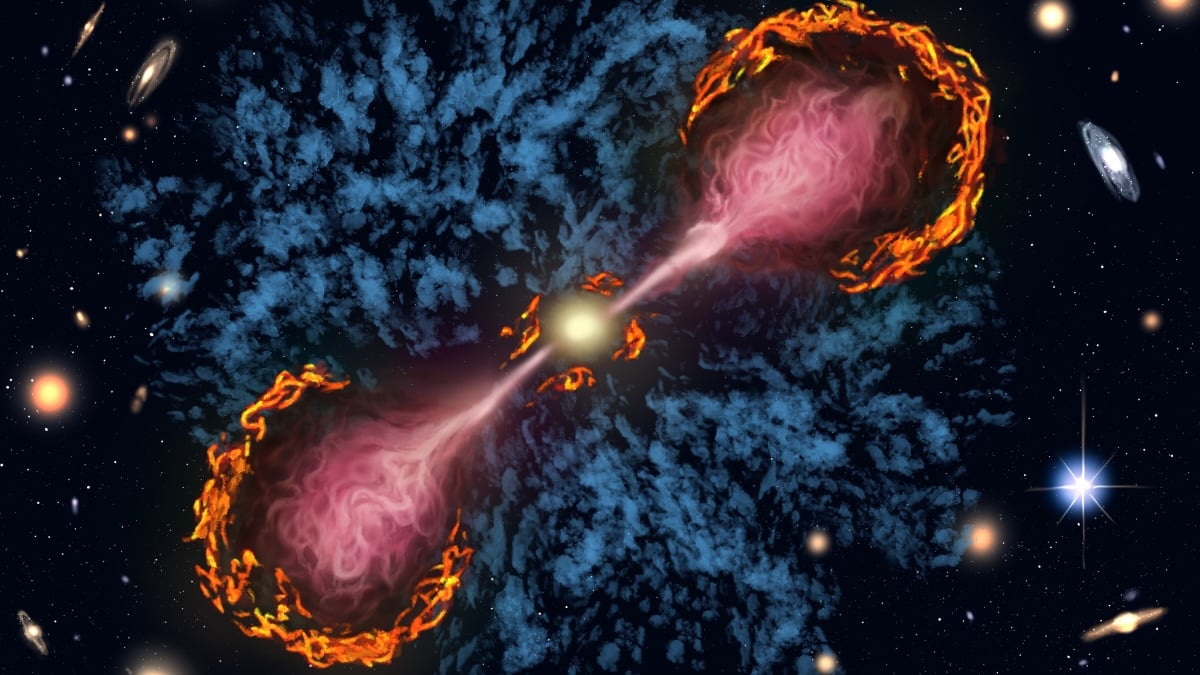
Supermassive black holes are powerful engines. They can rip stars apart and feed upon them. They blast jets of ionized gas at near-light speeds. On the other hand, these gravitational beasts are rather small. Though they can be millions or billions of solar masses, they are localized to within the size of a stellar system. The galaxies they call home span more than 100,000 light-years and can be more than 100 billion solar masses. So how do these localized powerhouses have such a large impact on galactic evolution? This is the focus of a new study in The Astrophysical Journal Letters.
We know from observations that black holes and their galaxies are intimately connected. We are still figuring out just how they interact. Much of the research focuses on the central region of a galaxy. After all, that's where the black hole is and where most of the stars, gas, and dust are located. This new study focuses on the outer region of a galaxy.
Although the stellar region of a galaxy is the part we easily see, galaxies also have a large region of gas surrounding them known as the circumgalactic medium (CGM). Over time the CGM cools and falls inward, providing a source of material for new stars. But surveys of CGM regions find that much of it remains at the outer edge of a galaxy. The question is why, and the answer seems to be the galactic black hole.
The powerful jets of a supermassive black hole carry material to the outer edge of the galaxy, but only along the polar axis of the black hole. It has been thought that much of the circumgalactic material wouldn't be affected by it. This new study finds a subtle interaction.
The team looked at H-alpha regions around hundreds of galaxies with active jets. H-alpha emissions are caused by ionized hydrogen. Anywhere you see the H-alpha signal, you know the region is warm enough to ionize hydrogen. Using data from the Dark Energy Spectroscopic Instrument (DESI) survey and the LOFAR Two-meter Sky Survey (LoTSS), the authors found H-alpha regions close to the jets as expected, but they also found that the light of the jets ionizes regions farther away as well. This means the jets heat the CGM more than we thought. The team also looked at an absorption line of magnesium, which indicated a lower overall temperature within the CGM. Thus, the heating is clearly driven by the jets themselves.
What this means is that active jets stir the pot. Heat is exchanged to the circumgalactic material, reducing the amount that falls inward to the galaxy. As a result, there is less material available for stars to form. There are other factors that drive star production, but this study shows how some interactions are subtle.
Galactic black holes are deadly to stars that stray too close, but they can also prevent some distant stars from being formed in the first place.
Reference: Roy, Namrata, et al. "Lighting Up the Circumgalactic Medium: Strong, Jet-aligned H α Emission around Radio Galaxies." The Astrophysical Journal Letters 1009.2 (2026): L34.