Universe Today
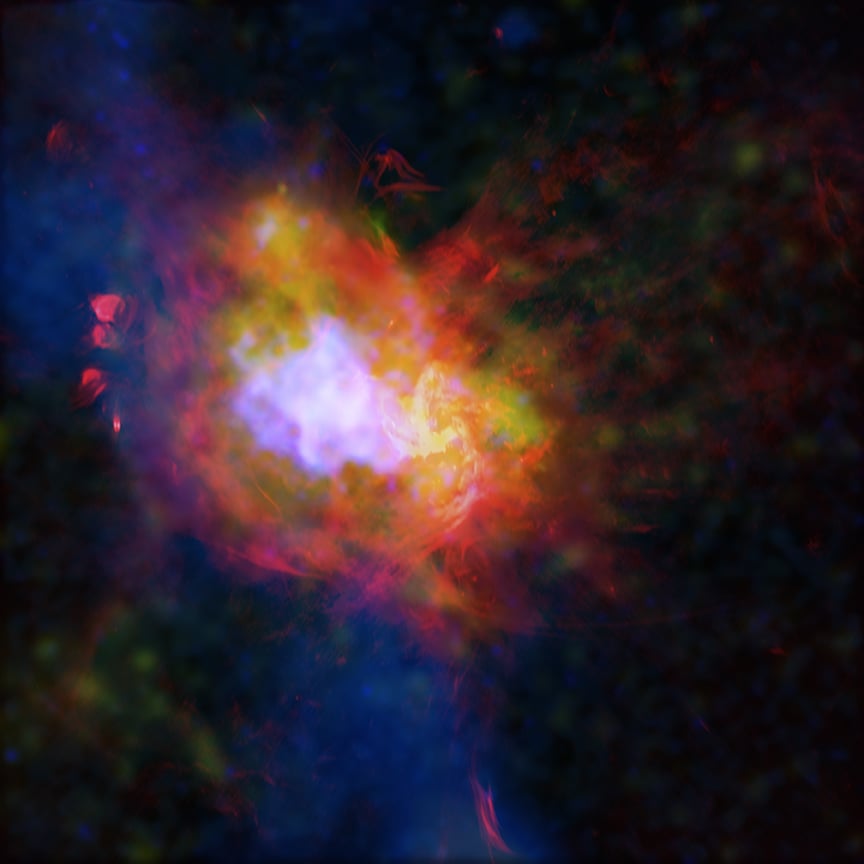
The core of the Milky Way is a dense, active, messy region, dominated by a supermassive black hole called Sagittarius A* (Sgr A*) hiding at the heart of the galaxy. But Sgr A* is only a supporting actor in this stunning new image from the Chandra X-ray Observatory. The starring role goes to Sagittarius A East (Sgr A East), a supernova remnant lit up like a glowing cosmic chandelier, dancing across the front of the black hole.
Supernovae are the remnants of exploded stars. This one, Sgr A East, exploded some 10,000 years ago, leaving behind the cooling red ring seen here surrounding a hot blue core. Just to the right, Sgr A* hides amidst a red spiral of gas and dust.
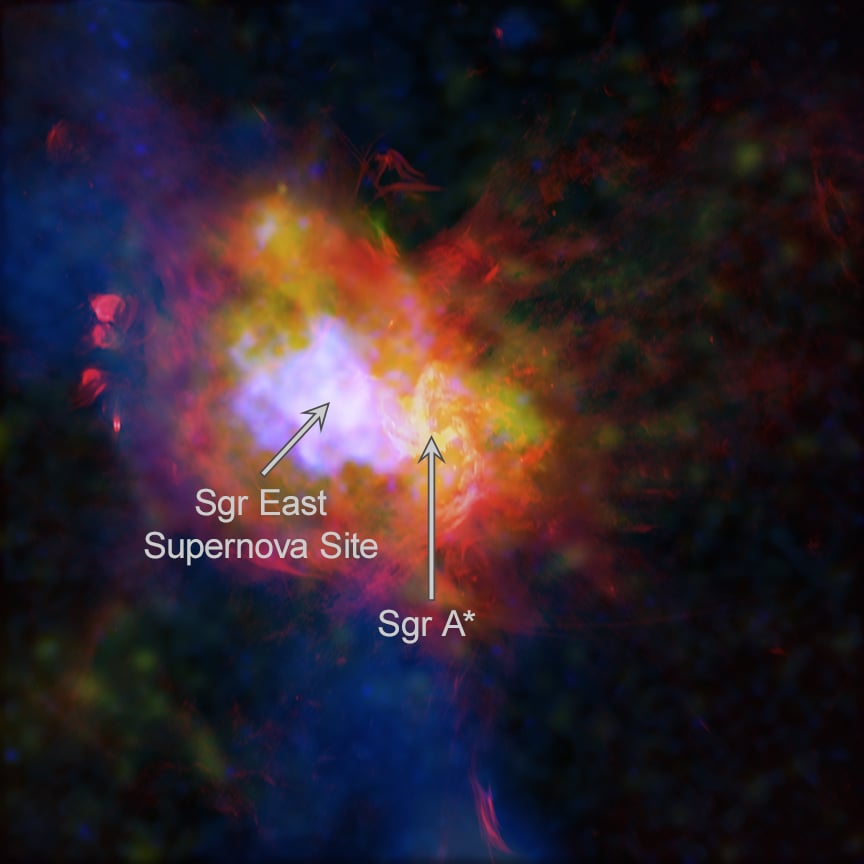 This composite image provides a view of Sagittarius A East (Sgr A East), a supernova remnant near the center of our Milky Way galaxy. Astronomers used a special technique to separate Chandra’s view of Sgr A East from other X-ray sources in this crowded region, allowing them to study its diffuse emission and map elements including iron, sulfur, argon, and calcium. Lower-energy Chandra X-rays are shown in green and higher-energy X-rays are shown in blue, combining to appear purple near the remnant’s center. Radio data from the NSF’s Very Large Array (red) and submillimeter data from the James Clerk Maxwell Telescope (dark blue) complete this multiwavelength view. Credit: X-ray: NASA/CXC/McGill Univ./M. Balakrishnan et al.; Radio: NSF/NRAO/VLA; Sub-mm: EAO/James Clerk Maxwell Telecope; Image Processing: NASA/CXC/SAO/P. Edmonds, N. Wolk
Sgr A East is the closest supernova to the galactic centre, and astronomers, led by Mayura Balakrishnan at McGill University, have been working to tidy up this noisy environment in order to see all the forces at play more clearly.
For one, thing, their findings suggest the supernova and the black hole aren’t just neighbours – they’re in a turbulent relationship, actively influencing each other and their surroundings. The supernova remnant “has expanded into, compressed, and shock heated the surrounding molecular material, likely carving cavities that shape the three-dimensional structure of the region,” write the authors.
Their work has also allowed them to see more clearly which X-ray signals come from which source. It’s not just the two cosmic giants at play: there are stellar winds from hot clusters of stars throughout the region, as well as a fainter glow from ordinary background stars, all of which shine in X-ray light.
By separating out each of these sources, they’ve been able to clarify the messy chaos into its component parts. This has also allowed them to map the location of various elements found within the supernova explosion, including iron, sulfur, argon, and calcium.
In the composite image, three layers with different wavelengths are combined: X-rays from the Chandra Observatory, Radio waves from the NSF’s Very Large Array, and submillimeter light from the James Clerk Maxwell Telescope.
The X-ray image on its own shows high-energy waves in blue at the supernova’s core, with lower-energy waves in green all around it.
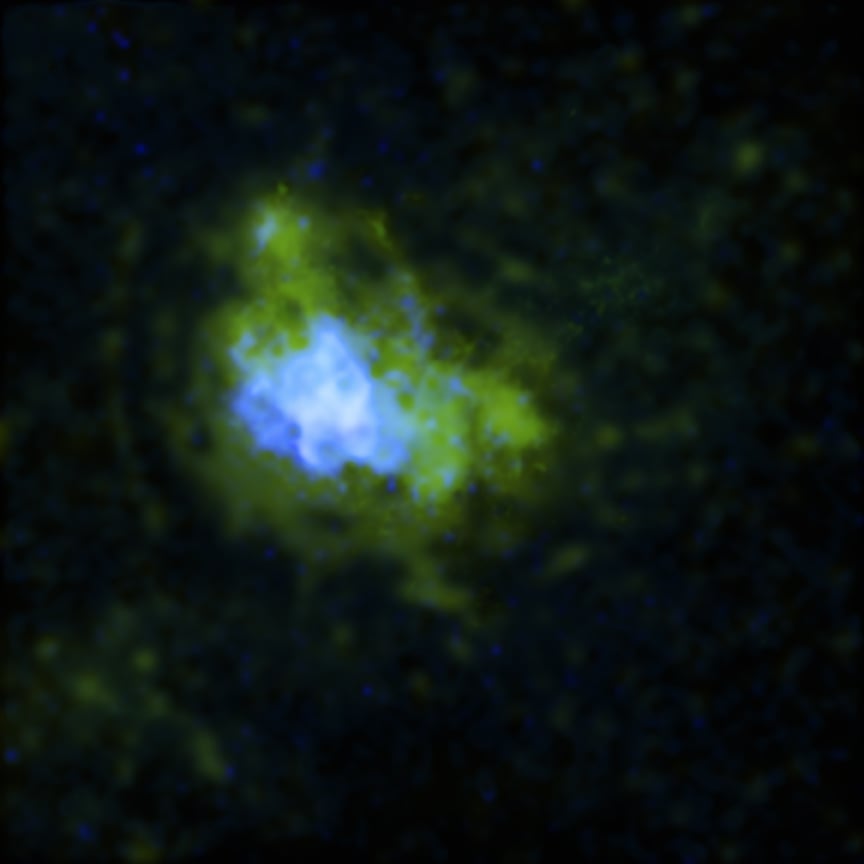 Chandra X-ray Image of Sagittarius A East
The Chandra X-ray Observatory NASA’s flagship X-ray telescope, launched in 1999 and still going strong. It is expected to be capable of operations well into the 2030s, though proposed budget cuts from the White House have made the observatory’s future uncertain, alongside many other NASA science programs. The US Congress has thus far been more supportive of NASA, rejecting most of the proposed cuts.
On September 1, 2026, Congress voted to maintain a flat budget for NASA going into the start of the 2027 financial year, though it will need to pass an extension before the next deadline on December 11, 2026.