 Universe Today
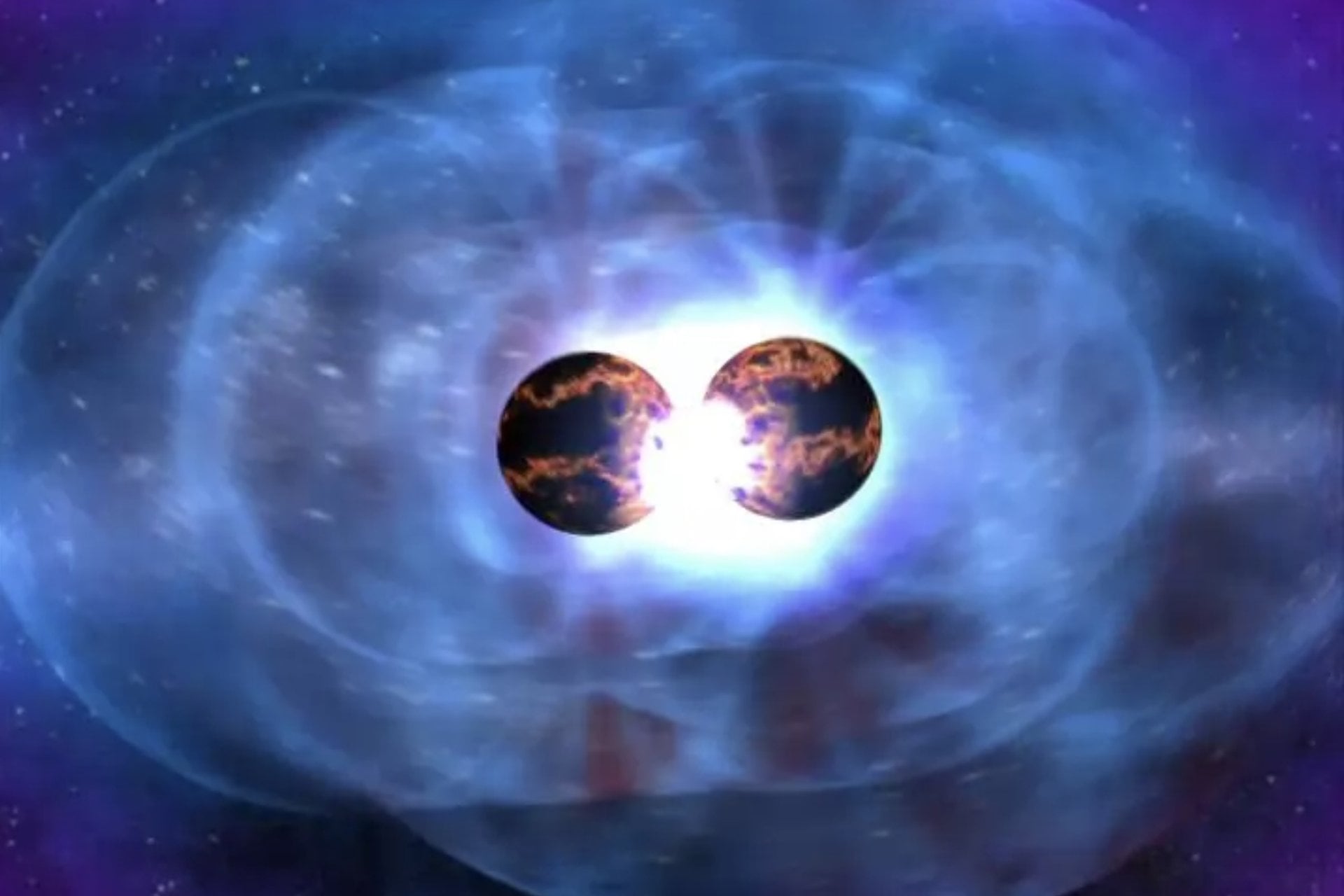
All neutron stars have intense magnetic fields. The typical magnetic field of a neutron star is about 100,000 times stronger than the strongest magnetic fields we can create on Earth. But about 1% of neutron stars have even stronger magnetic fields. Known as magnetars, their magnetic fields can be 1,000 times stronger than a regular magnetic field. They are a likely cause for powerful transient events such as soft gamma-ray repeaters and fast radio bursts. A new study looks at how magnetars might form.
The work focuses on the mergers of binary neutron stars. Often when two neutron stars collide they form a black hole. This is because the combined mass of the two neutron stars is greater than the Tolman-Oppenheimer-Volkoff (TOV) limit, which is around 2.6 solar masses. Most neutron stars are more massive than white dwarfs, which have a Chandrasekhar limit of about 1.4 solar masses. But some neutron stars have smaller masses. If they happen to have a total mass less than the TOV limit, then they can merge and become a single neutron star.
Using high-resolution simulations run on the Japanese supercomputer FUGAKU, the team looked at the merger of low-mass neutron star binaries. To simplify things a bit, they assumed stars with identical masses, but otherwise just typical neutron stars. They assumed the magnetic field strengths of these stars were around 3 trillion Gauss, which is in the upper range of typical neutron stars. Their simulations ran from just moments before the stars collide until just after.
What they found was that within milliseconds after the two stars make contact, the neutron fluid within the region enters a Kelvin–Helmholtz instability. This is a physics way of saying the fluid becomes turbulent. You've likely seen such an instability before. If you gently blow out a candle, there is a smooth stream of smoke that rises off the wick. But as it rises, the stream becomes swirly and random. That transition is where it reaches the instability.
The thing about Kelvin–Helmholtz instability is that it can mix things up tremendously. In the simulations, this mixes the neutron material so fully and quickly that the magnetic field is amplified significantly. This mixing trickles through the rest of the material, dragging the magnetic field with it. As a result, the resulting magnetic field of the merged neutron star can be more than 300 times stronger than the initial magnetic fields. It's also possible that further turbulence would strengthen the field even more, though this is beyond the limits of the simulation.
What's surprising about the simulation is just how quickly the magnetic field is amplified. It ripples through the stars within about a millisecond, meaning that it could play a role in how the merger progresses and could impact the structure of the resulting neutron star. More study will be needed to determine just how it plays out. But it is clear that magnetars can form through mergers like this.
Reference: Kiuchi, Kenta, et al. "A magnetar formation in binary neutron star merger." arXiv preprint arXiv:2606.11299 (2026).