Universe Today
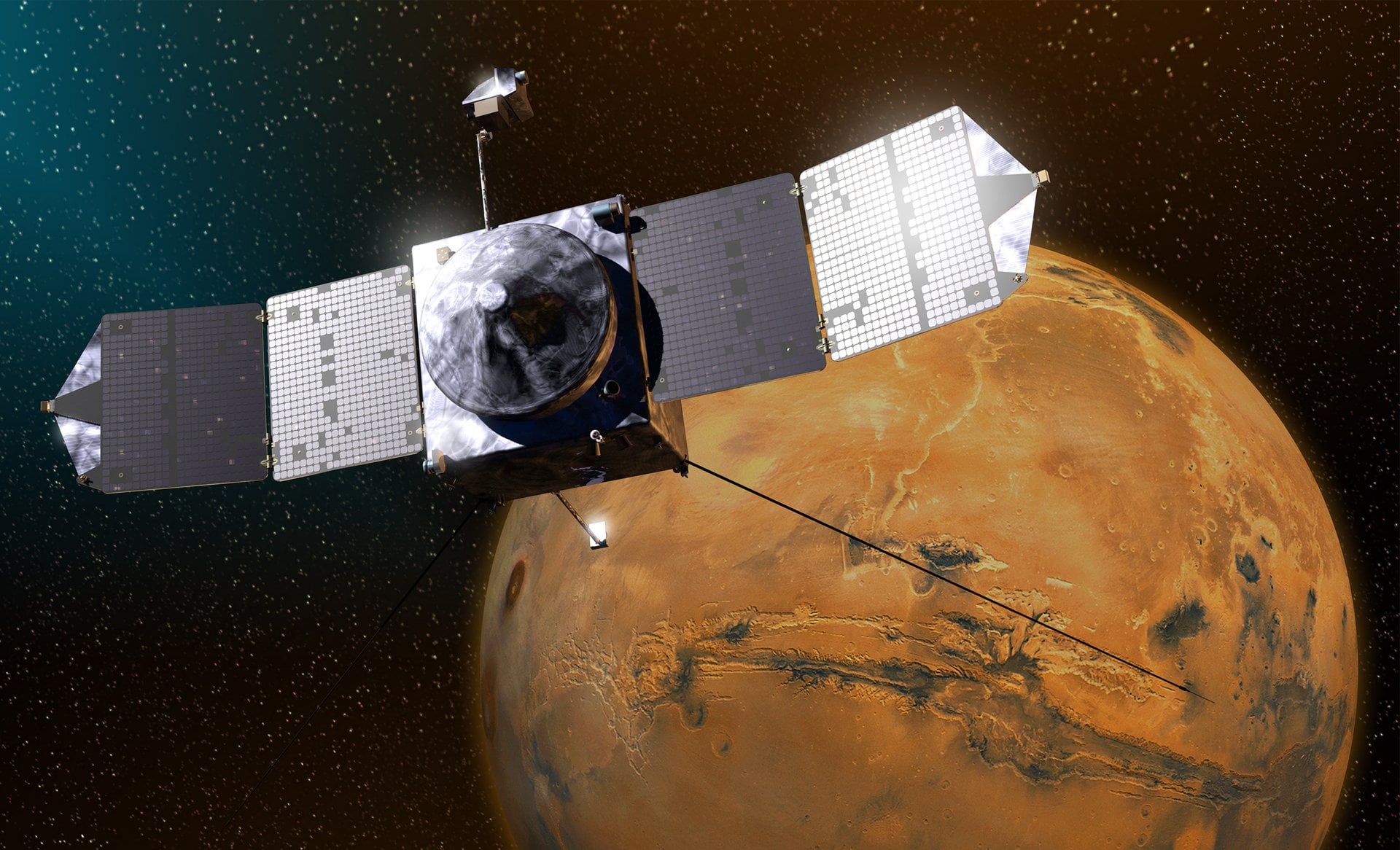
On Wednesday, June 3rd, NASA hosted a media call to announce the end of the Mars Atmosphere and Volatile Evolution (MAVEN) mission. As the first mission dedicated to observing the Martian atmosphere and its evolution, MAVEN was responsible for many breakthroughs in our understanding of the Red Planet. The satellite operated in orbit around Mars for 11 years, 10 years longer than its primary 1-year mission. Unfortunately, after months of trying to reestablish communications, NASA's review board concluded that the satellite was in an unrecoverable state.
The issue took place on December 6th, 2025, when MAVEN experienced an unexpected loss of signal after passing behind Mars. Once it reemerged, NASA's Deep Space Network (DSN) did not observe a signal coming from the spacecraft. What little information they did receive, a brief fragment of telemetry data, indicated that the probe was in safe mode and rotating at an unusually high rate. This suggested a disruption in MAVEN’s orbital trajectory, which in turn drained the spacecraft's batteries, causing the communication system to lose power.
An anomaly review board was convened in February to assess the spacecraft’s current state and evaluate recovery options. As NASA indicated during the teleconference, the review board has determined that the MAVEN spacecraft is not recoverable and can no longer conduct science operations, consistent with the mission team's findings. Their findings have yet to determine the root cause of the anomaly, but the review board is expected to provide its final report later this year.
During the teleconference, the agency also spoke of the MAVEN mission's achievements, which were legion. These included improving our understanding of how planetary atmospheres interact with solar wind, how charged particles from the Sun drive atmospheric loss, and resolving the mystery of how Mars lost most of its atmosphere and surface water billions of years ago.
Launching in November 2013, the MAVEN mission was tasked with exploring the Red Planet’s upper atmosphere and its interactions with the Sun. The purpose of this was to address the burning questions of how and when Mars lost much of its atmosphere to space. Understanding atmospheric loss also helps scientists understand planetary habitability, which could help resolve the mystery of why Earth has remained habitable throughout its history while planets like Mars and Venus did not.
MAVEN was in an advantageous position to measure how the solar wind and space weather affected Mars, as it was the only spacecraft capable of simultaneously measuring both. One of MAVEN’s first discoveries was that Mars' atmospheric loss increases drastically during solar storms, characterized by sudden explosions of charged particles that extend throughout the Solar System. As Louise Prockter, the director of NASA's Planetary Science Division, explained in a NASA press release, MAVEN's accomplishments were vital to future human exploration beyond Earth:
The science MAVEN has given us is key to informing what kind of radiation protection and safety measures we must take before sending humans to Mars. The data collected from MAVEN will continue to provide valuable insight into Mars for decades to come.
The mission was also the first to measure "atmospheric sputtering" around any planet, a process in which ions collide with the Martian atmosphere at high enough speeds to push gas molecules out of it. The mission team did this by observing argon, a noble gas that rarely reacts with other elements in the Martian atmosphere. The only way it can be removed is by atmospheric sputtering, which the team measured in real time for 11 years.
This revealed argon sputtering at high altitudes in the exact locations where charged solar particles crashed into the atmosphere. They also observed in real time how the solar wind slowly strips Mars' atmosphere, which provided crucial insight into how the Martian climate was altered ca. 3.7 to 4.2 billion years ago. In addition to making the planet extremely cold, atmospheric loss is also why Mars lost much of its surface water to space.
As Shannon Curry, MAVEN’s principal investigator and a researcher at the Laboratory for Atmospheric and Space Physics (LASP) at the University of Colorado Boulder, said, “The MAVEN mission has truly advanced our understanding of the Martian atmosphere and evolution. This dataset has had a tremendous impact on the field. Our science team is exceptionally proud of all of these amazing discoveries.”
The MAVEN mission also witnessed several types of auroras caused by the constant stream of energetic particles hitting its atmosphere. This led to the discovery that protons create new kinds of auroras at Mars that can occur anywhere in its atmosphere. This is something that rarely occurs in Earth's atmosphere, occurring only in very small regions near the poles.
The mission also witnessed the famous dust storms of 2018, which created a dust cloud so large that it enveloped the entire planet. By studying this "global dust storm," a relatively rare event on Mars, the MAVEN team was able to study how it affected Mars' upper atmosphere. This provided insight into how these events affect the escape of water into space and confirmed that heating from dust storms pushes water molecules much higher into the atmosphere, where they are lost to space.
Lastly, MAVEN contributed to NASA's efforts to monitor 3I/ATLAS as it made its historic flyby of Mars in October 2025. Over the course of 10 days, the MAVEN team took multiple images of the comet in several wavelengths as the comet zoomed past at a distance of about 30 million km (18.6 million mi). This included high-resolution UV images that captured hydrogen escaping from the comet. These images allowed scientists to learn more about the comet's composition and history.
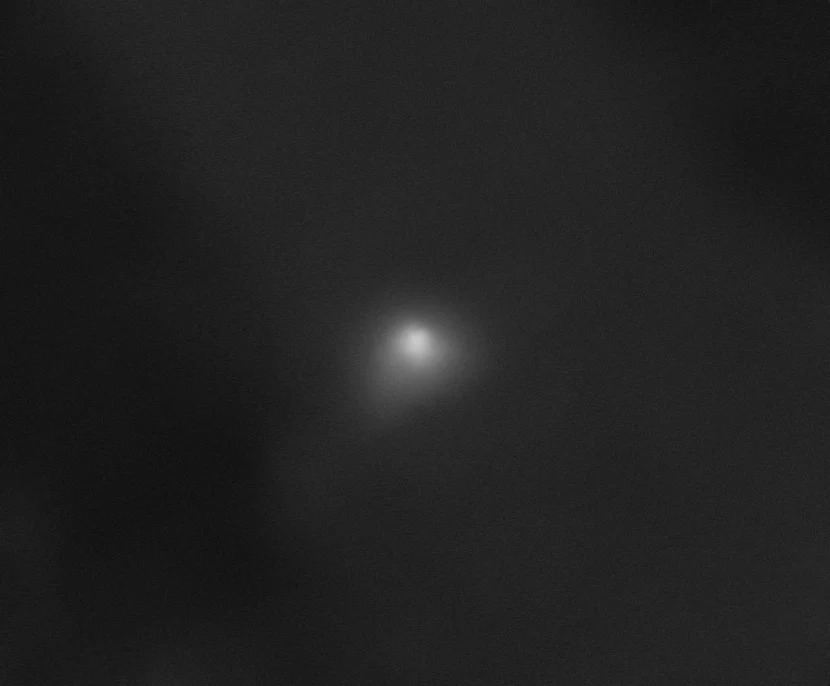 On a largely black background, interstellar comet 3I/ATLAS appears as a white smudge with a semicircular shape at its core. Credit: NASA/JPL-Caltech/University of Arizona
NASA has begun the official decommissioning process for the MAVEN mission and archiving the full mission dataset, which will be made available to the science community. During the mission’s lifetime, the data MAVEN acquired led to the science team's publishing more than 800 scientific papers. Additional publications are planned, and many more are expected with the public release of the full dataset.
Those interested in hearing audio of the media teleconference can find it on the agency’s website at: https://www.nasa.gov/live
Further Reading: NASA