 Universe Today
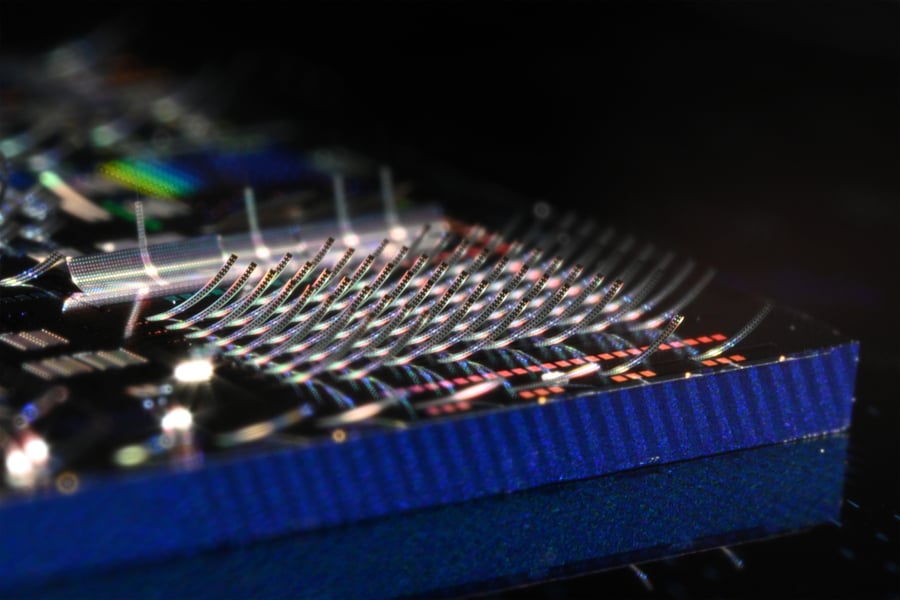
Every ounce counts when launching a rocket, which is why considerations for the Size, Weight, and Power (SWaP) of every component matters so much. For decades, one of the heaviest and most power-hungry components on a spacecraft has been its optical and communications hardware - specifically the bulky mechanical mirror used for LiDAR and free-space laser communications. But a new paper, published in Nature by researchers at MIT, MITRE, and Sandia National Laboratories, might have just fundamentally changed the SWaP considerations of LiDAR systems. Their technology, which they’re called a “photonic ski-jump” could one day revolutionize how spacecraft communicate.
At its core, the technology described in the paper is a photonics innovation. To get light off a computer chip and out into the world, engineers typically have to rely on a frustrating trade-off. They either use diffractive optics or micromechanical scanners - each has its own set of disadvantages. Diffractive optics are easy to scale, but they have poor beam quality. Micromechanical sensors, on the other hand, are physically huge and not easily scalable, especially on spacecraft.
The new “ski-jump” bypasses their weaknesses entirely. It is a nanoscale optical waveguide integrated directly onto a piezoelectrically controlled microcantilever - which makes it look like a series of miniaturized “ski jumps” taking off from the chip itself. It’s fabricated in a standard 200-mm CMOS foundry, and uses the thermal forces between the cooling of different layers of the chip, causing the cantilever to curve out at a 90 degree angle - straight up from the chip surface.
Video of one of the inventors discussing the ski-jump technology. Credit - MIT MIcrosystems Technology Laboratories YouTube ChannelApplying alternating voltages to electrodes at the bottom of the ski-jump causes the tip at its end to whip around at kilohertz-rates. The researchers used that to create a device that can shoot thousands of precisely controlled laser beams into a certain point in free space with a footprint of less than .1 mm squared. That’s the equivalent of being able to draw a 30,000 pixel image in an area the size of half of a grain of salt.
Immediate applications come to mind for the technology, such as augmented reality glasses that can populate the area around a user with hyper-resolution images. But the authors were originally developing this system to solve a problem in quantum computing. To control millions of physical qubits (the quantum computing form of a bit), researchers need millions of precisely arranged lasers. That is exactly what the new photonics systems provide.
To prove their system works, the researchers projected a series of highly stable, full color images and videos into free space not far from the chip’s surface - essentially making a very highly resolved 2D hologram. They also put their system inside a cryostat to directly detect the state of a single silicon vacancy in a quantum chip - a huge step forward for quantum computing, and the main reason for developing the system.
But the real “killer app” for this technology might lie with LiDAR. Currently, LiDAR systems, which use a laser to scan its surroundings, and crucially detect distances to objects, are mostly famous for their use on autonomous cars - they’re the spinning parts normally placed on top. However, they are also useful on drones as spacecraft, which occasionally have to get into very close contact with other objects in orbit, or when they’re landing.
Video explaining the concept of LiDAR. Credit - Phoenix LiDAR Systems YouTube ChannelLiDAR’s disadvantage is in its size and power consumption. They are heavy, bulky, relatively fragile, and require a ton of power. The new ski-jump photonics system would, at least in theory, solve most if not all of those problems for future LiDAR systems. But it has to make it out of the lab first. It’s still very early days for such a system, and arguably the first applications will likely be augmented reality glasses because of their mass market appeal. Space exploration might have to wait for a bit, but the eventual adoption of this technology, assuming it can stand the rigors of launch and radiation, is a potential game changer for how spacecraft navigate in close quarters.
Learn More:
MIT News - New photonic device efficiently beams light into free space
M. Saha et al. - Nanophotonic waveguide chip-to-world beam scanning
UT - Scientists Publish the First Direct Measurement of Space Debris Pollution
UT - These are the Boulders OSIRIS-REx is Going to Use to Navigate Down to the Surface of Bennu

