 Universe Today
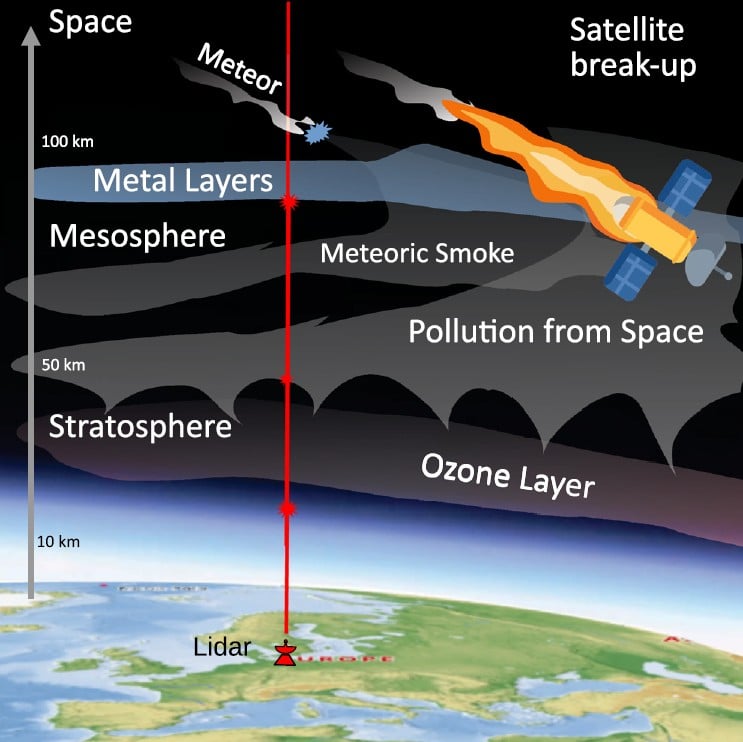
Back in February 2025, a SpaceX rocket that had delivered 22 Starlink satellites to orbit had a malfunction. It failed to execute a planned deorbit burn and drifted for 18 days in orbit before beginning an uncontrolled descent about 100km off the west coast of Ireland. Some parts of the rocket landed in Poland, and while they didn’t injure anybody, there was enough concern about the lack of communication that Poland dismissed the head of its space agency. But that wasn't the only lasting impact of this failure. A new paper from Robin Wing and her colleagues at the Leibniz Institute for Atmospheric Physics, published in Communications Earth & Environment ties that specific rocket reentry to a massive plume of pollution for the first time.
To do this, they used a highly sensitive resonance fluorescence lidar system, located in Kühlungsborn, Germany. But they weren’t doing it specifically to check for the fallout from this launch. They were simply monitoring the upper atmosphere, like atmospheric scientists tend to do. But right around midnight on February 20, 2025, they noticed a spike in lithium vapor levels.
Lithium is not something typically found at high concentrations in the atmosphere, but it is one of the primary components of a Falcon 9 rocket stage. In the atmosphere, lithium levels are regularly around 3 atoms per cubic centimeter. Just 20 hours after the Falcon 9 rocket descended, the density spiked up to 31 atoms per cubic centimeter - crucially at an altitude of between 94.5 and 96.8km.
Fraser discusses the problems of dealing with space junk.Extraordinary claims require extraordinary evidence, and tying the plume of lithium back to a specific rocket entry will take more than just saying “ohh look, this rocket just crashed, and there are higher lithium levels now.” So the authors turned to atmospheric modeling. They ran 8,000 simulations of backward wind paths from their lidar station in Germany back to the reentry point of the rocket over Ireland. They then checked other possible sources, and everything came back negative.
The lithium itself was an important factor in this determination. As discussed, it exists in the atmosphere in only trace amounts, but even meteorites only supply around 80 grams of the stuff per day to the entire planet. By contrast, a Falcon 9 upper stage has an estimated 30 kilograms of lithium in it, spread throughout lithium-ion batteries as well as an aluminum-lithium alloy hull plating. Another key finding from the paper is that that hull plating would begin melting at precisely 98.2km - matching the observations from the lidar station.
We’ve reported before on the concern scientists are expressing about the chemicals we’re putting into the atmosphere from burning up rocket stages and satellites. This represents the first time a specific incident has been tied to such a pollution plume. But it begs wider questions - what impact will this influx of lithium have on atmospheric chemistry? Since satellites are intentionally deorbited, is there some way we can limit the pollution risk when they do?
CBS coverage of the failed Falcon 9 launch that caused the lithium plume. Credit - CBS LA YouTube ChannelThese are still questions without answers for now. As more and more satellites are launched into megaconstellations to maintain our communications, and we use more and more rockets to do so, they are becoming increasingly important. This paper represents a first step in tracking the actual environmental fallout from an unintentional space debris reentry. It certainly won’t be the last.
Learn More:
EurekaAlert - Environment: Atmospheric pollution directly linked to rocket re-entry
R. Wing et al - Measurement of a lithium plume from the uncontrolled re-entry of a Falcon 9 rocket

