 Universe Today

The Milky Way could host billions of free-floating planets (FFP) according to some research estimates. Also called rogue planets, these worlds drift through interstellar space on their own trajectories, unbound to any star. Many of these worlds form around stars like other planets do, and so it's reasonable to think that they also have moons.
Typically, rogue planets are ejected from their systems by planet-planet interactions or stellar flybys. In some cases, planetary scientists think they could form via direct collapse like stars do and may have never orbited a star. Regardless of how they form, if there are billions of them, it's almost certain that some of these planetary drifters have exomoons.
Though spending billions of years drifting through the cold vacuum of space would seem to contraindicate life appearing and evolving on these moos, new research says that's not necessarily the case. The FFPs themselves may be too cold, but their moons could be kept warm. In fact, given the right conditions, complex life could even evolve on these exomoons, at least theoretically.
New research in the Montly Notices of the Royal Astronomical Society explains how this could happen. It's titled "Habitability of Tidally Heated H2-Dominated Exomoons around Free-Floating Planets," and the lead author is David Dahlbüdding, a doctoral researcher in physics Ludwig-Maximilians-University in Munich, Germany.
Life needs liquid water, and liquid water needs a heat source. So for exomoons to host life, a heat source is needed. Without a star to provide it, the heat can come from two other sources. Some of the moons in our Solar System show us how.
Even though they're at great distances from the Sun, Jupiter's moons Europa and Ganymede both have subsurface oceans (we think.) Tidal flexing keeps Jupiter's moon Europa warm enough for its ice-covered ocean to remain liquid. Radiogenic heating does the same for Ganymede. The same mechanisms could help rogue planets and their exomoons remain warm.
In this work the authors focus on exomoons orbiting planets that were once part of a solar system. They modelled 26,293 Earth-mass exomoons orbiting Jupiter-mass FFPs. Earth-size moons are important because less massive moons don't generate as much heat during tidal flexing. Less massive moons also lack the gravity to hold onto thick enough atmospheres. "Hence, an Earth-like exomoon presents a plausible best-case scenario," the authors write.
When an FFP is ejected from its solar system, its moon likely ends up in and eccentric orbit around the FFP, unless it's thrown out of orbit completely. That's key to this work.
"Exomoons around free-floating planets (FFPs) can survive their host planet’s ejection," the authors write. "Such ejections can increase their orbital eccentricity, providing significant tidal heating in the absence of any stellar energy source."
Tidal heating can be very effective, as moons like Europa show us. It's locked in orbital resonance with two of its siblings, volcanic Io and massive Ganymede. This keeps it in an eccentric orbit, and that's the key to tidal heating. As it moves closer to and further from Jupiter, Europa is compressed and released repeatedly. That creates friction which generates heat. Enough heat, we think, to maintian a huge ocean of liquid water under its icy surface.
So as Europa shows us, even without energy from a star, an exomoon could generate heat internally for billions of years.
Regardless of the heat source, for life to exist and evolve into complex life, exomoons orbiting FFPs need to retain this heat with their atmospheres, just like Earth does.
On Earth, we understand that the more carbon-rich our atmosphere is, the more heat it retains. But Earth is heated by the Sun, while exomoons recieve no stellar radiation. Previous research shows that CO2-rich atmospheres could keep exomoons warm enough for liquid water for up to 1.6 billion years. But in the frigid conditions endured by exomoons, CO2 would eventually condense and fall to the surface. If 1.6 billion years is an accurate number, then it's not enough time for complex life to develop as far as we understand it.
But this research shows how atmospheric makeup could still help exomoons retain heat, but not because they're carbon-rich. Instead, hydrogen is the key.
The researchers found that some types of atmospheres on tidally-heated exomoons could evolve into hydrogen-rich atmospheres that could retain heat long enough for complex life to appear. Though hydrogen doesn't trap infrared radiation like carbon does, under high enough atmospheric pressure the physics change. A mechanism called collision-induced absorption comes into play. Under high-pressure, hydrogen molecules are forced together to form transient complexes that can trap infrared energy and prevent it from escaping into space.
The researchers found that collision-induced absorption could trap enough heat to maintain liquid surface water for up to 4.3 billion years, which is awfully close to Earth's current age. Complex life on Earth exloded during the Cambrian explosion just over 500 million years ago. So if an exomoon could remain warm for 4.3 billion years, there's a case to be made that complex life could arise.
In this research, the heating and cooling from tidal flexing played a role beyond maintaining liquid water. For life to form, complex organic molecules need to form, and the evaporation/condensation cycle of water is a mechanism that drives their formation. "Wet-dry cycling caused by the strong tides together with the alkalinity of dissolved NH3 could create favourable conditions for RNA polymerisation and thus support the emergence of life," the researchers explain in their work.
In a press release, lead author Dahlbüdding pointed out that on life-supporting Earth, asteroids may have lent a helping hand. “We discovered a clear connection between these distant moons and the early Earth, where high concentrations of hydrogen through asteroid impacts could have created the conditions for life,” he said in a press release. Asteroid impacts during Earth's early Hadean eon introduced iron which reacted with the ocean's H2O under extreme pressure and heat. The iron stripped oxygen atoms from H2O molecules to form iron oxides, and the hydrogen remained in the atmosphere. Dahlbüdding isn't saying the same mechanism could happen on exomoons, because without an asteroid belt as a source it may not be likely. But it does show hydrogen-rich atmospheres can play a role in the eventual emergence of life.
We haven't discovered any confirmed exomoons. There are only tantalizing indications for a couple: Kepler-1625b-i and Kepler-1708b-i.
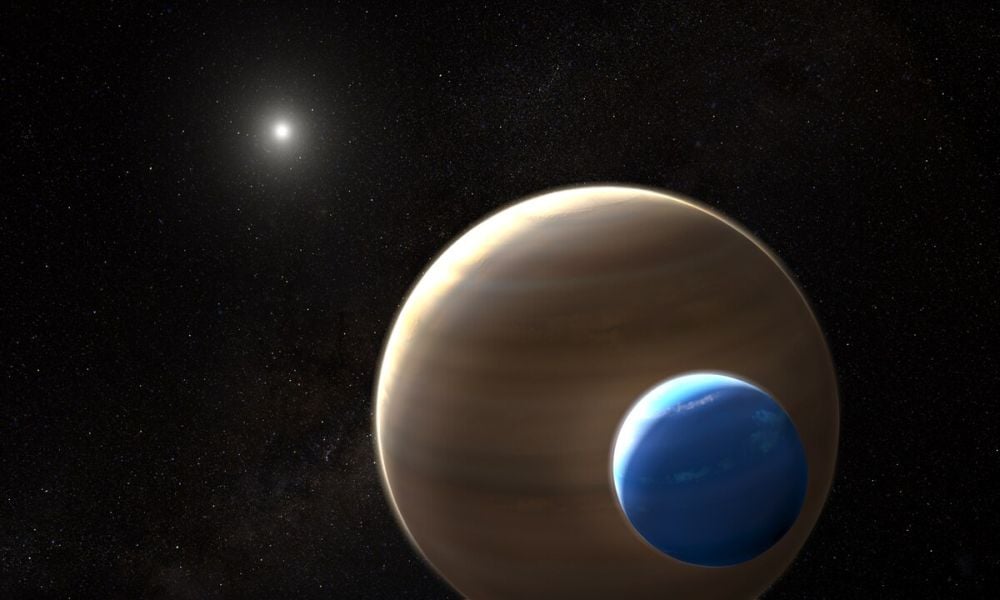 This artist's illustration shows the exoplanet Kepler-1625b and its potential exomoon, Kepler-1625b-i. This is the first exomoon candidate ever detected, and observations show it's about the same mass as Neptune, while the planet has several Jupiter masses. It's not a free-floating system and the star is in the background. Image Credit: By ESA/Hubble, CC BY 4.0, https://commons.wikimedia.org/w/index.php?curid=73369715
When it comes to exomoons orbiting rogue planets, the paucity of discoveries is even greater. Currently, there are no confirmed rogue planets, only several hundred candidates, though it's a little fuzzy. We simply can't see them. So finding exomoons around rogue planets is even more difficult.
Things will change when the Nancy Grace Roman Space Telescope launches. Some estimates say it will discover hundreds of rogue planets through gravitational microlensing. It's also poised to discover at least some exomoons.
The Roman Space Telescope should be able to detect rogue planet exomoons that are around half as massive as Ganymede, the largest moon in our Solar System. If it performs a dedicated transit search for exomoons, some estimates say it could find about one dozen exomoons about the size of Titan orbiting FFPs. It's possible that the Roman could discover an entire population of them, though that's on the hopeful side.
Detecing FFP exomoons is one thing. But even if we succeed at that in the next few years, understanding their atmospheres is probably a long way off. Without that understanding, we can't discern their habitability.
"These potentially habitable moons could be detected through a variety of techniques, such as transits of its FFP or microlensing," the authors write. "The direct observation of volcanic hotspots could even confirm the absence of a thick atmosphere."
"To verify and analyze an atmosphere, on the other hand, may not be feasible with any instruments currently in operation," the researchers conclude.

