Universe Today
This is Part 3 of a series on topological defects. Read Parts 1 and 2.
And yeah, we have a problem.
Mathematics—specifically the kind of topology that makes coffee mugs and donuts the same thing—insists that the early universe was a messy, knotted-up disaster. Our best theories of phase transitions say these defects HAD to be born in the cooling fires shortly after the Big Bang. And as we just established, once you’ve got a knot in the fabric of space-time, you’re stuck with it. There is no cosmic eraser. No reset button. The knots are there, forever (I mean, kind of, but when they go they really GO in an unignorable way).
So... where are they? Or the evidence of where they might have been?
Seriously. I mean, just look at the strings. We’re talking about 1D cracks in the vacuum that are thinner than a proton but weigh more than a mountain range for every kilometer of their length. They have gravity. They have presence. If the universe is as glitchy as our theories suggest, the sky should be a chaotic spiderweb of these high-tension quantum powerlines.
We should be tripping over them. But we look at the sky, and it’s suspiciously clean. It’s like walking into a crime scene where the DNA matches, the motive is clear, the weapon is sitting on the table, but the body is just... gone.
Like I said, cosmic strings wiggle…a lot. And when that much energy moves that fast, it should create a literal chirp that ripples outwards in the fabric of space-time. We call these gravitational waves. We have detectors like LIGO and NanoGRAV that can hear the collision of black holes and neutrons stars billions of light-years away.
But the constant, high-pitched background hum of vibrating cosmic strings? Silence. Not a peep. Our most sensitive ears for the universe are picking up nothing but static.
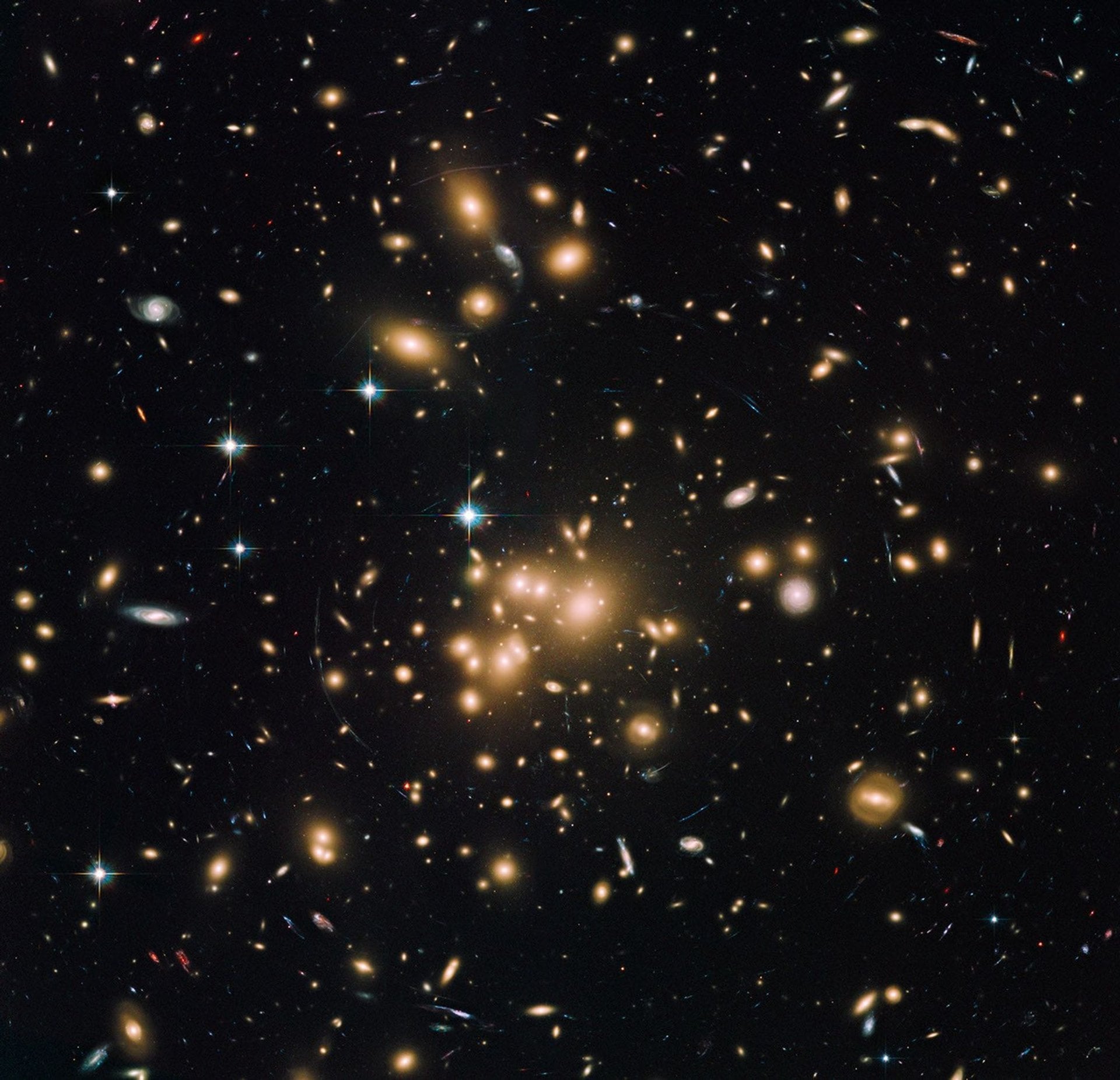
There’s more (there’s always more). If a massive cosmic string passes between us and a distant galaxy, it warps space-time so severely that it splits the light around it. From our perspective on Earth, we would see two identical copies of the same galaxy, side-by-side. A perfect, double-take inducing duplicate.
We found plenty of lensing from regular old dark matter, sure. But a perfectly straight, string-like lensing signature? Zero.
And don't even get me started on the monopoles.
In 1982, a physicist named Blas Cabrera actually thought he’d caught one. On Valentine’s Day, his detector recorded a single, perfect signal that matched the signature of a magnetic monopole passing through. It was a "one-and-done" event. We built bigger detectors. We waited for years. We essentially threw a worldwide party and invited every monopole in the neighborhood to show up.
Nobody else came. In science, one event is a weird coincidence. Two is a discovery. We only ever got the coincidence.
The "Missing Monopole" problem is actually even worse than that. If monopoles existed in the numbers our standard theories predict, their combined weight would be so immense that the universe could have stopped expanding and collapsed back into a "Big Crunch" before the first star ever turned on. The fact that you are sitting here, listening to me talk about physics while dreaming about cheese, is living proof that the standard story is missing a chapter.
So, what happened? Is it all a lie?
Well, we have one "Get Out of Jail Free" card: Inflation.
You remember inflation, how could we forget it? If the defects were created before or during inflation, then that radical expansion might have just... swept the floor. Imagine you have a few dots on a balloon.
You blow that balloon up to the size of the solar system in a fraction of a second.
Those dots are still there. They didn't die. But they are now so far apart that you could spend a billion years traveling and never see your neighbor. Inflation might have diluted the defects so much that there’s only one monopole left in our entire observable horizon. It's a convenient answer. Maybe a little too convenient.
But even with inflation, we should see something. A tiny hint of the residue. A scrap of the construction debris. I mean, come on universe, throw us a bone here, we’re getting desperate!
But…Maybe we aren’t seeing the defects because we’re looking for the wrong thing. We’ve been hunting for strings that span the cosmos and monopoles that explode power powerfully than a supernova.
But what if the defects didn't get swept away by inflation? What if they just... changed?
It might be possible for some defects to remain. We can take a string, wrap it around itself, but instead of having it vanish into a shower of radiation, what if it…stops?
If you had a universe filled with tiny, heavy, invisible knots that didn't interact with light, what would you call it?
Yeah. Dark matter.
It’s time…to talk about the Vortons.
To be continued...