 Universe Today

There's a bit of a historical mystery surrounding the star Theta Eridani. Ptolemy in the 2nd century AD and al-Sufi in 964 AD both recorded Theta Eridani as one of the thirteen brightest stars in the sky. Hipparchus may have said the same. But there's a problem. For it to be one of the thirteen brightest, it had to be much more luminous than it is today.
Theta Eridani is a star system about 167 light years away. Though ancient astronomers thought it was a single star, Italian astronomer Giuseppe Piazzi resolved it as a binary in 1814. Theta 1 Eridani is the primary star and Theta 2 Eridani is the secondary. But modern observations with powerful telescopes revealed that Theta 1 Eridani is actually a very tight binary, and together they're called Theta Eridani Aa (historical primary) and Ab (its close companion). So Theta Eridani is actually a triple star system, and this fact is key to understanding its thousand-year transient brightness event.
Theta Eridani is a V=2.9 star, where V stands for visual. Astronomers measure stellar brightness in different ways, and the visual scale mimics what human eyes see. The visual magnitude scale is backward and logarithmic, so the Sun, for example, is a whopping V = -26.74. Sirius, the brightest star in the sky other than the Sun, is V = -1.46.
Theta Eridani was never as bright as Sirius, but it must've been significantly brighter than it is now based on Ptolemy's and al-Sufi's writings. Exactly how bright it was, and how it reached such brightness, is the topic of a new paper. It's titled "The forgotten bright star: Theta Eridani as a millenary stellar transient observed by Hipparchus, Ptolemy and al-Sufi," and it's available at arxiv.org. The authors are Idel Waisberg and Boaz Katz, the former an independent researcher and the latter from the Department of Particle Physics and Astrophysics at the Weizmann Institute of Science in Israel.
"Theta Eridani was listed by both Ptolemy in 137 AD and by al-Sufi in 964 AD among the thirteen brightest stars in their (visible) night sky, in addition to being reported by Hipparchus around 129 BC as a particularly bright star," the authors write. "This is in stark contrast with its modern and relatively humble V=2.9 brightness. The discrepancy with ancient observations has been a subject of controversy for over a century."
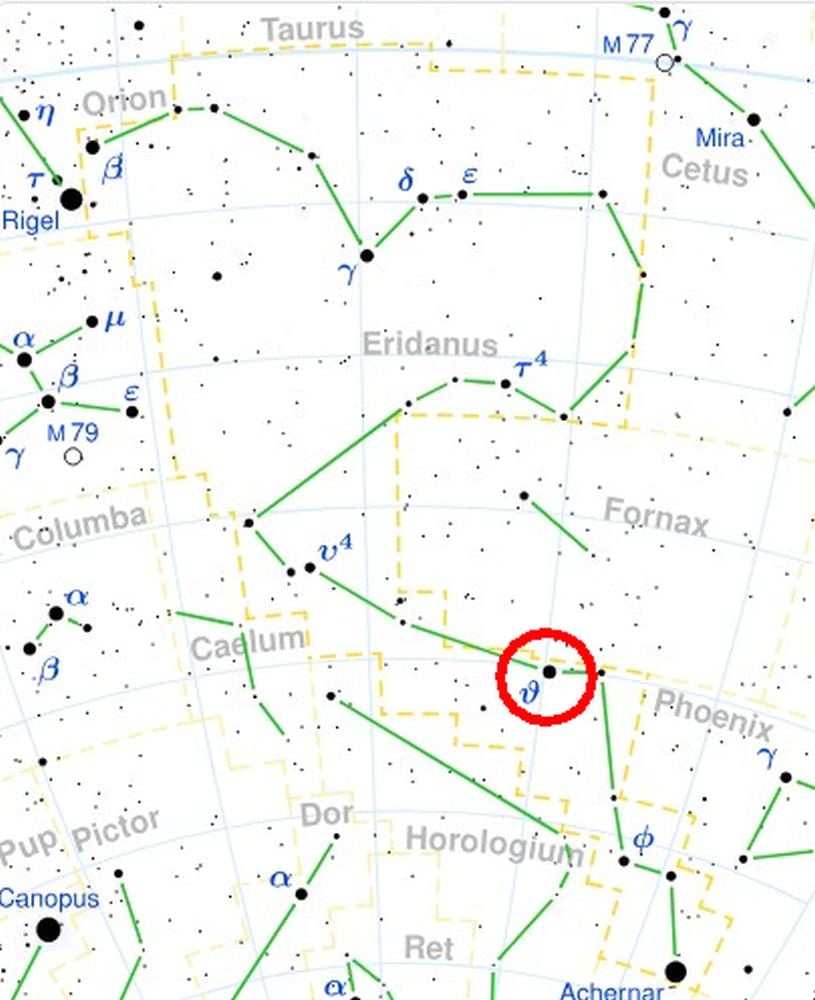 Theta Eridanus circled in red in the constellation Eridanus, named after a mythical Greek river. Image Credit: By Eridanus_constellation_map.png: Torsten Brongerderivative work: Kxx (talk) - Eridanus_constellation_map.png, CC BY-SA 3.0, https://commons.wikimedia.org/w/index.php?curid=10839623
The authors calculate that Theta Eridani's ancient brightness was V ≈ 0.2, compared to its current V = 2.9. "The discrepancy between its historical and modern visual magnitude ΔV∼2.7 is the highest among the ∼ 1000 stars in the Almagest," the authors write, referring to Ptolemy's 2nd century work on stars and planets. Since the scale is logarithmic, this means that Theta Eridani was 12 times brightern then as it is now.
In this work, the authors used interferometric, spectroscopic, and photometric data from different observatories and telescopes to determine the orbital parameters, the radii, and the masses of the close inner binary in Theta Eridani Aa+Ab. They found that it's a close eccentric binary with a tight semi-major axis of au = 0.083. That's less than 1/10th the distance between the Earth and the Sun. With an orbital eccentricity of 0.105, the orbit is a slight oval. Both stars have intermediate masses and are a little larger and hotter than the Sun. Aa has about 2.3 solar masses, while Ab has about 2.2 solar masses, so they're almost twins.
All of these measurements explain what happened with Theta Eridani around 1,000 to 2,000 years ago, as recorded by Ptolemy and al-Sufi. Its transient brightness was a result of these factors, which the authors call a "remarkable set of stellar parameters."
"The historical brightening of Theta Eridani was due to a millenary transient phase powered by orbital energy extraction during a long-lived “common envelope” stage," the researchers explain. "In order to explore a possible mechanism for the transient, we note a further two tantalizing facts about the binary. The first is that the primary Aa is close to filling its Roche lobe."
Altogether, this paints a picture where the primary star filled its Roche lobe, triggering mass transfer onto the smaller star. This released orbital energy that raised the star's brightness for centuries. Now, the system has calmed down and settled into its less eccentric configuration.
 This simple drawing shows a binary star and Roche lobes. The more massive star on the left has filled its Roche lobe. When that happens, material can overflow from the lobe, creating a common envelope that raises the star's brightness. Image Credit: By Philip D. Hall - Own work, CC BY-SA 4.0, https://commons.wikimedia.org/w/index.php?curid=51844337
"We also find that the primary is in a very special phase of its evolution in which it has just finished core hydrogen burning," the authors write. This fact fits neatly into the narrative. When a main star finishes core hydrogen burning, it becomes a red giant. It doesn't get hotter, but it does expand. And with greater surface area comes greater brightness.
If this happened with Theta Eridani, it's likely happened elsewhere. In fact, it could be quite common in close-in binaries.
"The discovery and characterization of more binary systems undergoing such process in modern photometric surveys holds the potential to better understand what may be a ubiquitous, short-lived but determinant phase in the evolution of close binaries," the authors conclude.

