Universe Today
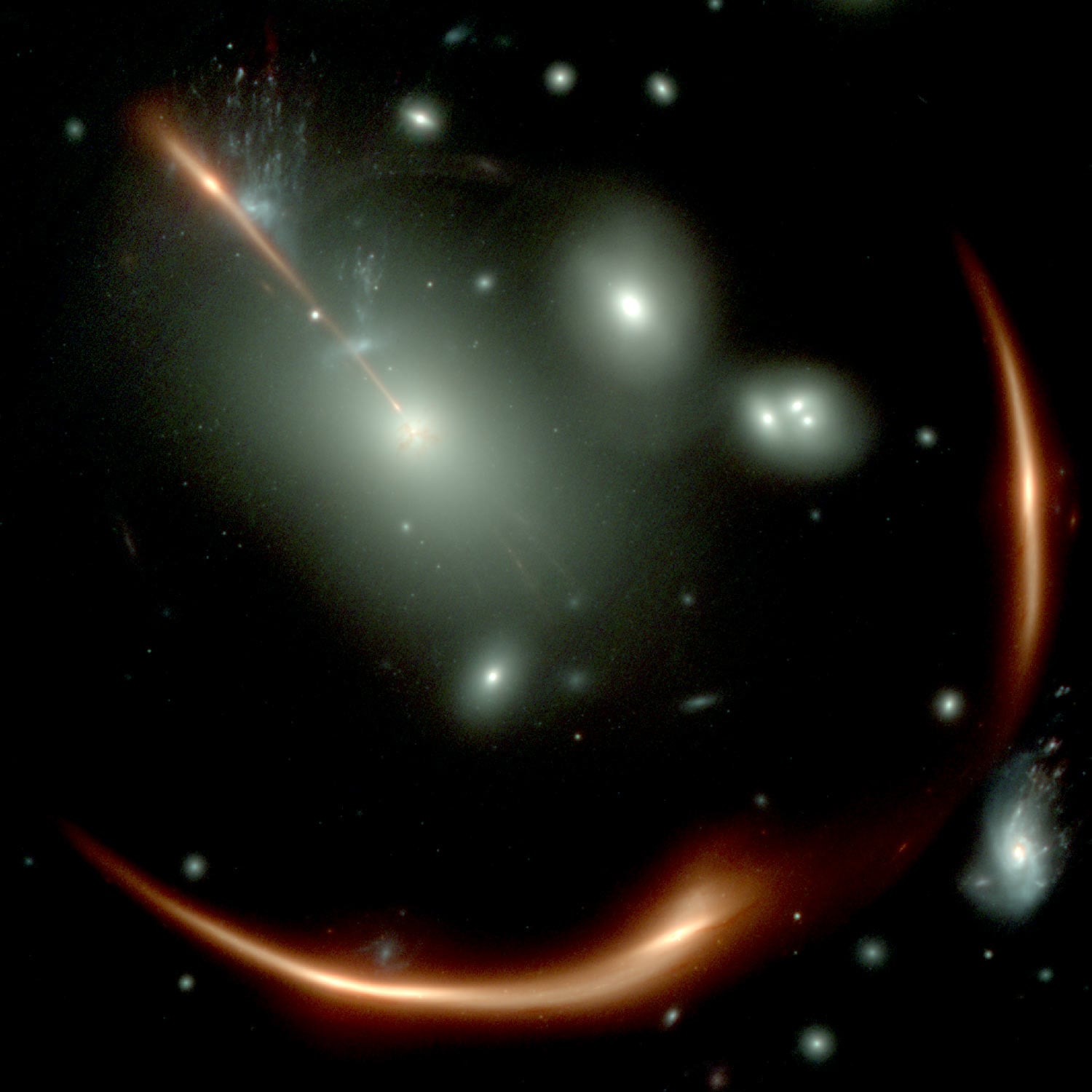
How do you measure the mass of a dormant black hole in the early Universe? That's a question astronomers at University College London (UCL) and Carnegie Science (in Pasadena, CA) wanted to answer about a distant object that exists but appears invisible. So, they turned to James Webb Space Telescope (JWST) studies of stars in the region around the supermassive black hole to find that answer.
The object, MRG-M0138, lies just over 10 billion light-years away, so it appears as it was when the Universe was around 3 billion years old. It's also the most distant quiescent black hole ever found. This object is a behemoth, containing the mass of about 6 billion Suns. Astronomers want to know a lot more about black holes like this one as they existed and "performed" in the early epochs of cosmic time. That's because the objects contain clues to what conditions were like when the Universe was just leaving its infancy.
Using Gravity to Measure Motions
A dormant black hole doesn't emit any radiation at all. That's because it's not "eating" material and emitting high-energy jets or lighting up its accretion disk. However, it still exerts a gravitational influence on material in its near neighborhood. That includes stars. The team used the motions of stars to measure the mass of the black hole. Those motions include how fast they move and the differences in motion between stars close to the black hole and those farther away. They then combined that information with a phenomenon called gravitational lensing, and a JWST image of MRG-M0138 being lensed by an intervening galaxy cluster.
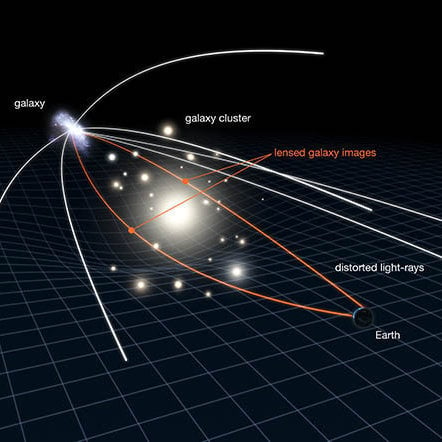 A schematic showing how gravitational lensing works. Courtesy NASA.
Lensing occurs when the light from a distant object passes through or near an intervening galaxy cluster (or galaxy). The gravitational pull of the cluster "bends" the path of the light, creating what often looks like warped mirror images of the more distant object. In this case, the gravitational influence of another galaxy, located directly between MRG-M0138 and Earth, bends the light around it, refocusing the background image and enlarging it 30 times.
“By combining JWST data with gravitational lensing, we could peer inside the black hole’s sphere of influence, where its gravity boosts the speeds of stars," said lead author and team member Andrew Newman of Carnegie Science. "This is one of the best techniques we have to weigh a black hole, so we were excited to extend it to a much earlier period in cosmic history.”
Stellar Dynamics for the Win
The idea of measuring the motions of stars to determine an object's mass isn't a new one. Such stellar dynamics measurements were used to calculate the mass of the black hole at the heart of the Milky Way, Sagittarius A*. It's also been used on several other close-by galaxies. But, as distance grows, the difficulty of making these measurements also grows. That's where JWST data came in handy. The combined measurements of stellar motions and gravitational lensing marks the first time astronomers have been able to measure a dormant black hole's mass at a great distance.
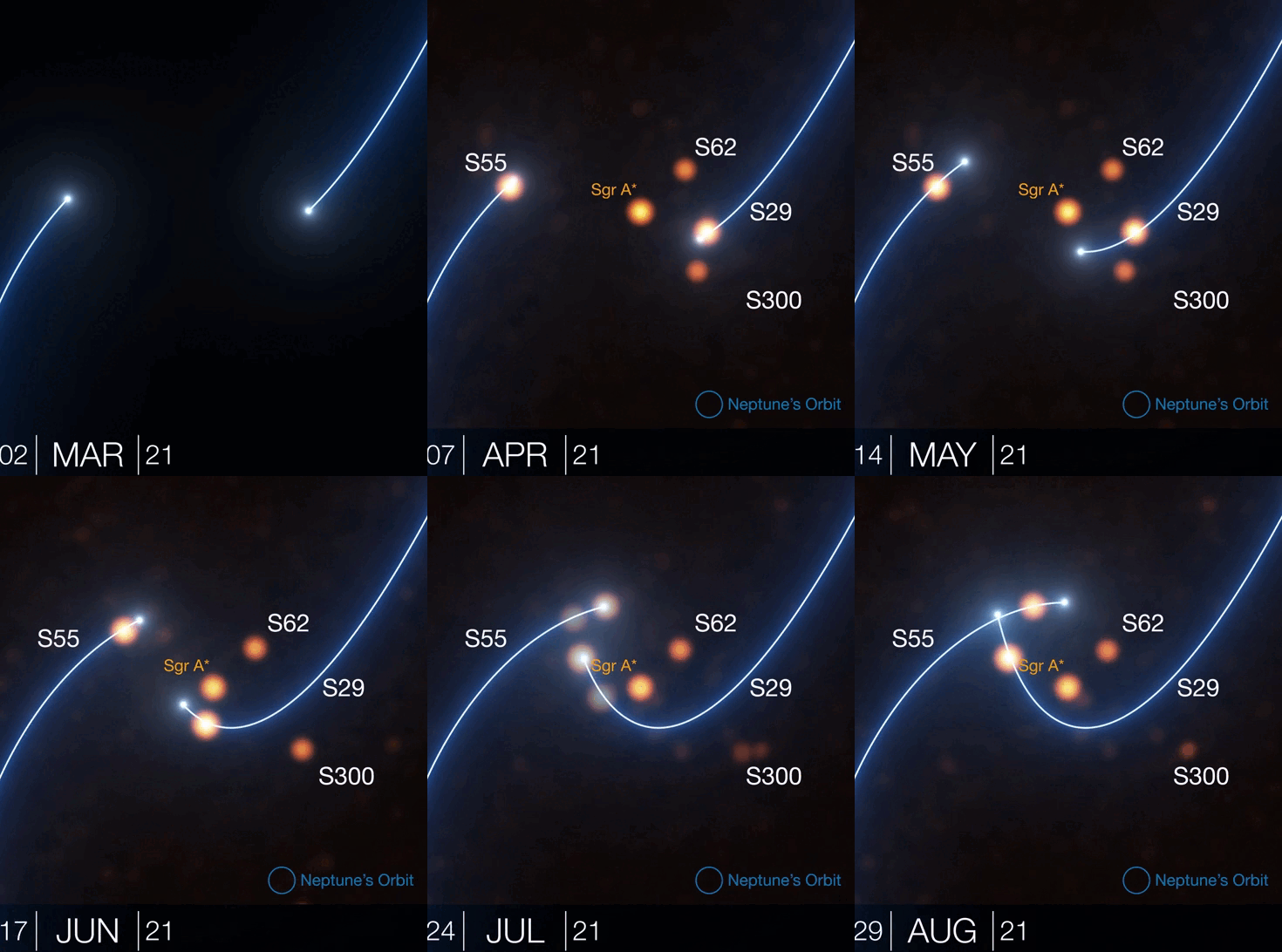 Stars seen moving around Sagittarius A in the Milky Way Galaxy. The strong gravitational pull of the supermassive black hole influences the orbits of nearby stars. Courtesy ESO/GRAVITYcollaboration/L. Calçada*
It also provides greater insight into conditions in the early Universe, according to team member Richard Ellis of UCL. “Determining how stars collectively move within the core of this distant galaxy has allowed us to measure the mass of its otherwise undetectable supermassive black hole," he explained. "By demonstrating the feasibility of such a technique for galaxies in the early Universe, we can now undertake a more complete census of how black holes develop over time and infer their role in shaping galaxy evolution.”
One of the big questions about the early epochs of the Universe has been about how galaxies and black holes essentially "grew up" together in those times. Today, we see many galaxies with supermassive black holes at the heart, many of them quite active. But, when we look at MRG-M0138, it appears that not only is the central black hole dormant, but the galaxy itself is quiescent. It's no longer forming any new stars. In the past, it may have been much more active and hosted a very active supermassive black hole as a quasar at its heart. It's possible that when when the black hole first formed and rapidly grew, it gave off quite a lot of energy as it ingested material. That energy release could have affected the remaining gas in the galaxy, burning it off or even ejecting it to intergalactic space. That pretty much killed off any chance for the galaxy to make new stars, since the lost gas is stellar seed material.
Are Dormant Black Holes Everywhere?
It's obviously hard to know how many dormant supermassive black holes there are in the Universe, thanks to their quiet ways. the lack of emissions, combined with distance, conspire to keep them from our view. That makes the technique of using stellar dynamics a useful one, especially when combined with lensing.
Further observations with JWST and other space observatories in the future should reveal more of these giant sleeping masses of matter, particularly in the early Universe. They should offer new insight into the roles that active black holes play, ranging from quenching of star formation and gravitational effects on the nearby neighborhoods. Such observations might also show us what happens when (or if) a dormant black wakes up hungry and starts to gobble down stars and gas.
For More Information
Researchers Weigh the Most Distant Dormant Black Hole
A Stellar Dynamical Mass Measurement of an Inactive Black Hole at Redshift 2