 Universe Today
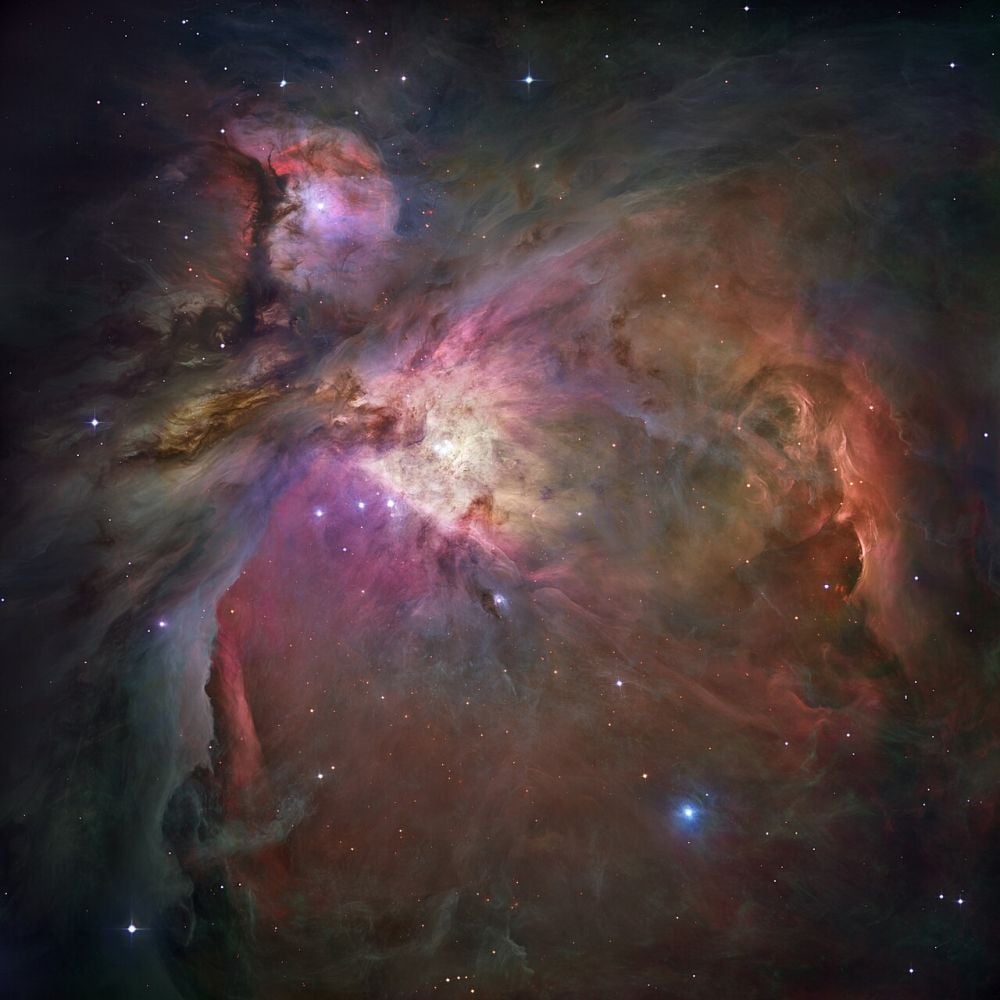
As one of the most prominent features of the night sky, the Orion Nebula has been studied, probed, and imaged by almost every telescope in existence. Because it's visible with the naked eye, billions of human eyeballs have also considered it. Orion, also called M42, is the closest massive star-forming region to Earth, and it's served as a natural laboratory to study astrophysics and star formation.
What we usually think of as the Orion Nebula is sometimes called the Huygens region, which is centered on the brilliant Trapezium cluster. Huygens sits inside a much larger structure called the Extended Orion Nebula (EON). In new research, astronomers have found a cavity in the EON which doesn't seem to have been carved out by a supernova, powerful stellar explosions known to carve out bubbles in the ISM. They've also discovered other structures in the EON, and came up with more accurate measurements for a known feature.
The new findings are based on observations of neutral atomic hydrogen (HI). HI is important in astronomy. As the Universe's most abundant type of atom, hydrogen is everywhere. HI is a critical tracer in astronomy, and since it's the precursor to the molecular hydrogen that forms stars, it's a powerful indicator of future star formation. HI's 21 cm—or 1420.4 MHz—emission line is considered forbidden because it's caused by what's known as a spin-flip. The likelihood of any individual atom spin-flipping is extremely low, but since hydrogen atoms exist in such vast quantities, radio telescopes can see enough of it to map large regions accurately.
The new research is titled "The Neutral Atomic Hydrogen in the solar neighborhood (NeAtHood) projectj: 1. Ghost in the shell: Neutral atomic hydrogen in the extended Orion nebula." It's published in Astronomy and Astrophysics and the lead author is Juan Diego Soler, an astrophysicist and researcher at the University of Vienna's Astronomy Department.
This work is based on combined observations from the Karl G. Jansky Very Large Array (VLA), an interferometer in New Mexico, and the Five-hundred-meter Aperture Spherical Radio Telescope (FAST) in China. The VLA is a workhorse observatory in use since the 1970s, while FAST is the world's largest single dish telescope, which began observations in 2016.
As astrophysicists learn more about star formation, they're understanding how the wider environment is connected to the gas clouds that birth them. These observations provide more detail in the environment around the star-forming Orion nebula.
"Neutral atomic hydrogen (HI) is a fundamental tracer of the cycling of matter and energy in galaxies," the authors write. About two-thirds of the Milky Way's gas is HI. That gas serves as a tracer for "the cold pre-molecular state before star formation and the warm diffuse interstellar medium before and after star formation," the researchers explain. Despite this, they say that maps of HI in the nearest star formation have been limited in both their resolution and their extension.
"We present 21-centimeter emission line observations that resolve for the first time the neutral atomic hydrogen (HI) gas in the extended Orion nebula (EON)," the authors write. The emission maps generated by these observations revealed an expanding shell that matches the EON's known contours, but with some differences. "Our combination of single-dish and interferometric HI observations suggests 100 solar masses of material for the front hemisphere of the shell, which is lower by roughly a factor of ten than the mass inferred from (previous) observations."
"Measuring mass is fundamental," lead author Soler said in a press release, "because it tells us about the efficiency of these newly formed stars shaping their environment with wind and radiation."
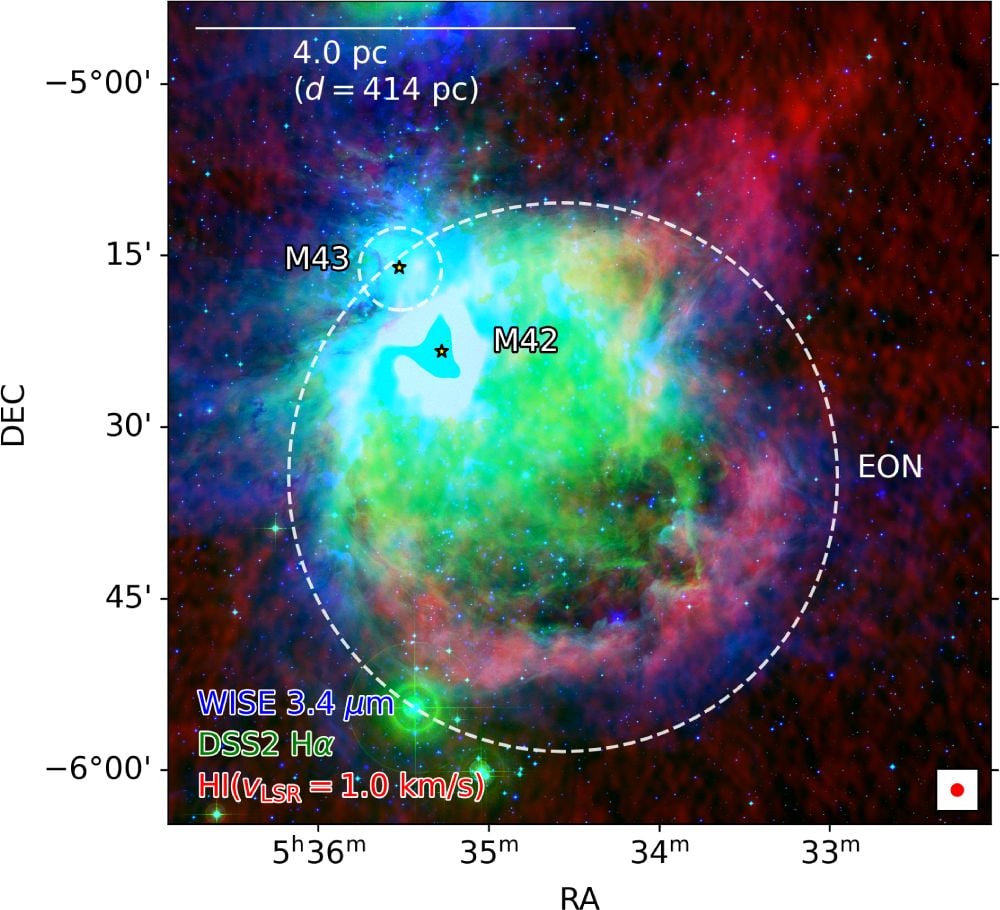 This is the Extended Orion nebula shell sampled by HI emission from the combined VLA and FAST observations (shown in red), Hα emission from the European Southern Observatory Digitized Sky Survey (shown in green), and 3.4-μm emission registered by the Wide-field Infrared Survey Explorer (WISE) satellite (shown in blue). The dashed white circles indicate the locations of the EON and M43 shells. The yellow stars show the position of their presumed progenitors, O7V-type star θ1 Ori C and B3V/IV-type star ν Ori. Image Credit: Soler et al. 2026. A&A
"Our extended 21 cm line maps also reveal uncharted structures in and around the EON," the researchers write. "They include a probable secondary bubble and a linear protrusion extending roughly four parsecs from the shell boundary."
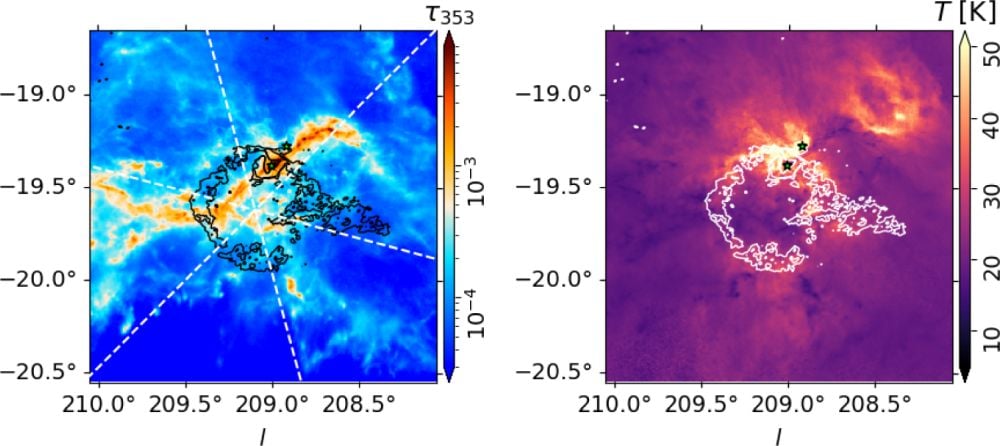 These images, especially the one on the right, show the elongated protrusion coming from the EON. It extends for about 4 parsecs, and is evidence that the EON bubble wasn't created by a single supernova. The stars mark the positions of θ1 Ori C and HD 37061. The dashed white lines indicate the center of the expanding shell. Image Credit: Soler et al. 2026. A&A
"The main and secondary EON bubbles might have been produced by two consecutive feedback events," the authors write. "First, the main EON bubble is blown by the winds from θ1 OriC. Second, another high-mass star leaving the ONC produces feedback, even shaping the second bubble."
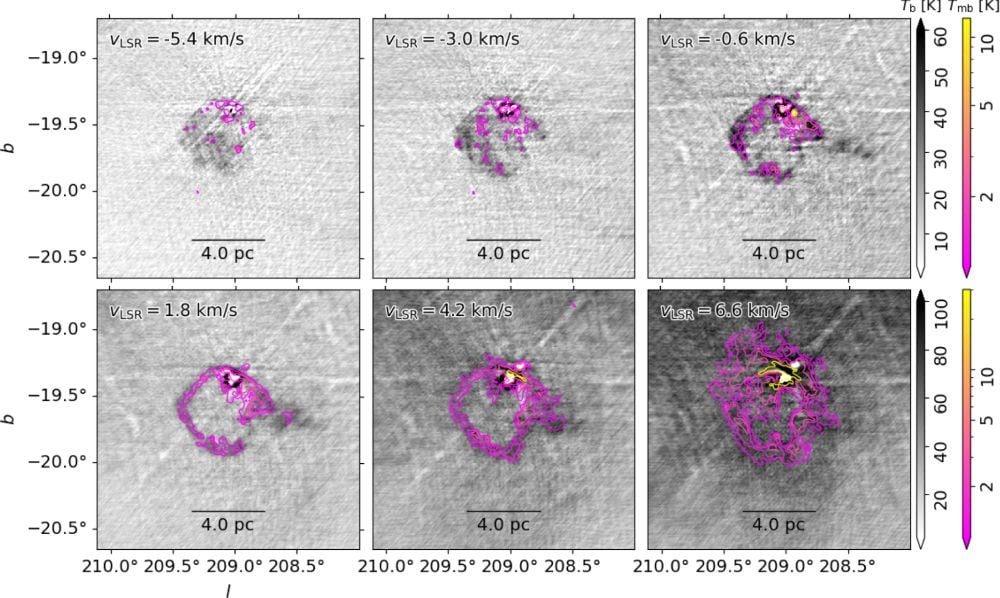 These images are maps of the 21 cm line at different velocities. They show the secondary bubble identified in this study, near the top of the EON. Image Credit: Soler et al. 2026. A&A
"These stunning observations serve as a reference for many modern astrophysical simulations investigating the evolution of gas and stars in the Milky Way," said study co-author Daniel Seifried from the University of Cologne. "These are the kind of images that challenge the theoretical models and numerical simulations that we use to understand how massive stars affect their immediate surroundings."
When China built FAST, astronomers eagerly anticipated its results. The large radio telescope exceeded the capabilities of the Arecibo observatory. Arecibo measured 305 meters and was the largest dish in the world for more than 50 years. Now that it's no longer in use, it makes FAST even more important. And results like these show why.
"This study is an exciting demonstration of the power of latest-generation radio telescopes to uncover new pieces to the star formation puzzle", said study co-author Claire Murray from the Space Telescope Science Institute (STScI).
It's also proof of how effective new observing techniques with interferometers like the VLA are.
"Orion is only the beginning. Our newly developed methods show how future interferometers will reveal the hidden structure and dynamics of the interstellar medium—even in regions that astronomers already believed they understood well," said lead author Soler.
"Our observations revealed previously uncharted features in the nearest wind-blown bubble and high-mass star-forming region," the authors write. They also point out that these combined single-dish and interferometry observations of HI can uncover the dynamics of gas movement and reveal more interactions between star forming regions and their surroundings. This is critical to understanding the complexity of star formation.
"Even in a well-studied region such as Orion, HI reveals something new in the heavens," the authors conclude.

