Universe Today
(This is Part 4 of a series on cosmic dust. Read Part 1, Part 2, and Part 3 first.)
Okay, fine. Dust does some chemistry. I'll give it that. But surely the rest of cosmic structure, the actual stars and planets and us, has nothing to do with these annoying microscopic grains.
Reader, it has everything to do with them.
Stars form when a giant cloud of gas contracts under its own gravity. That part you probably know. But the cloud can't just collapse on command. As gas falls inward, it heats up. Heated gas has high pressure. High pressure pushes back against gravity. If you can't get rid of that heat, the collapse stalls and the cloud just sits there, indefinitely, refusing to form a star. The whole process is a delicate balance: gravity wants to pull everything together, thermal pressure wants to push everything apart, and the question of whether a star ever ignites comes down to which one wins.
You need a way to cool the cloud. Some way for the heat generated by gravitational contraction to escape into space and stop fighting back. Pure hydrogen and helium gas, the bulk of the cloud, is actually pretty bad at this. The atoms have very few accessible ways to dump energy as radiation at the temperatures involved. Cool a hot pile of hydrogen and...it just kind of sits there, frustrated.
Dust solves this. Dust is REALLY good at radiating energy, especially in the infrared. The grains absorb the heat from collisions in the cloud, and they re-emit that heat as infrared light, which can escape the cloud easily and carry the excess energy away into space. The cloud cools. Pressure drops. Gravity wins. The collapse proceeds, the core heats up to fusion temperatures, and a new star ignites.
But there's a second piece. The same dust grains that cool the cloud also block UV radiation from outside. Without that shielding, ultraviolet starlight from nearby massive stars would dissociate the molecular bonds in the cloud, ripping apart H2 faster than it can form, and the whole molecular cloud structure would dissolve into atomic gas. Dust forms a kind of protective shell around the densest parts of the cloud, letting the chemistry get on with itself in peace.
Without dust, the cloud can't cool. Without cooling, the cloud can't collapse. Without collapse, no stars. Without the shielding, the molecules dissociate. Without the molecules, you don't have the structure that fragments and forms stellar nurseries. Galaxies would still exist, technically, but they'd be unrecognizable. Smooth, hot, diffuse, dim. No spiral arms. No bright young clusters. No us.
And speaking of us, dust makes planets too.
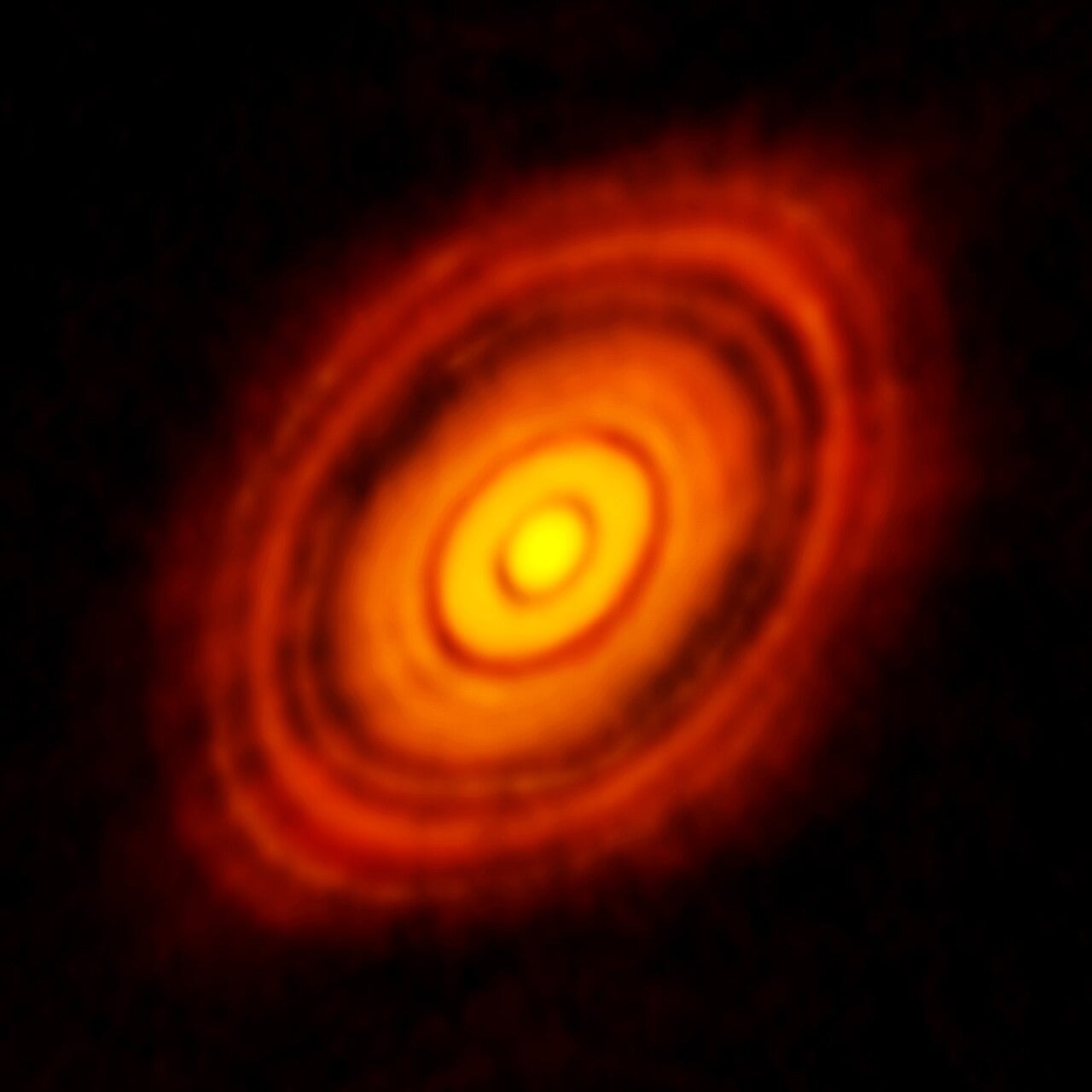
Take a young star. Surround it with a disk of gas and dust. Now what? Well, the dust grains are heavier and they tend to settle toward the midplane of the disk, getting denser as they collect. Grains bump into other grains. They stick. Electrostatic forces hold them together, the same kind of static cling that makes a balloon stick to your hair, but operating across vast numbers of grains for very long times.
Slowly, those grains build into pebbles. Pebbles build into rocks. Rocks build into boulders. Boulders build into kilometer-sized planetesimals. Planetesimals gravitationally attract each other, smash together, accrete more material from the disk, and eventually you've got planets. The whole pathway is literally a ladder, and the first rung is dust grains clinging together. Take away that first rung and the entire planet-formation process never gets started. No rocky planets. No gas-giant cores to start gobbling up hydrogen. No moons, no asteroids, no comets. Just a star sitting alone in a gradually dissipating gas cloud.
And flows of dust carry complex molecules across the galaxy. They're born in dead stars, they get blown by interstellar winds, they combine in interesting ways in the depths of space, they trigger star formation and planet formation, they ride along with comets as they impact young planets. And all the while, those little microscopic chemistry labs are creating the building blocks of life, and it's dust that ensures that all those building blocks end up in the right place at the right time.
Oh, no. No, no, no. This can't be true. If dust didn't exist...stars...planets...life...wouldn't exist? We wouldn't be here if it weren't for dust? We owe our LIVES to interstellar dust?
I'm...going to need a minute. And I think I need a bigger apology.
Look, most of the dust you encounter in your daily life is terrestrial. Even biological. Local. It's bits of skin and bits of critters that eat bits of skin and lots of other things that you really don't want to think about too much. Some of the dust in your room comes from across the globe. Some of it is ash from a volcano or sand from the Sahara.
And some of it, just a tiny portion, comes from outer space. Every year, about 40,000 tons of extraterrestrial material rains on the Earth. Most of it is micrometeoroids, bits of dust so small you couldn't even see them. They just drift down, contributing to the global dust population.
Find the nearest dusty bookshelf. Swipe your finger on it. Think of all the countless grains on your fingertip. Some of them, just some of them, traveled here for thousands of light-years. And some of them even predate the solar system itself. We've identified individual dust grains, embedded in meteorites, that are more than 7 billion years old. Created in some stellar system that no longer exists. Older than the Sun. Older than the Earth. Older than every atom of you that didn't come from a hydrogen nucleus left over from the big bang.
So right there, right at your fingertips, is the stuff that makes you possible. And some of it is the oldest thing you could ever hold in your hand.
I'm sorry, dust. I won't be mad at you any more.