Universe Today
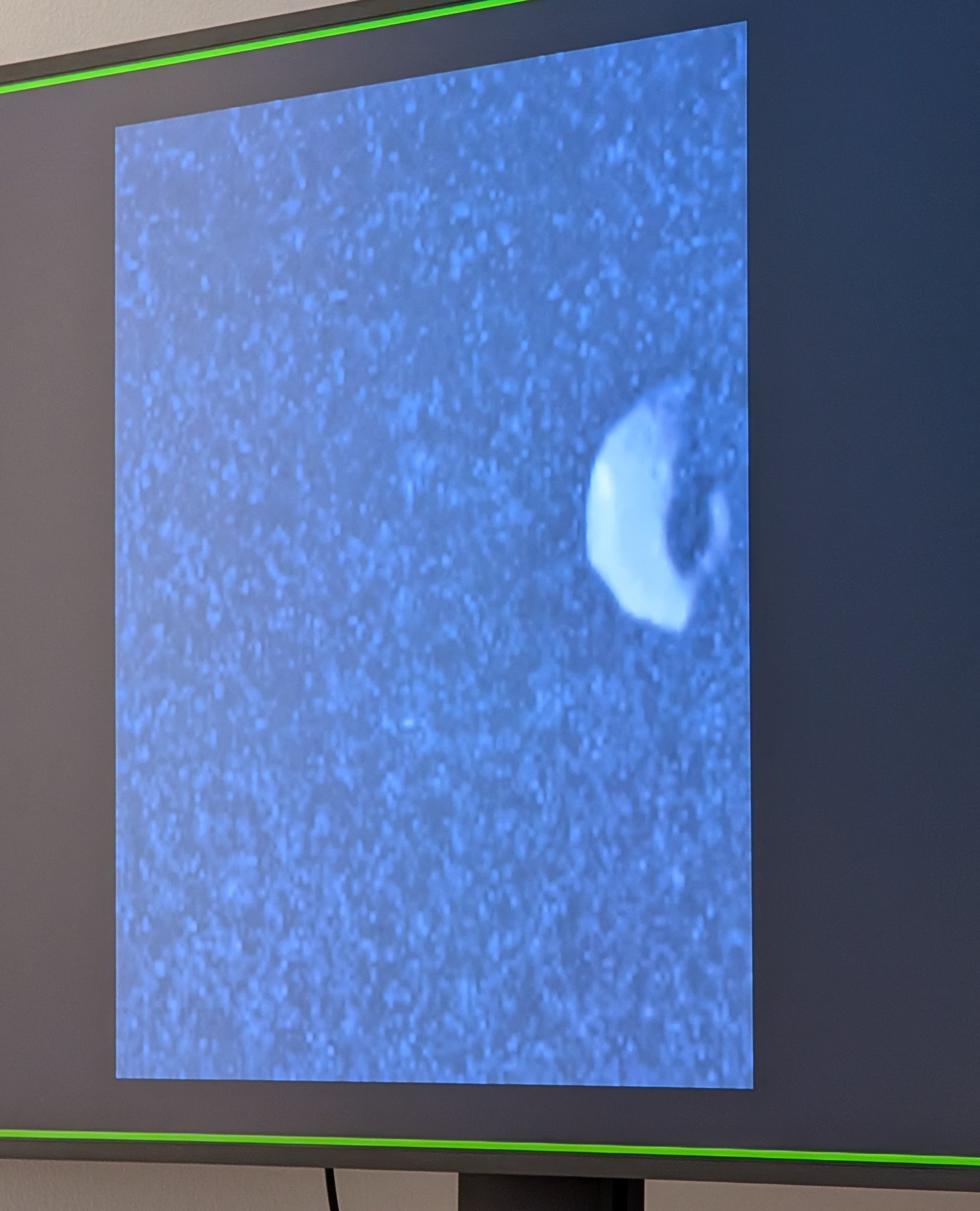
NASA’s Juno mission to Jupiter and its moons has made the closest ever approach of only 5000km to Jupiter’s moon of Thebe. The tiny natural satellite is a veritable dust bunny in comparison to our gas giant planet Jupiter. Thebe lies in dark shadows on the outer edge of Jupiter’s dry gossamer ring, a planetary ring totally unlike the rings of Saturn, one that has heretofore been a footnote in planetary science.
First detected in 1979 during data analysis of NASA’s Voyager 1 spacecraft’s flyby, Juno’s most recent image of Thebe was released early this month at a press conference at the European Geosciences Union 2026 general assembly in Vienna. The image, made at the unprecedented spatial resolution of only 3km, shows a very large crater that covers some 40 percent of the tiny moon’s surface.
Juno project scientist Steve Levin jokingly quipped at the press briefing that it looks like Jupiter --- which lies only some orbiting 222,000km from Thebe --- has its own Star Wars-styled death star.
Like everything in Jupiter’s innermost system – its dust ring, magnetic field and radiation belts, the ring moons – Thebe is part of an interconnected puzzle, still full of mystery, Heidi Becker, a planetary scientist and Lead Co-Investigator for the Juno SRU at NASA JPL, told me via email. We learned Thebe’s rough dimensions (just under 100km in diameter on average) from the imagery collected by the Galileo spacecraft, says Becker.
Fittingly, Thebe is named for a mythological nymph, a lover to Zeus, the Greek equivalent of the Roman-named planet Jupiter.
But its composition and density are still not well understood, says Becker. Thebe’s origin is another mystery with more than one hypothesis; she says, is it a captured interloper, a broken-up piece of a larger body from the past, or an accumulation of material that previously orbited Jupiter?
Studying how Thebe’s orbit is evolving over time gives hints about its density which can help narrow down the formation theories, she says. But Juno images that reveal Thebe’s position in space are contributing to this, says Becker.
The new image we released was from the low-light sensitive Stellar Reference Unit (SRU) star tracker camera.
In prior orbits, the SRU collected Juno’s highest resolution images of the Galilean moons Ganymede, Europa and Io while pointing at areas on their night sides that were illuminated only by Jupiter-shine (sunlit portions would have saturated the camera), says Becker.
As the team noted, the SRU is actually the main star tracker on the Juno spacecraft. But in this instance, they were able to use it as a low light camera to explore objects that they deem both unique and dim in the Jupiter system.
The team also noted that the SRU camera was able to capture both sunlit and night side portions with lots of feature shadowing. That in itself should tell them more about Thebe’s craters, while also providing hints about Thebe’s evolutionary history.
A Tenuous Hold On Its Dust
Thebe’s gravity field and its centrifugal forces are almost equal to the theoretical roche limit, which means that dust that's on its surface can easily escape. As a result, as noted in Vienna, the Juno team thinks that the formation of Jupiter’s gossamer ring is the product of a continual shedding of dust from both Thebe and another tiny Jupiter moon, Amalthea.
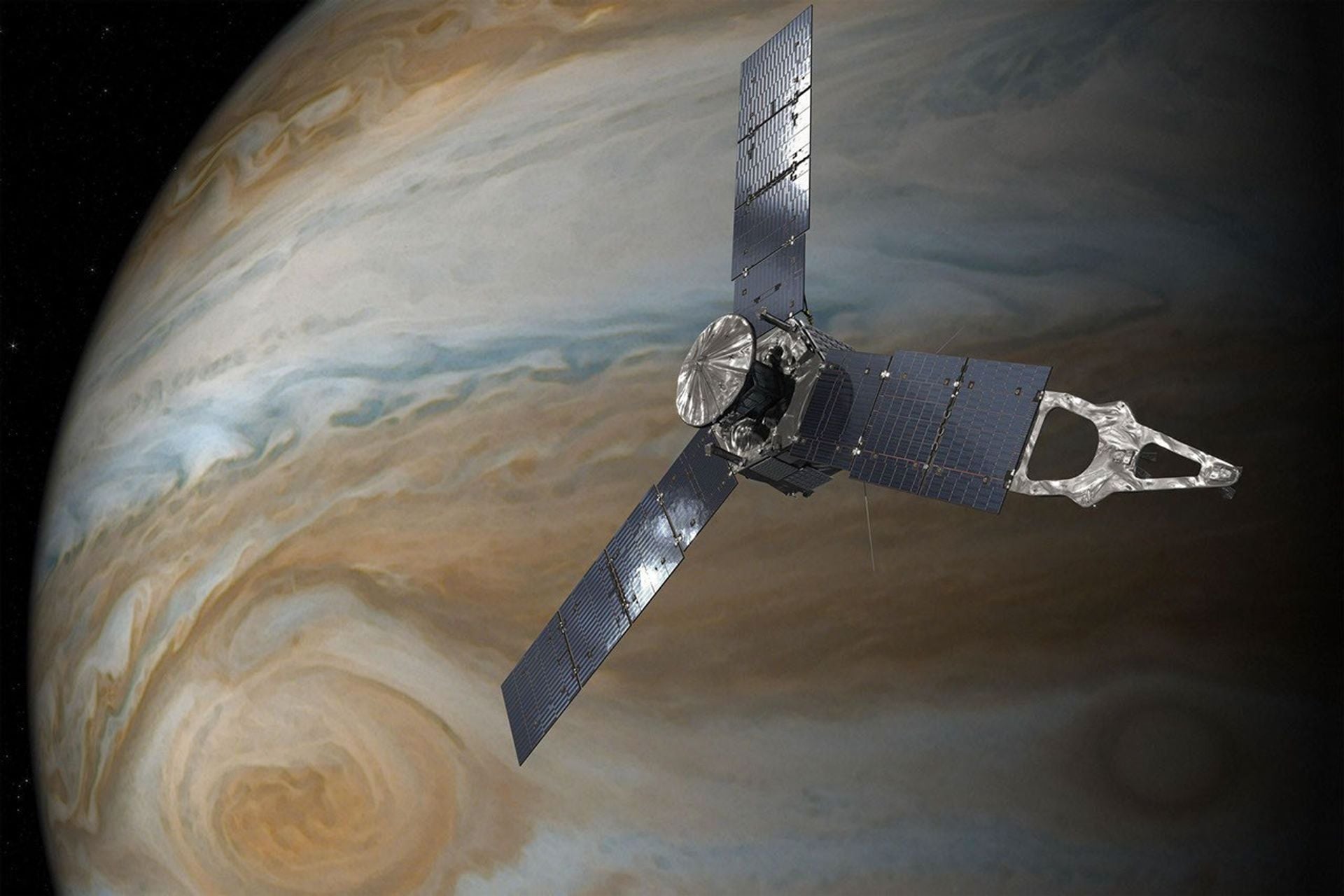 Artist'conception of Juno spacecraft at Jupiter. Credit: NASA
In the image displayed in Vienna, Thebe’s left side is illuminated by the Sun, while the right side is only illuminated by Jupiter shine, or sunlight scattered back up from the giant planet. Thebe and the tiny Jupiter moon of Amalthea are both thought to provide the material for the gossamer ring via the shedding of dust, says NASA.
A Mythological Husband?
The team thinks the large crater is one called Zephys, named for Thebe’s mythological husband. But it will take more time to analyze and interpret the data from the Juno spacecraft to confirm Zephys as the crater that’s in the image.
Regardless, humanity has come a long way since Galileo’s early 17th century observations of Jupiter’s four largest moons.
As for the significance of imaging such a tiny moon orbiting our solar system’s largest planet?
I’m very intrigued by how forlorn Thebe appears against the backdrop of dark space, says Becker. A 100 km [in diameter surface] is certainly not small in human terms, but that poor little moon looks like it’s absolutely had the living daylights knocked out of it, with craters on the same scale as the Moon itself, she says.
The Bottom Line?
It’s humbling to appreciate that we don’t know exactly where Thebe is; its orbit is a model that gets better the more we observe it, but we still have more to learn, says Becker.