 Universe Today
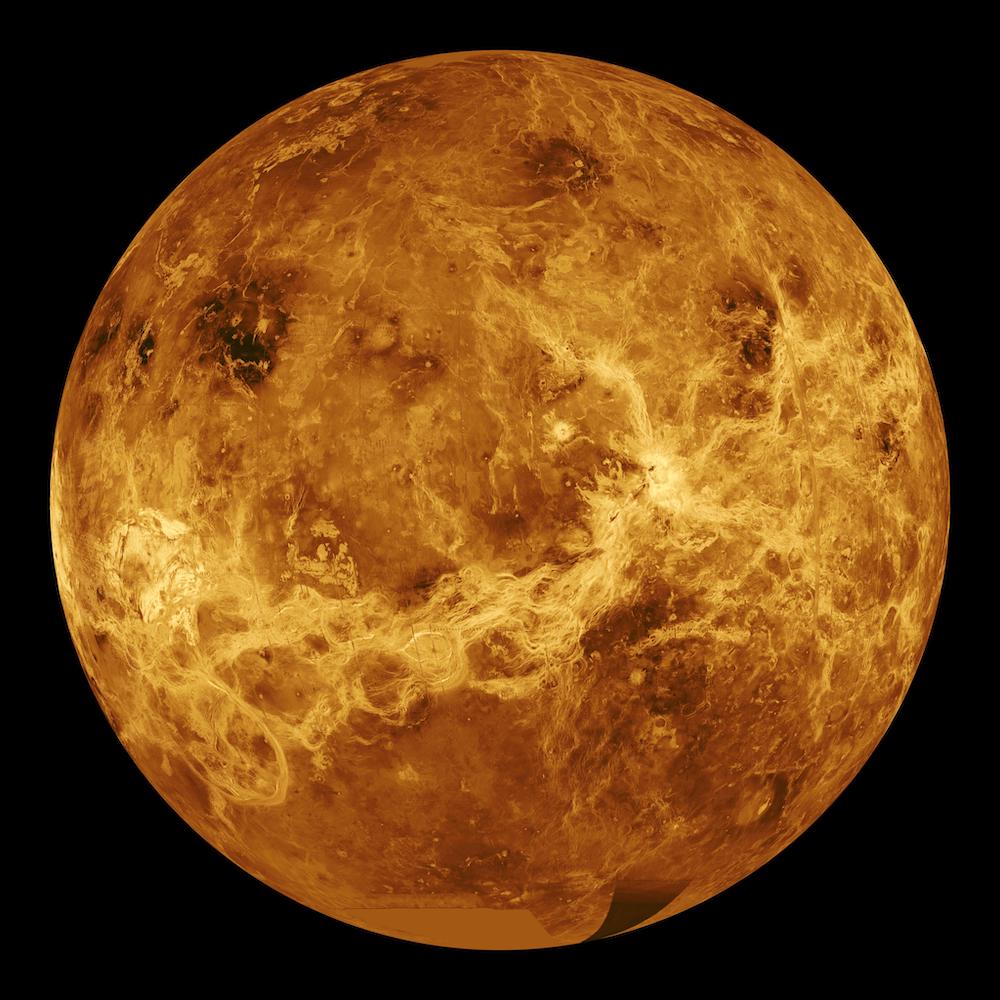
You don't hear it much anymore, but people used to refer to Venus as Earth's 'sister planet'. They're very close in size and composition, so it made sense. There are obvious differences between the two, though. While Earth is warm, wet, hospitable, and resplendent with life, Venus is a blistering hell-hole.
Planetary scientists like to puzzle over these differences. But there's another difference that also begs for attention. While Earth has a moon, Venus does not.
Why is that? Did it ever have one, and if so, what happened to it?
New research in The Astrophysical Journal tackles these questions. It's titled "Tidal Demise: The Evolution and Fate of a Hypothetical Venus Moon," and the lead author is Stephen R. Kane. Kane is professor of planetary astrophysics at the University of California, Riverside, and is known for his expertise on exoplanets and Venus.
Researchers have theorized about Venus having a moon, and have also wondered if it met its demise in a collision. Not with Venus, but with another object. Scientists have also theorized about Venus never suffering the same type of Moon-creating impact that the Earth did in the Giant Impact Hypothesis, and that it never had a moon.
But if it did have a moon, what happened to it?
"Venus possesses no natural satellite, raising the question of whether a formed moon could have survived," the authors write. "We explore the tidal evolution of a Venus-moon system, coupling Venus’s spin to the satellite’s orbit under tides from the moon and Sun."
Venus is blisteringly hot, and its dense atmosphere can crush landers. This sets it apart from other Solar System bodies. But it has other unusual properties, too.
Earth rotates rapidly, completing a rotation every 24 hours, and transfers rotational energy to the Moon. That energy slowly drives the Moon further from Earth. Venus rotates much more slowly, every 243 days, and in a retrograde motion. For these reasons, and because of greater influence from the Sun, any hypothetical Venusian moon would be pulled spiralling into the planet.
This means that if Venus did have a moon, no catastrophic impact was required to remove or destroy it.
“My study shows Venus didn’t require a catastrophe to arrive at what we can see today,” lead author Kane said in a press release. “It turns out the gravity of the planet itself combined with the rate at which it spins naturally caused the moon to collapse on top of it.”
Earth and Venus may have started out as sister planets, but they've followed much different paths since they formed billions of years ago. Planetary scientists want to understand how much the presence or lack of a moon may have shaped those paths. Fortunately, this is one aspect of planetary science they can study in our own Solar System.
"The absence of a Venusian moon has long been noted as one of the fascinating puzzles of comparative planetology, with implications for the divergent evolutionary pathways of Earth and Venus," the authors write.
To understand this better, Kane and his colleagues built a computer model of planetary bodies interacting with gravity. They tested the model for accuracy by seeing if it could recreate the evolution of the Earth and the Moon.
Working with the model, they varied the mass of the hypothetical Venusian moon from one-half to ten times the mass of Earth's Moon. They also varied Venus' rate of rotation, which scientists think began with an earlier, extremely rapid rotation, before slowing to its current retrograde crawl.
Most of the simulations ended the same way: the hypothetical moon slammed into Venus. And the more massive the simulated moon, the sooner the impact.
“When I made this discovery, I was shocked,” Kane said. “I thought surely the broad range of scenarios I was exploring would lead to a variety of results. But it all went pretty much in the same direction.”
The work doesn't tell us whether or not Venus ever had a moon. But it does tell us how long it could've lasted, and the answer is not very long.
"Explaining Venus’s present state requires satisfying two constraints simultaneously: loss of the satellite and despinning of an initially rapid rotator," the researchers write. "Both are met only within a restricted region of parameter space, favoring moderate post-impact spin periods and lunar-to-super-lunar masses."
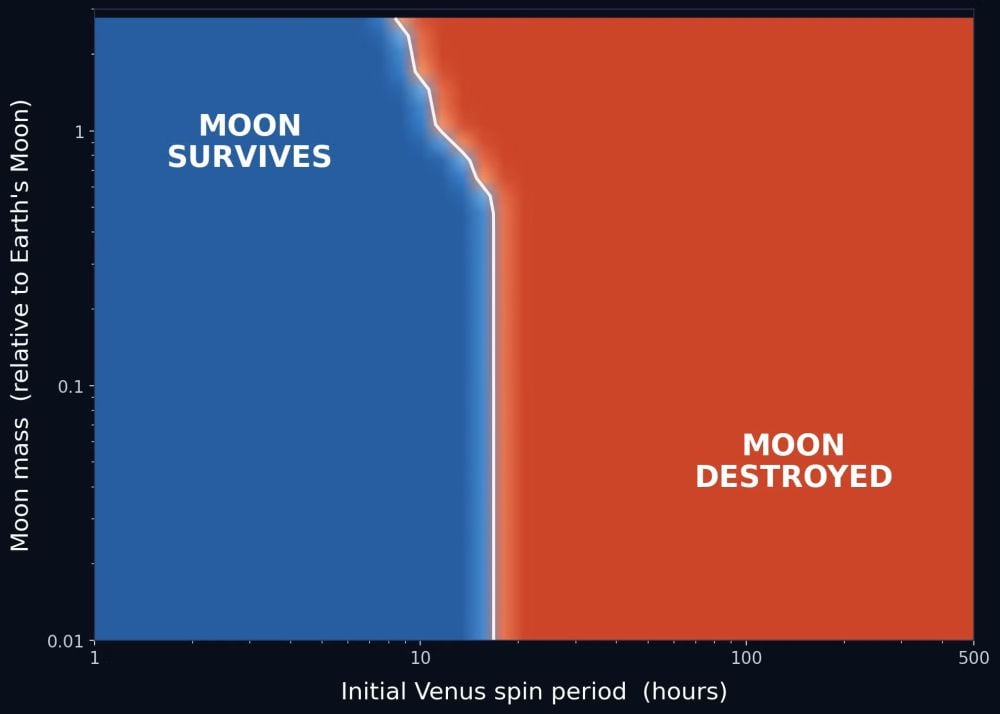 This figure illustrates how a Venusian moon fared, if one ever did exist. In most simulated cases, the moon crashed into the planet. The more massive the moon was, the sooner that impact occurred. Image Credit: Kane et al. 2026. ApJ
If a moon did crash into Venus, finding evidence of that is a monumental challenge. Never mind that no lander has survived on its surface beyond about two hours, and that happened only once, decades ago. But the planet's surface is only lightly cratered, suggesting that it was almost totally resurfaced in a major volcanic event hundreds of millions of years ago. This means any obvious evidence has been erased.
But there's still a chance planetary scientists could find some evidence of an ancient moon colliding with Venus. Researchers have found sub-surface, seismic evidence in Earth of the giant impact that created the moon. Maybe similar evidence is hiding under Venus' surface.
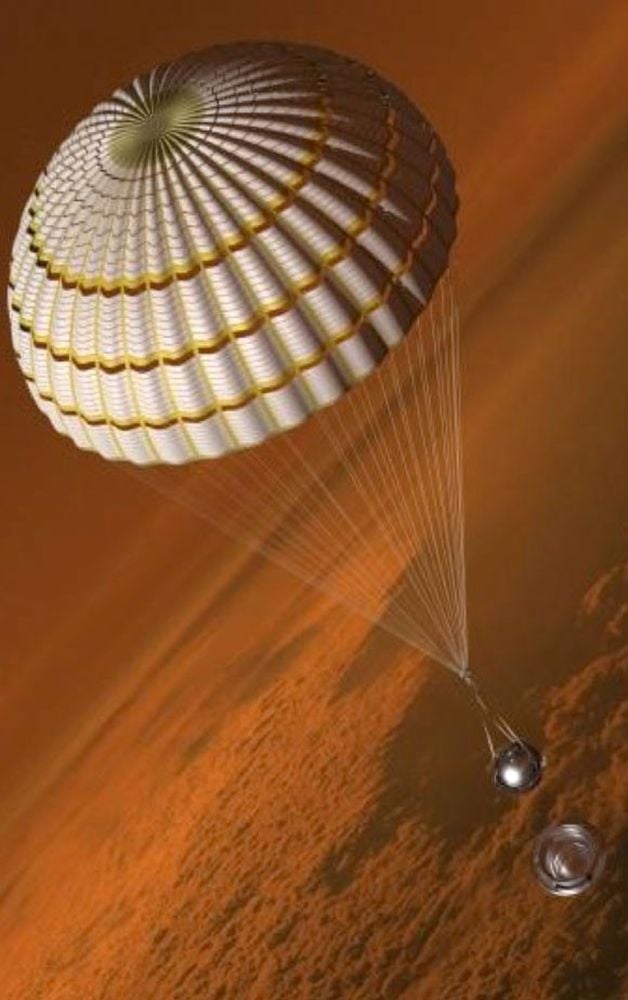 NASA's DAVINCI mission to Venus has both an orbiter, and an atmospheric entry probe, shown here. Image Credit: NASA / JPL-Caltech
While Venus is inhospitable now, it may not always have been a sulphuric, runaway greenouse hellhole. Scientists have wondered if it once had oceans, and if it was at one time much more temperate. If it was, and if it had an ancient moon that collided with it, that could've spelled its doom.
Scientists wonder if Venus may have had an ancient ocean, as shown in this illustration. Image Credit: NASA
"The presence of a large satellite during Venus’s first ∼1 Gyr would have several consequences for the planet’s early habitability," the authors write. "A moon of ∼1 MMoon would stabilize Venus’s obliquity against chaotic variations, potentially maintaining favorable insolation patterns for surface habitability." Scientists think that moons may influence habitability and the appearance of life. A moon would've driven tides, which in turn would've spread heat throughout an ocean, aiding habitability.
“My feeling is there are benefits to having a moon, but it isn’t required for habitability,” Kane said. “The moon has definitely changed the way Earth has evolved through time, but we don’t fully know how important that role is.”
Habitability would've been eliminated if the moon crashed into Venus. "The eventual destruction of the moon at the Roche limit would deliver a massive energy pulse to the Venusian surface and atmosphere, with potential implications for the loss of surface water and the onset of a runaway greenhouse state," the authors explain.
Upcoming Venus missions can tackle this issue tangentially. DAVINCI and VERITAS, both NASA missions, will study Venus surface. (On a side note, lead author Stephen Kane has argued in support of these Venus missions on Capitol Hill.) DAVINCI is an orbiter with a descent probe, and VERITAS is solely an orbiter. VERITAS will map Venus' surface in high-resolution, and observations will tell us a lot about the planet. If it exists, the spacecraft should find evidence of a rapid, global restucturing event. While detecting won't mean that it was caused by a moon impact, it will mean scientists can't rule it out.
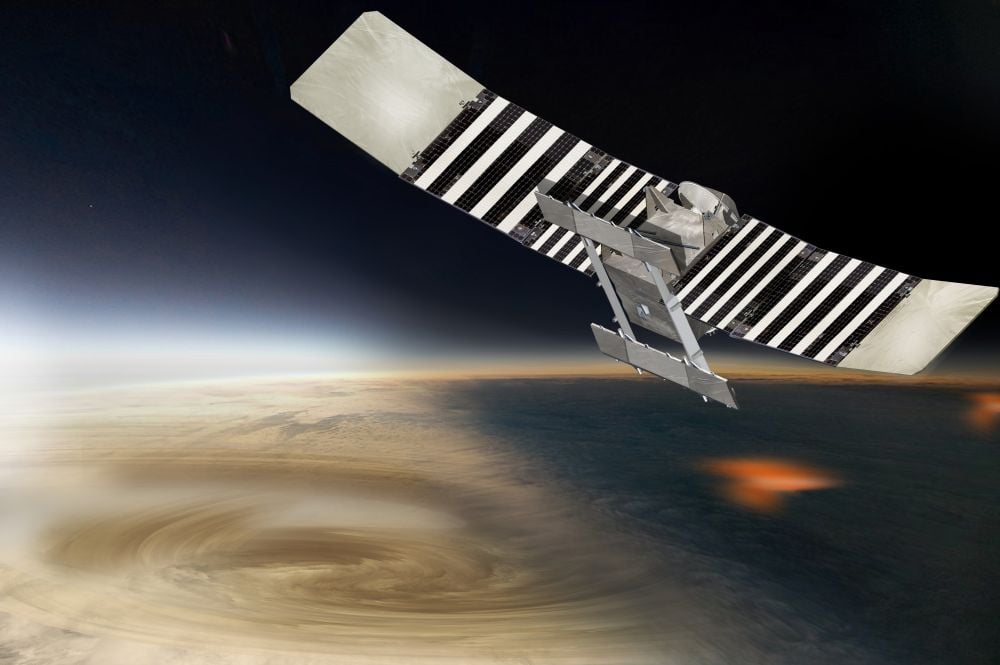 An artist's illustration of NASA's VERITAS orbiter, at work above Venus. Image Credit: NASA
These results also extend to exoplanets. They show that exoplanets similar to Venus, in similar proximities to their stars, may succumb to inhabitability.
"The application of these results to Venus Zone exoplanets suggests that slowly rotating terrestrial planets in the inner regions of planetary systems are unlikely to retain large satellites, with important implications for their obliquity stability and long-term habitability," the authors conclude.

