 Universe Today
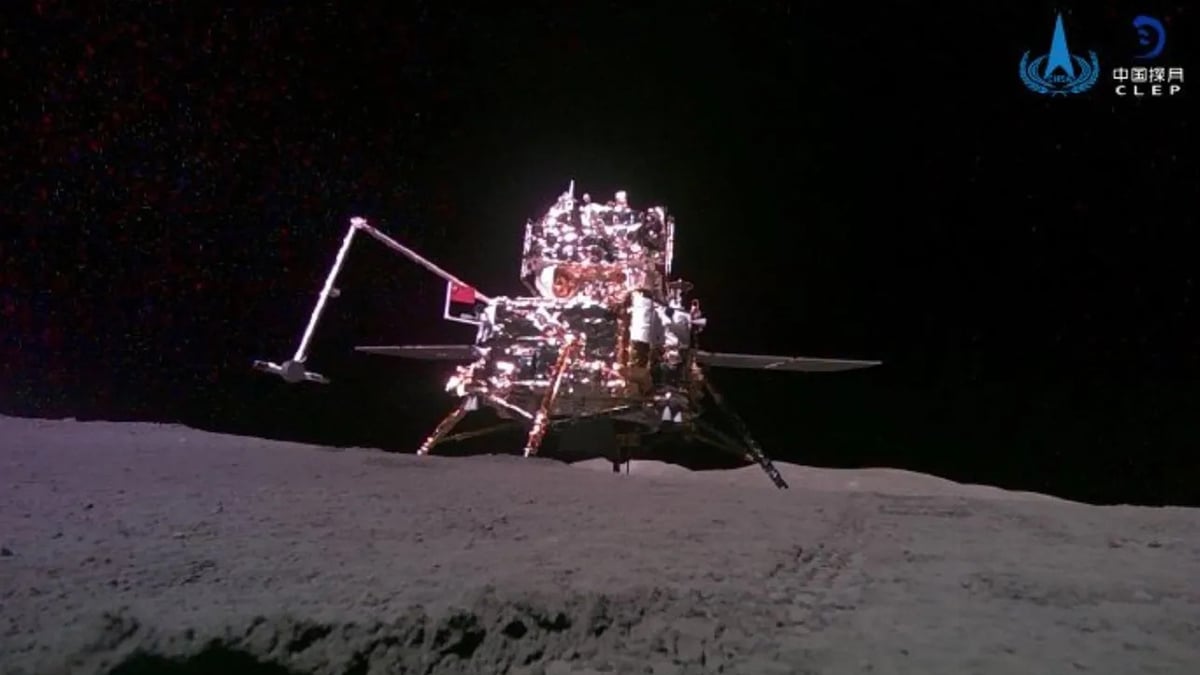
Lunar dust can be a pain - but it’s also literally the ground we will have to traverse if we are ever to have a permanent human settlement on the Moon. In that specific use case, it’s clingy, jagged, staticky properties can actually be an advantage, according to a new paper, recently published in Research from researchers at Beihang University, who analyzed the mechanical properties of samples returned by Chang’e 6 mission to the far side of the Moon.
Chang’e 6 is the first mission ever to return samples from the far side of the Moon. It collected some from the South Pole-Aitken (SPA) basin - the solar system’s largest, deepest, and oldest known impact crater, which formed around 4.2 billion years ago. That formation caused major changes in the geotechnical properties of its soil, compared to those of the near side that had previously been collected by NASA astronauts and Chinese landers.
But testing those properties on Earth is hard. Simulants can’t really do the real thing justice, and there simply isn’t enough true lunar regolith on Earth to give unlimited samples to every interested researcher. Performing some of the testing also destroys the sample, which makes them unusable for other research later on, so the authors came up with an alternative - do non-destructive testing, and then run a simulation.
Fraser discusses how big of a problem dust is.They settled on the Discrete Element Method (DEM) for the model. This mathematical approach simulates the behavior of bulk materials by calculating the physical interactions, friction, and collisions of millions of individual particles. As an input, it takes the particle's shape and some of its physical properties, and as an output can produce a “digital twin” of the soil future rovers, or astronauts, must traverse, without ever touching another sample.
Getting there required the authors to touch a few samples first, though. They did so by using high-resolution x-ray micro-computer tomography (micro-CT) to scale part of the sample returned by Chang’e 6. This non-destructive imaging technique, which also utilizes another technique called a convolutional neural network, allowed the researcher to individually reconstruct almost 350 thousand individual particles for analysis.
Analyzing that dataset showed some distinct differences between the far side sample and those taken from the near side. Most notably, the far side sample has fewer large, coarse particles than near-side samples, but also that those particles have low “sphericity”, which measures how close to a true sphere a particle is.
Battling dust with an electric field is one of the ways of combating it, as Fraser explains.After plugging this dataset into their DEM program, the authors found the regolith is exceptionally strong, sitting at the upper bounds of measurements from Apollo-era samples. This is primarily driven by a high internal friction angle and dust cohesion. Most likely the jaggedness of the particles, which makes them so frustrating when on machines or in human lungs, is actually helpful in the context of increasing their mechanical properties on the ground. In addition, the samples’ mechanical strength was boosted by “cementation” caused by glassy agglutinates, most likely caused by a micrometeoroid impact. These make up roughly 30% of the sample, acting as a cement to hold the rest of the particles together.
To build large infrastructure, such as a future Artemis habitat, or the International Lunar Research Station, understanding the underpinnings of the ground is key. This first-of-its kind geotechnical survey of the far side shows how varied samples can be. And while it might be a while before we truly build anything on the far side (due to communications issues), it’s still good to know that, when we do, we’ll have some solid ground waiting for us. Even if that same solid ground could eventually break down our machines and kill us if exposed to it for too long.
Learn More:
Research / EurekaAlert - Building on the far side: AI analysis suggests sturdier foundation for future lunar bases
H. Wang et al - Particle Morphology Controls the Bulk Mechanical Behavior of Far-Side Lunar Regolith from Chang’e-6 Samples and Deep Learning
UT - The Sticky Problem of Lunar Dust Gets a Mathematical Solution
UT - Flexible Force Fields Can Protect Our Return to the Moon

