 Universe Today
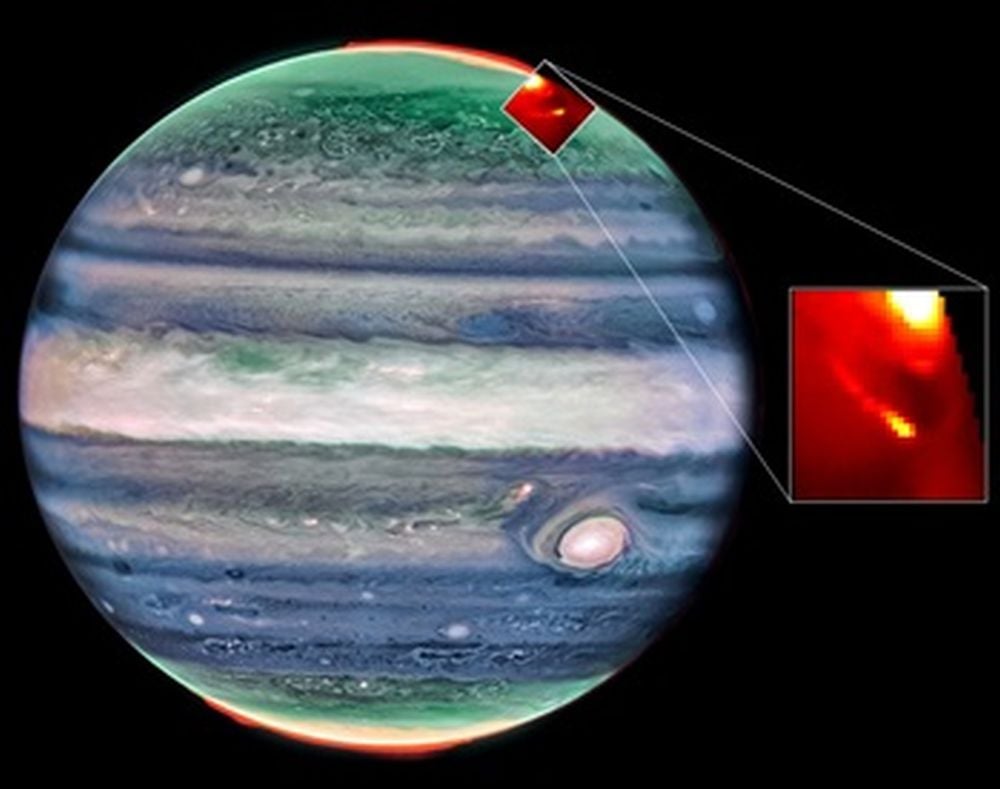
On Earth, aurorae are fleeting displays. They occur when charged particles from the Sun strike Earth's magnetosphere. Most of these particles are deflected away, but some particles become trapped and are directed toward the poles by magnetic field lines. They find their way into the upper atmosphere where they collide with atoms and molecules. This creates the energetic display in the sky, and the stronger the flow of charged particles from the Sun, the further the aurorae extend into middle latitudes.
But on enormous Jupiter, aurorae are different. The gas giant has the strongest magnetic field of all the planets. If Earth's northern lights are a capricious, dance-like phenomenon, then Jupiter's are more like a permanent and violent electrical storm. Jupiter's aurorae are also different from Earth's because they're shaped by interactions with its Galilean moons, a critical difference between the two.
Rather than being driven by the Sun, Jupiter's aurorae are largely driven by its volcanic moon Io. Jupiter's northern lights also have features that Earth's lack. The magnetic field lines connecting the planet to its moons create bright spots on the aurora where the lines connect.
New research in Geophysical Research Letters presents the first spectral measurements of these infrared auroral bright spots. It's titled "Short-Term Variability of Jupiter's Satellite Footprints as Spotted by JWST," and the lead author is Katie Knowles. Knowles is a post-grad researcher in the School of Engineering, Physics & Mathematics, at Northumbria University in the UK.
If you want to know more about aurorae in general, it makes sense to observe Jupiter.
"Jupiter's aurorae are the most powerful and continuously observable of any aurorae in the Solar System, and are a manifestation of the coupling between the atmosphere and surrounding space environment," the authors write. The planet's powerful magnetic field, rapid rotation, and dense plasma environment make it the perfect place to understand aurorae better. The dense plasma environment is largely because of atmospheric escape from volcanic Io, which forms a permanent torus of plasma inside Jupiter's magnetosphere. It ejects about 1,000 kg into space every second, creating a ring around Jupiter known as the Io plasma torus.
"A striking feature of the Jovian aurorae are the emissions associated with the Galilean satellites," the researchers explain. Both Jupiter and its magnetic field rotate faster than the Galilean moons orbit. That means that the four moons are continuously interacting with the plasma in the magnetic field. That generates the bright spots.
The bright spots on Jupiter's aurora are called Alfvén wing (MAW) spots. They're named after Swedish Nobel Prize in Physics winner Hannes Alfvén, who did important work in plasma physics.
"We present the main Alfvén wing (MAW) spots of Io and Europa as observed by the Near-Infrared Spectrograph onboard the James Webb Space Telescope," the authors write. "These auroral footprint features have been measured previously, but only in emission."
The JWST observations uncovered something surprising. Jupiter's aurora is full of hot plasma, but the JWST's infrared observations found a cold spot in Io's auroral footprint. The temperature was much lower than expected, and the density was extraordinarily high. This work is based on five separate 'snapshots' with the JWST's NIRSpec, and the cold spot and the high density were only present in one snapshot.
What's going on?
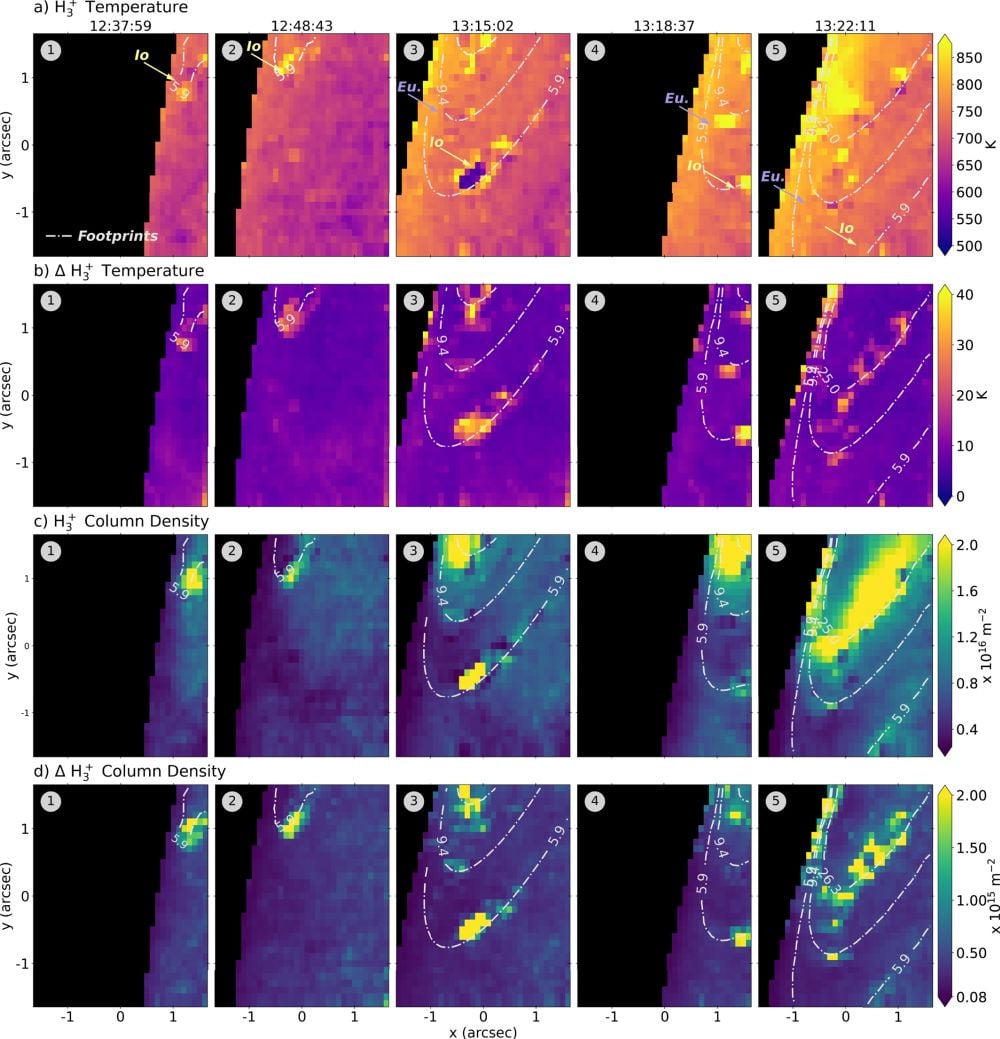 This figure shows the JWST NIRSpec observations of Jupiter's aurora. The dotted/dashed lines show the footprints from Europa and Io. "Figure 2a shows a spatially confined cold structure, unique to (3) and localized to the core of Io's MAW spot," the authors explain. 2c3 and 2d3 both show the extreme density in the footprint. Image Credit: Knowles et al. 2026. GRL.
“We found extreme variability in both temperature and density within Io's auroral footprint on the timescale of minutes,” lead author Knowles said in a press release. “This tells us that the flow of high-energy electrons crashing into Jupiter's atmosphere is changing incredibly rapidly."
“The cold spot registered temperatures of just 538 Kelvin, or 265°C, compared to 766 Kelvin, or 493°C in the rest of Jupiter’s aurora," Knowles added. "The cold spot also contained material three times denser than Jupiter's main aurora, with the highest densities we have ever recorded.”
The researchers think that these changes are likely caused by the flow of electrons—called electron precipitation—coming from Io and striking Jupiter's upper atmosphere. These changes would have to be extreme, though, and Knowles and her co-authors aren't sure what's behind that. The best they can do is attribute it to "temporal variations in the electron precipitation due to either local changes in the acceleration process or in the moon-magnetosphere interaction."
Europa's footprint was observed as well, and the researchers noted similar phenomena in it, but they're not as convinced that it's part of the same phenomena. "There are suggestions of a similar, less extreme population associated with the Europa footprint," the researchers write.
The variability of the changes is especially puzzling. Nothing can be expected to be totally static, but the magnitude of the changes is striking. “We only saw this phenomenon in one of our five snapshots, which leave us with questions," Knowles said. "How often does this occur? Do our current observations represent the “typical” variability? How does it change with space, time, and under different conditions?”
Only more observations can lead to an explanation. NASA's Europa Clipper and the ESA's Juice are both on their way to the Jovian system. Their observations will help us understand the system in all its complexity. But they're many years away from reaching their destination.
Fortunately, an explanation for this pronounced variability may not have to wait that long. Knowles has already performed 32 hours of additional observations of the Jovian aurorae with NASA's Infrared Telescope Facility in Hawaii, and is still analyzing the data. That should tell us if the extreme variability revealed by the JWST is common or rare.
“This work opens up entirely new ways of studying not just Jupiter and its other Galilean moons, but potentially other giant planets and their moon systems,” said Knowles. “We're seeing Jupiter respond to its moons in real-time, which gives us insights into processes that occur throughout our solar system and perhaps further afar."
NASA's Juno spacecraft is currently studying Jupiter and its moons, and this work could help us understand its observations, as well as future observations by Europa Clipper and Juice.
"This analysis, as well as future endeavors, can supply context to in situ measurements acquired by Juno as it traversed within the moons' orbits during its prime and extended missions, as well as for Juice and Europa Clipper," the researchers conclude.

