 Universe Today
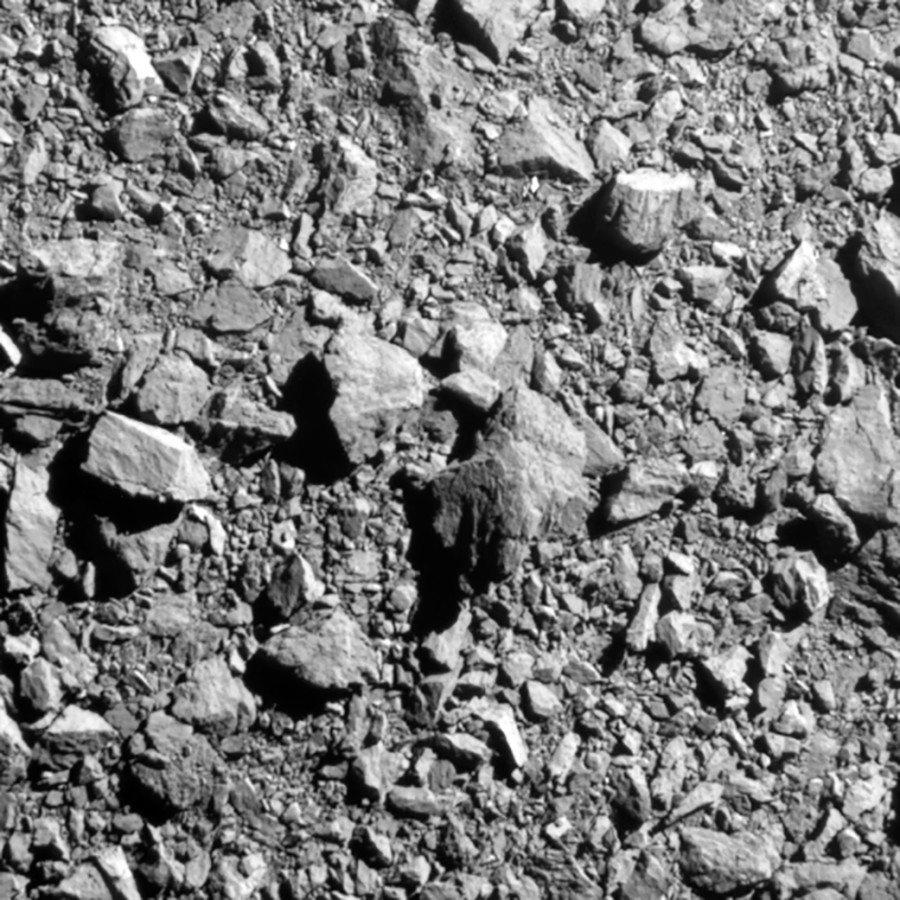
Scientists occasionally have a hard time figuring out whether data they are seeing is an actual physical phenomenon or just a trick of their instrumentation. A new paper in The Planetary Science Journal from Jessica Sunshine and their colleagues at the University of Maryland describes one such confusing scenario. In this case, the researchers noted some fan-like patterns across the surface of Dimorphos, the asteroid hit by NASA’s DART mission, and thought it might be a trick of their camera. But after some image correction, computation, and physical experimentation, they determined the patterns were caused by the first-ever documented cases of material transfer between two asteroids.
Dimorphos is part of an asteroid binary with its larger sibling Didymos. The two asteroids are only about 1.2 kilometers apart from each other, and scientists have long thought that smaller asteroids would end up shedding material from their equator due to a process called the Yarkovsky-O’Keefe-Radzievskii-Paddack, or YORP, effect. Sunlight will heat up one side of a small celestial body, such as an asteroid, and the resulting infrared radiation acts as a tiny thruster, causing the body to spin. Over the accumulation of millions of years, eventually these spins grow to a point where the asteroid starts losing chunks of its own material.
The researchers didn’t originally set out to prove that theory. They simply noticed there appeared to be a pattern on Dimorphos’ surface and wanted to figure out what it was. Originally they thought it was an artifact of the camera used to collect images of the asteroid’s surface. But once they mathematically stripped away some of the shadows cast by boulders on the asteroid’s surface, the features were still there, converging near the equator on the side of Dimorphos facing away from Didymos.
Impact of the DART mission on Dimorphos. Credit - Johns Hopkins Applied Physics LaboratoryOnce the existence of those fan-like rays was confirmed, the researchers started offering explanations as to what caused them. Seismic vibrations seemed unlikely as they wouldn’t have the distinct “fan” pattern. Electrostatic lifting also didn’t seem plausible, as it was unclear what, if anything, about the “starting” point of the pattern was unique electrostatically. So they decided the most reasonable explanation is that Dimorphos was being hit by “snowballs” from its larger sibling.
Given that there weren’t any impact craters from these snowballs, they must have been moving very slowly. To calculate that speed, the authors ran some orbital calculations and realized that material launched off Didymos’ equator at just 30.7 cm/s (slower than human walking speed) would strike the far side of Dimorphos at a sluggish 6 cm/s. That speed would be enough to break apart the “snowballs” as the authors called them in a press release. But to be clear, the material appears to be made of loose fine silicate powder, as both Didymos and Dimorphos are S-type asteroids and don’t have much “snow” to speak of.
While calculations are nice, simulations are better, and the authors decided their claims required both a physical and computational simulation to prove their theory that the fan-shape streaks were caused by active material transfer. First, they turned to supercomputers hosted at Lawrence Livermore National Laboratory. They modeled a 1-meter clod of small particles impacting the surface of Dimorphos, complete with strewn boulders, and used a combination of physics and orbital mechanics code to watch the result. It looked almost exactly like the fan-shaped pattern they saw on the surface, as the boulders blocked the spread of particles directly behind them, but the particles fanned out as they moved past the boulder.
Fraser talks about the aftermath of the DART missionPhysical simulation was up next, with the authors building a sand pit, complete with painted gravel to act as “boulders”. They then dropped a marble into the pit, and, with the help of some high-speed cameras and some math, watched as the sand formed the rays seen in both the computer simulations and directly on the asteroid’s surface. Combining all three pieces of evidence seems to definitively prove active material transfer between two asteroids has officially been observed for the first time.
There’s an opportunity for another test, though, as another mission will be reaching the Didymos / Dimorphos system soon. Hera, which will arrive in December, hopes to track the impact (literally) of the DART mission, which was designed to change Dimorphos’ orbit. From preliminary data, we know it not only successfully did that, but also changed the shape of Dimorphos itself, and with it the overall orbital period of the whole binary system. But it’s unclear whether the same fan-like rays will be visible to Hera’s cameras, or whether there’s been an increase or decrease in material transfer since the impact. Either way, in about a year we should start seeing additional information coming from this particularly interesting binary asteroid system.
Learn More:
UMD - New NASA DART Mission Data Reveals that Asteroids Throw ‘Cosmic Snowballs’ at Each Other
J. M. Sunshine et al. - Evidence of Recent Material Transport within a Binary Asteroid System
UT - Many Asteroid Rotations Are Chaotic. A New Model Helps Explain Them.

