 Universe Today
Finding an Earth-like world beyond the solar system is the Holy Grail of exoplanet research, and the field has experienced incredible technological advancements in searching for and identifying exoplanets since the first exoplanet was discovered in 1995. This includes both ground- and space-based telescopes, specifically the powerful James Webb Space Telescope. However, directly imaging exoplanets remains elusive, primarily due to the enormous technological challenge of imaging a point of light so far away.
But a proposed mission called the Habitable Worlds Observatory (HWO) could advance progress towards not only observing but directly imaging Earth-like exoplanets. While HWO has been in the works for about 10 years now, it’s still not slated to launch until sometime in the 2040s. In the meantime, researchers are developing new engineering concepts for this highly anticipated telescope. These concepts were discussed in a June 2026 study published in the Journal of Astronomical Telescopes, Instruments, and Systems and hold the potential to continue HWO’s development well in advance of its launch.
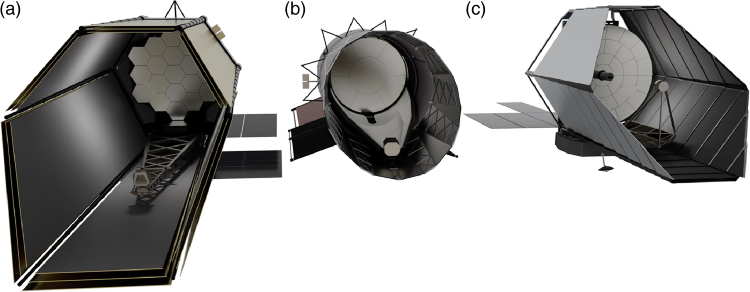
For the study, the researchers introduced engineering concepts called Exploratory Analytic Cases (EACs) designed to balance the science goal demands with the engineering needs. The purpose of this study was to discuss the first three of five EACs regarding HWO’s architecture design focusing on telescope type, size, and whether they need to have an on- or off-axis design.
The telescope size includes the mirror diameter in meters, and the type of telescope includes the mirror and aperture design, with the study focusing on inscribed, circumscribed, round, and outer diameter. For example, inscribed includes the inner baseline measurement while circumscribed includes the measured outer region that holds a set of mirrors. A round mirror is how it sounds, while a outer diameter mirror denotes the maximum edge-to-edge measurement. The difference between on-axis and off-axis design is the former has all of the components within the field of view of incoming light, obstructing a portion of the view, while the latter has all of its components outside the field of view, resulting in an unobstructed view.
For the EACs, the researchers designed EAC1 as having a 6-m inscribed / 7.2-m circumscribed, off-axis design; EAC2 with a 6-m round, off-axis design; and EAC3 having an 8-m outer diameter, on-axis design. In the end, the researchers favored the off-axis design to allow greater light-gathering operations, along with focusing on a larger aperture size to enable greater light-collecting area, too. Another design the researchers recommended was the temperature properties, which influence light-collecting and overall telescope operations. This is especially prevalent with the coronagraph instrument (CI), which blocks out the star’s glare, enabling the direct imaging of orbiting exoplanets.
The study notes, “The SET [Systems Engineering Team], comprised of team members across NASA centers and JPL, successfully completed design architectures for EACs 1 to 3 and developed end-to-end modeling for EAC1. This team was established to support design explorations and formulating technology requirements. Using model-driven practices based on JWST heritage and enhanced by Roman experience, the team developed several tools to perform parametric design studies and trades. In parallel, the models were shared with industry partners to support their technology maturation efforts and independent architecture studies.”
As noted, HWO isn’t slated to launch until the 2040s, but its science goals remain unchanged as it is also slated to replace the James Webb Space Telescope as the preliminary space telescope. The primary goal of HWO will be to directly image Earth-like exoplanets, and the designs and objectives outlined today will undoubtedly influence these science goals and the telescope operations in determining whether Earth is the only habitable planet and whether we’re alone in the universe.
What new concepts will scientists conjure up before HWO’s launch in the 2040s? Only time will tell, and this is why we science!
As always, keep doing science & keep looking up!