 Universe Today
![This artist's illustration shows what the early Earth may have looked like. New research shows how the important prebiotic chemical hydrogen cyanide (HCN) could have appeared. HCN is an important precursor to amino acids and nucleic acids, and without it, life may have never arisen. Image Credit: By Tim Bertelink (Own work) [CC BY-SA 4.0], via Wikimedia Commons](/article_images/Hadean-1200x645_20260602_171321.jpg)
In early Earth's chemical soup, toxic hydrogen cyanide (HCN) was the unlikely hero ingredient. Though a killer to all but a few lifeforms, HCN is at the base of a host of prebiotic chemical reactions. Without it, life may never arisen on our planet.
Though it's just a simple molecule with three atoms, its importance in chemistry can't be overstated. Chemists debate whether it's defined as organic or not, but its role in creating the building blocks of life is undisputed. It's a precursor to both amino acids and nucleic acids.
Questions about HCN and its role in the appearance of life focus on where it came from and how it behaved on primitive Earth. New research in the Proceedings of the National Academy of Sciences claims to have solved a stubborn puzzle regarding HCN and its origin. It's titled "Mineral-facilitated aqueous synthesis of hydrogen cyanide from prebiotically abundant amino acids for chemical evolution," and the first author is Zening Yang from the Earth-Life Science Institute in the Institute of Future Science, Institute of Science Tokyo.
One of the longstanding models of the appearance of life concerns HCN and how it appeared. Early Earth had a reducing atmosphere, and along with the presence of methane, provided the conditions for the formation of HCN. But recent research has potentially upended this, showing that the atmosphere likely lacked abundant methane, cutting off the formation channel for HCN and all that followed it.
"Origin of life strongly relies on reactive carbon and nitrogen precursors, among which hydrogen cyanide (HCN) is one of the most versatile molecules that can be used for synthesizing almost all essential biomolecules," they write. However, recent geochemical studies have raised concern about the availability of HCN, as the highly reducing methane-rich atmosphere, which is required for HCN synthesis, has been considered to be uncertain."
But in this research, the authors found a way that HCN could've appeared without methane: with help from amino acids themselves.
HCN is a precursor to some amino acids, but other amino acids have been widely detected in space. They've been found in gas clouds and on asteroids and comets. These amino acids could've been abundant on early Earth and critical in HCN's formation even though methane was lacking.
"Different from methane, amino acids can be synthesized via diverse chemical pathways and supplied by extraterrestrial delivery; thus, amino acids are likely prebiotically abundant," the authors explain. They're reporting a new aqueous pathway for HCN creation from amino acids that's promoted by a mineral: manganese dioxide (MnO2) .
They started by theorizing that minerals present on the early Earth could've played a role in transforming HCN into amino acids in the presence of water, despite the lack of atmospheric methane at the time. They then lab-tested 38 naturally-occurring minerals to determine if they could convert glycine into HCN in oxygen-free conditions. They chose glycine for several reasons. "Glycine was selected because it was the simplest and most abundant amino acid on the early Earth and can be generated by methane-independent pathways, including electrical discharge, UV irradiation, and hydrothermal reactions," the researchers explain. Glycine has also been detected in a meteorite here on Earth, in the sample from the comet Wild 2, and on Comet 67P/Churyumov–Gerasimenko by the ESA's Rosetta spacecraft, and those detections bolster its suitability in these experiments.
The minerals they tested included silicates like olivine and serpentine, along with oxides, sulfides and elemental metals. Of the 38, three of the minerals—manganese dioxide (MnO2), cuprous oxide, and copper hydroxide—produced meaningful amounts of HCN. But MnO2 produced concentrations of HCN two orders of magnitude higher than the others.
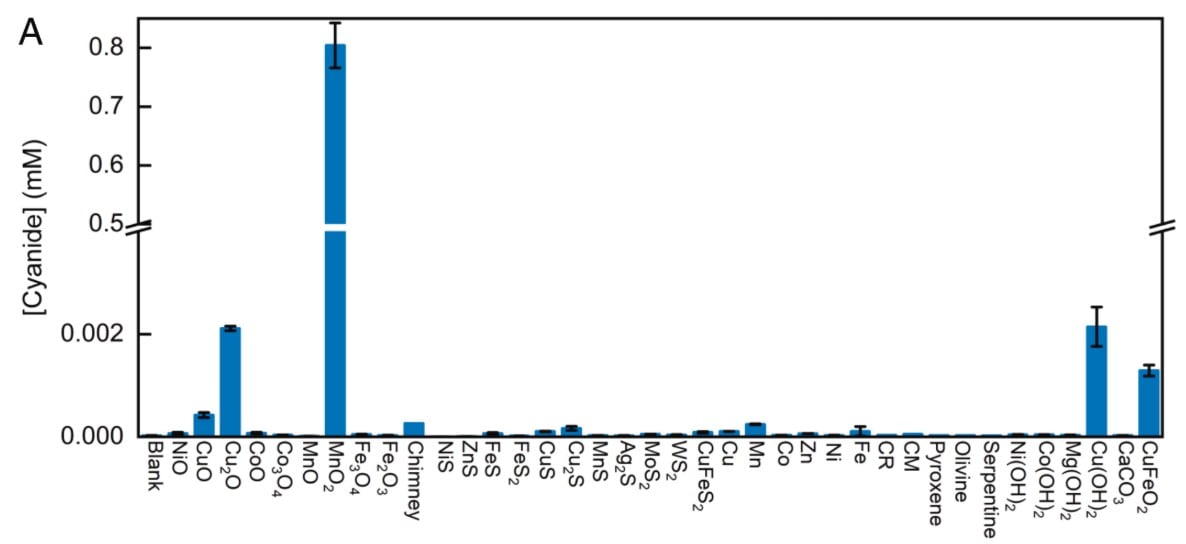 This figure shows the 38 minerals tested and the amount of HCN they each produced. Only three of them produced meaningful amounts of the chemical (greater than 0.002mM) with HCN producing far more than the others. Image Credit: Yang et al. 2026. PNAS. https://doi.org/10.1073/pnas.2515805123
Importantly, the HCN production wasn't confined to one specific set of conditions. "The MnO2-promoted cyanide production reaction proceeded under a broad range of geologically plausible conditions from alkaline to acidic (pH 2.0 to 12.6) and also exhibited a wide temperature tolerance (6 to 60 °C)," the authors write.
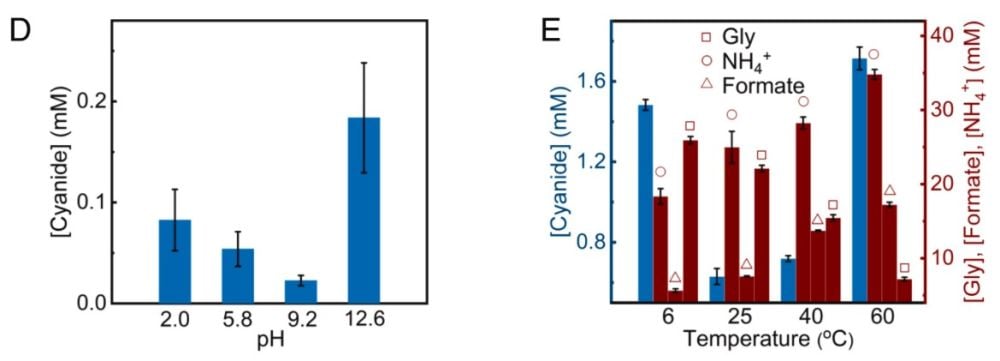 These two panels show how MnO2-facilitated HCN was produced across a range of pH and temperatures. Image Credit: Yang et al. 2026. PNAS. https://doi.org/10.1073/pnas.2515805123
Of course, this relies on the presence of MnO2 on the early Earth. "Manganese (Mn) is the third most abundant transition metal in the Earth’s crust after iron and titanium and is thought to have been prevalent on the early Earth," the authors explain. Since UV irradiation was ubiquitous on the surface of the early Earth, and could easily penetrate shallow water, the researchers say that MnO2 could have formed via photochemistry in shallow freshwater and alkaline carbonate lakes. "Through these processes, the reduced MnO2 pool by glycine could be rejuvenated to sustain HCN formation on Hadean Earth’s surface," the researchers explain.
“Together, our results demonstrate that HCN could have been continuously supplied on early Earth without invoking methane-rich air, instead arising from abundant amino acids produced by methane-independent prebiotic pathways or delivered by meteorites,” explained co-author Professor Ryuhei Nakamura in a press release. Nakamura, who is from the Earth-Life Science Institute at the Institute of Science Tokyo, leads the research team responsible for this work.
Co-author Yamei Li, also from the Earth-Life Science Institute, pointed out how modern biology also produces HCN in a similar pathway, strengthening their results. "Because modern biological systems also generate HCN from amino acids through similar intermediates, the newly identified reaction provides a striking chemical parallel between prebiotic processes and contemporary life-evolution pathways, offering a fresh perspective on chemical evolution," Li said.
We may never know exactly how or when life first appeared on Earth. If we ever do reach that understanding, it'll be because of incremental work like this. Chemistry is like a connecting bridge, with biology one one side and geology on the other. Scientists will never be able to travel back in time and sequence the first DNA, and there are no fossils from the very early days of Earth's laboratory.
In chemistry, there are no mutations, and chemical bonds behave the same way over billions of years. It was chemistry that generated life on Earth, and work like this is how we can understand it.

