 Universe Today
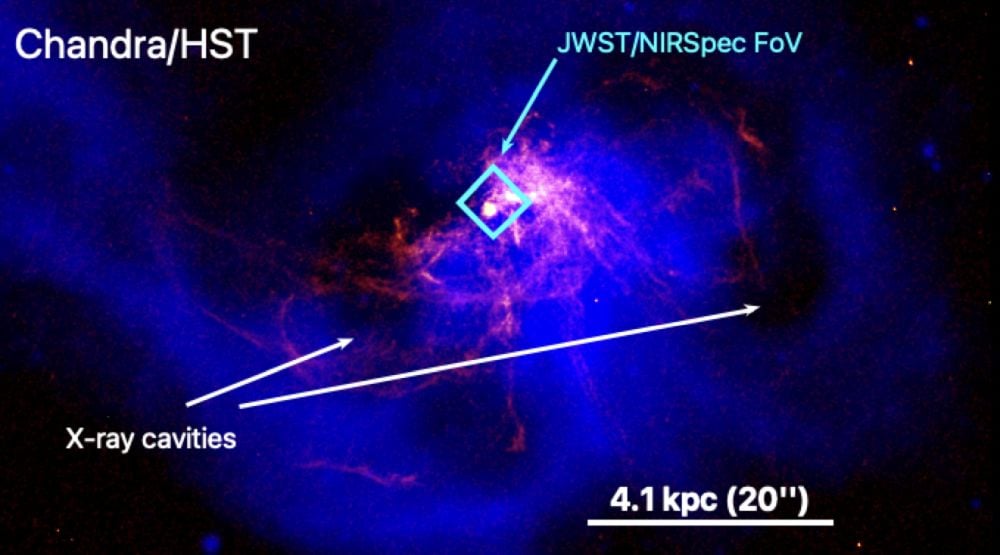
How supermassive black holes (SMBH) in the center of galaxies accrete material, how they feedback into the surrounding region, and how they regulate these to influence the evolution of their galaxies are all hot topics in astronomical/astrophysical research. Astronomers are nearly certain that all large galaxies like the Milky Way have a SMBH, and detailed observations of them are where answers will be found. But only some galaxies are readily observed in detail, even by the powerful JWST.
One of them is in the Centaurus cluster.
The Centaurus cluster is about 170 million light-years away and contains hundreds of galaxies. It's central and most luminous galaxy, NGC 4696, is embedded in a network of gaseous filaments. Since the cluster is so close in astronomical terms, the Hubble has imaged this region and found an S-shaped swirl of ionized gas within the sphere of influence of the galaxy's black hole.
In new research, astronomers used the JWST to observe this swirl and learn more about it. The researchers say it could be the missing link between SMBH phenomena on two different scales: cooling flows and black hole accretion.
The research is "JWST reveals how black holes are fed: kiloparsec-scale multiphase filaments feed sub-kiloparsec circumnuclear disks," and it's been submitted to The Astrophysical Journal. It's currently availalbe at arxiv.org. The lead author is Julie Hlavacek-Larrondo from the Physics Department at the University of Montreal, Quebec, Canada.
"The Centaurus cluster is one of the most important archetypes of radio-mode AGN feedback, with its central galaxy, NGC 4696, launching powerful jets that inflate X-ray cavities and regulate cooling and star formation," the authors write. Centaurus is "one of the few systems where gas flows can be spatially resolved down to scales comparable to the black hole’s sphere of influence," the authors explain. This is critical, because it lets researchers test different accretion models, and at the same time, they get a very detailed view of the gas in the center. This sets Centaurus apart from more distant clusters like Perseus.
The swirl of ionized gas near NGC 4606 was detected by the Hubble in Hα imaging, a very important and a very widely-used emission line in astronomy that traces ionization.
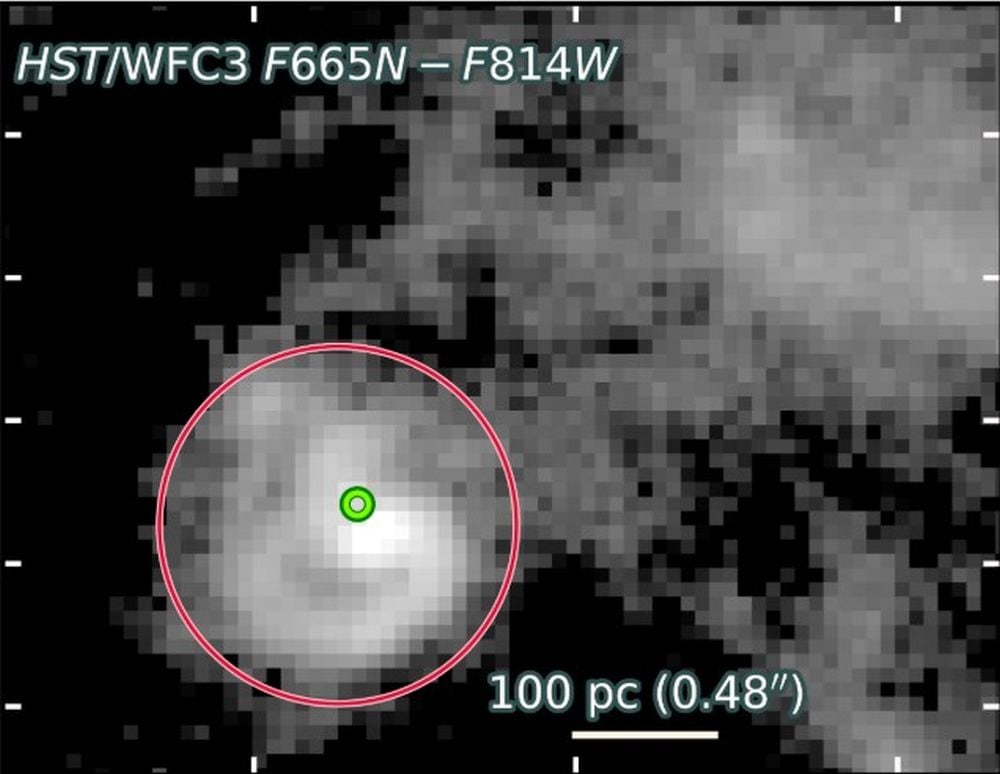 This Hubble image shows the S-shaped swirl in the central region of NGC 4696. The SMBH/AGN is the green circle, and the red circle is the circumnuclear disk (CND). Image Credit: Hlavacek-Larrondo et al. 2026.
Now, as has become its operational habit, the JWST is examining the same region with it's more powerful infrared capabilities. Astronomers used the telescope's NIRSpec instrument to examine the region's inner 618 pc × 618 pc at 10 pc resolution.
Those detailed views of Centaurus places its central galaxy in its important context. "NGC 4696 lies within a spectacular multiphase nebula of filaments extending over tens of kiloparsecs and spanning six decades in temperature, from hot (10^8 K) X-ray-emitting plasma to cold molecular gas."
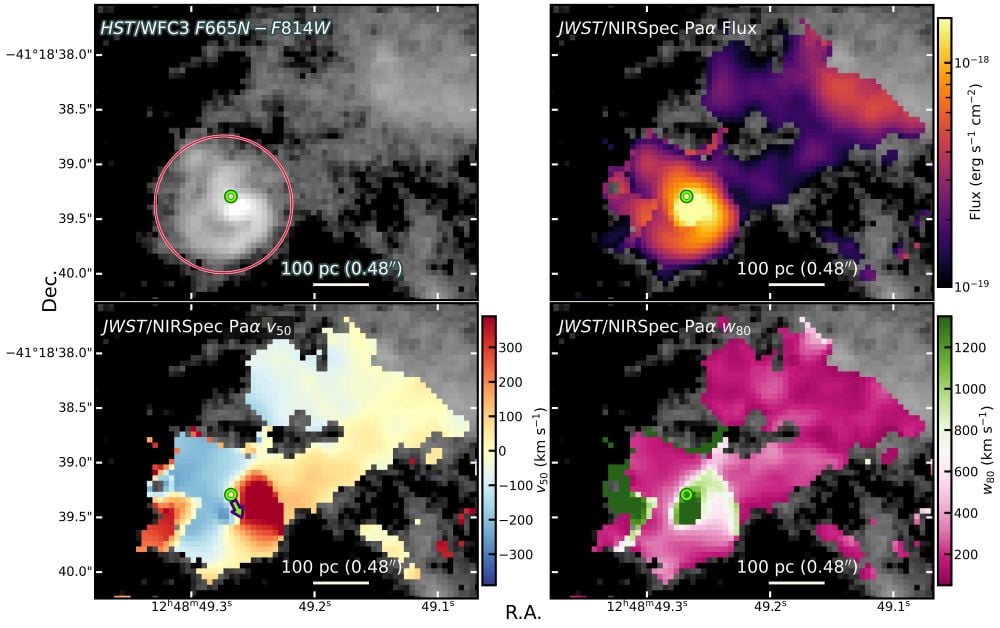 These four panels show NGC 4696 and the surrounding gaseous filaments. The upper left is the Hubble image, showing the swirl in black and white. The other three images are from the JWST and show that the swirl is actually a rotating circumnuclear disk (CND) receiving gas from a network of filaments. These images show Paα, which does a better job of showing kinematics than Hα. Though it looks blotchy in these NIRSpec images, the network of gaseous filaments is clearly visible to the right of NGC 4696 and its CND. Image Credit: Hlavacek-Larrondo et al. 2026.
The key finding is this: "These data reveal that the ionized swirl is a rotating, multiphase circumnuclear disk (CND) physically and kinematically connected to the larger-scale filamentary network," the authors write. This connection is the missing link in SMBH growth, according to the authors.
The results also touch on another problem in our understanding of galaxy clusters, sometimes called the cooling flow problem. Galaxy clusters like Centaurus contain vast amounts of heated gas in the intracluster medium (ICM). This gas should be able to cool down and flow inward, and in the process trigger prodigious star formation. Astrophysicists have observed isotropic heating in this gas, meaning the heating is uniform in all directions. But if black hole jets are doing the heating, the heating should be more oriented toward jet flow, not isotropic.
This research shows that the network of filaments can shift over time, and that can re-orient the CND. That in turn can change the direction of the jets emitted by the accreting SMBH. The authors say this could explain the isotropic heating in the CND. "This filament-driven wobbling of the CND offers a plausible physical mechanism for reorienting AGN jets and may help explain how jet feedback can heat cluster cores in a nearly isotropic manner," the authors explain.
Understanding how galaxies grow and evolve through SMBH growth and feedback is one of astrophysics' central challenges. This all happens across a vast scale, as this research shows. "By resolving sub-kpc gas dynamics in NGC 4696, we show that the ionized swirl seen with HST is a compact CND physically connected to larger-scale filaments," the authors write.
"This establishes the long-sought link between kpc-scale multiphase filaments and gas dynamics within ≲100 pc, where inflowing gas settles into a CND that feeds the SMBH."

