Universe Today
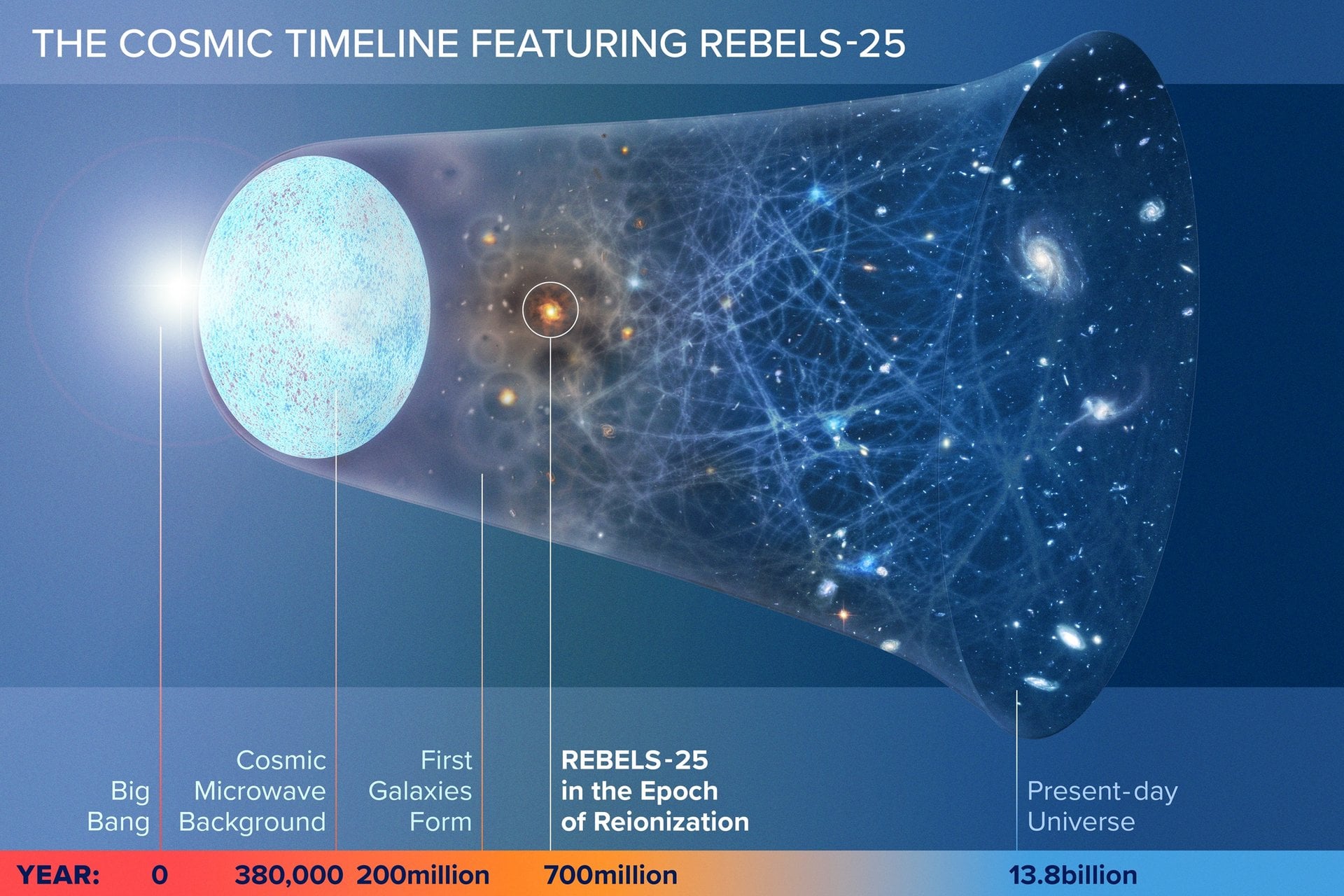
Using the data from the Very Large Array (VLA) radio telescope and the Atacama Large Millimeter/submillimeter Array (ALMA), a team of astronomers has peered into REBELS-25, a massive star-forming galaxy that existed just 700 million years after the Big Bang. This coincides with the period known as the "Epoch of Reionization," when the Universe transitioned from being dark and filled with neutral hydrogen (hence the nickname, "Cosmic Dark Ages") to being visible to modern-day instruments (transparent).
In the course of studying this galaxy, the team observed a huge reservoir of cold molecular gas, the stuff from which new stars are born. By studying galaxies like REBELS-25 and other galaxies that existed when the Universe was less than 1 billion years old (aka. high-redshift galaxies), astronomers are learning more about how the first stars and galaxies in our Universe formed. The team's findings also helped address a long-standing mystery about early star formation.
The research was led by PhD candidate Karin Cescon of Leiden University. She was joined by an international team of researchers from the Institute of Astronomy and Astrophysics at the Academia Sinica in Taipei, the Sterrenkundig Observatorium, the International Center for Radio Astronomy Research (ICRAR), the Canadian Institute for Theoretical Astrophysics, the Flatiron Institute Center for Computational Astrophysics, the Space Science Observatory of Astrophysics in Bologna, and many universities worldwide. The team's paper appeared on June 11th in the Monthly Notices of the Royal Astronomical Society.
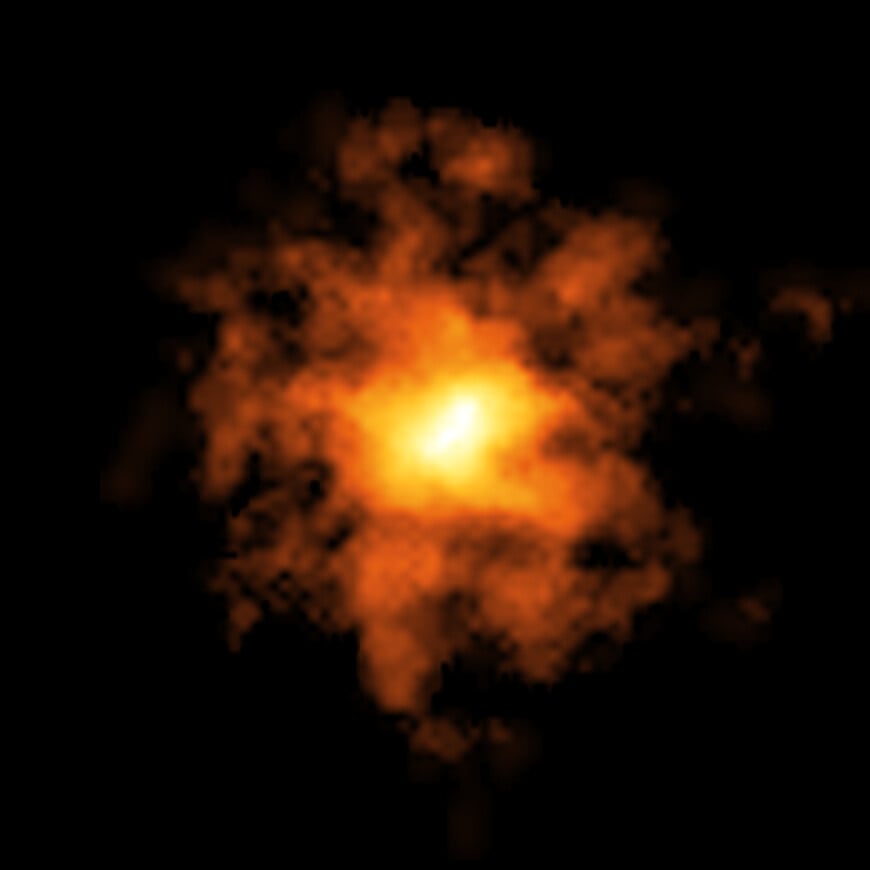 Image of the galaxy REBELS-25, taken by the Atacama Large Millimeter/submillimeter Array (ALMA). Credit: ALMA (ESO/NAOJ/NRAO)/L. Rowland et al.
Once the James Webb Space Telescope (JWST) observed galaxies that existed during the Epoch of Reionization, scientists immediately noticed that they were unusually large and bright. In addition, there were more galaxies than conventional models predicted, raising the question of how early galaxies grew so quickly. Until now, astronomers suspected that they had huge gas supplies to support rapid stellar formation, but no direct evidence for this theory yet existed.
To investigate this question, astronomers observed REBELS-25 for faint radio emissions caused by the absorption of light by carbon monoxide (CO) molecules. The specific frequencies emitted by various gases allow astronomers to trace molecular gas populations in distant galaxies. The VLA data revealed a low-energy CO signal indicative of cool gas, while ALMA observed high-energy CO emission, allowing the team to constrain the gas' density and temperature.
This was no easy task, given that observations of the early Universe are subject to interference from the Cosmic Microwave Background (CMB), the relic radiation of the Big Bang. While this radiation is present in all astronomical observations, it is particularly bright in high-redshift objects, reducing the contrast of cold gas emission. As Cescon said in an NRAO press release:
Our results show galaxies just 700 million years after the Big Bang already contained large reservoirs of cold gas available for star formation. With these deep NSF VLA observations, we were able to overcome the observational challenges posed by the CMB.
The brightness of the signal indicated that REBELS-25 already had a very large supply of star-forming material when the Universe was very young. The VLA data also constitute the most distant low-energy CO detection ever made. The large gas content observed in REBELS-25 indicates that some early galaxies were already prepared for intense star formation when the Universe was less than 1 billion years old, providing vital insight into how galaxies grew during the first billion years of cosmic history.
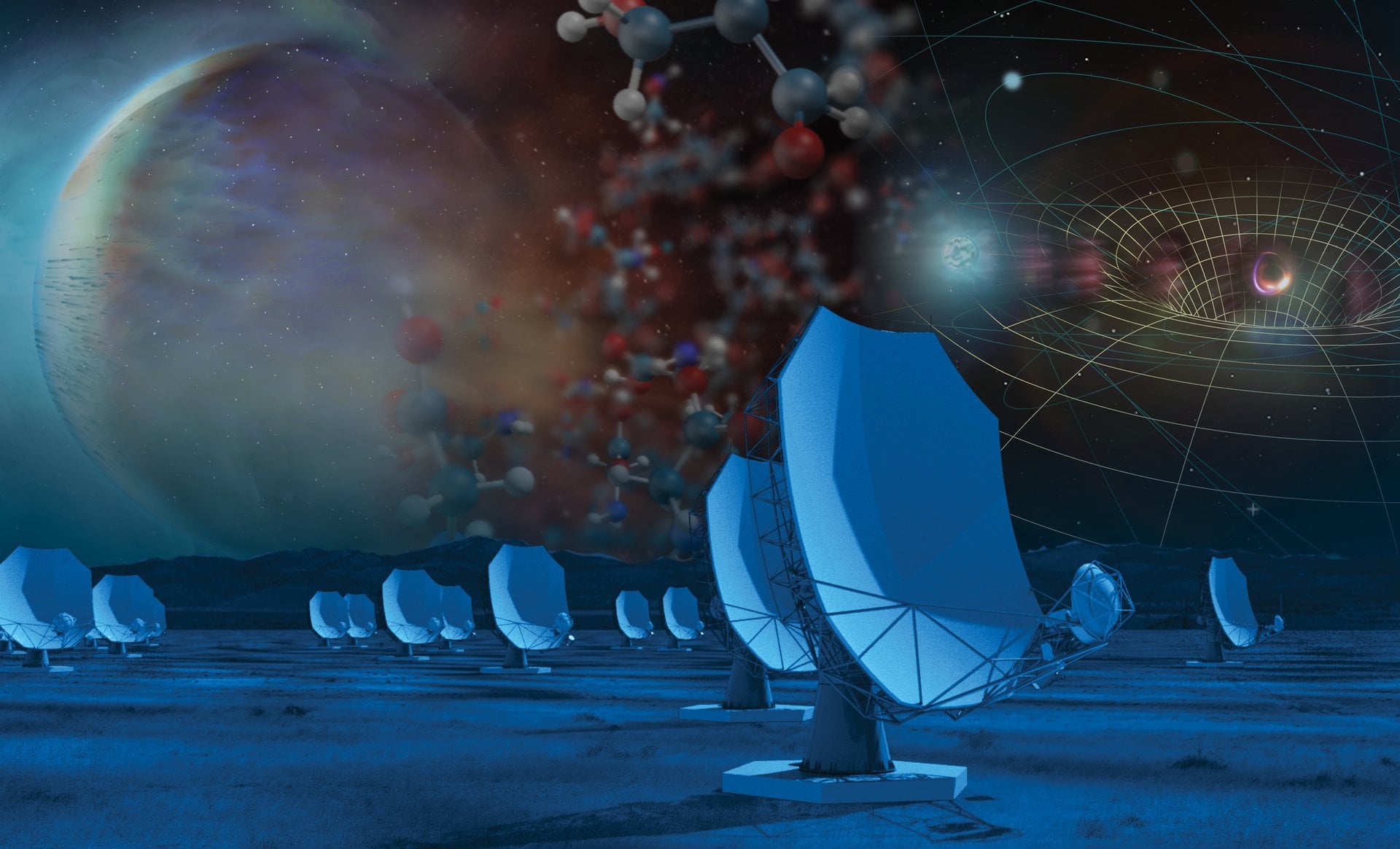 Artist's conception of the central portion of the Next Generation Very Large Array. Credit: Sophia Dagnello, NRAO/AUI/NSF
With this detection, astronomers can now directly measure the material driving this rapid growth, rather than having to infer it indirectly. This discovery also offers a preview of what will be possible when the Next-Generation Very Large Array (ngVLA) becomes operational. With its new arrays spanning northern Mexico, the southwestern United States, and across North America, the ngVLA will be able to conduct measurements about 10 times faster, enabling the detection of much larger samples of early galaxies rather than individual studies.
In addition, the ngVLA will study fainter and more distant systems during Cosmic Dawn (ca. 250 to 500 million years after the Big Bang). When paired with ALMA, it will also be able to map how early galaxies gathered cold gas and grew. "This NSF VLA detection is an exciting sneak peek of what’s to come with the ngVLA,” said Professor Jacqueline Hodge, Karin’s PhD advisor. "The ngVLA will allow us to find and study cool gas in many more young galaxies, including those at even earlier times. This will be crucial for understanding how the first galaxies formed and grew."