 Universe Today
Life on Earth took a long evolutionary journey that eventually created us, the purportedly intelligent species that dominates the planet. But there was no grand plan or design, only happenstance, nature, and luck. Life on Earth suffered multiple extinctions, but got up, dusted itself off, and continued on its long march to complexity.
The Chicxulub impact that wiped out the dinosaurs and set the stage for the ascension of mammals grabs plenty of headlines. But there may have been more subtle events that also led to extinctions. Gravitational tides generated by the flybys of planetary mass objects or dwarf planets may have played a role.
That's according to a new paper by Daniele Fargion, a research professor from Rome University and the Osservatorio Astronomico di Capodimonte in Naples. It's a conference proceedings paper titled "Mass Extinctions by Gravitational Tides" and it was presented at the 'Multi-frequency Behaviour of High Energy Cosmic Sources' conference in Palermo, June 2025. It's currently available at arxiv.org.
Fargion points out that there's ample evidence for a population of dwarf planet sized objects in the outer Solar System, of which Pluto may be the most well-known member. There could be thousands of tens of thousands of these objects on elliptical orbits. Gravitational perturbations could send some of these objects into the inner Solar System, where collisions like the one between Earth and Theia created the Moon. But far more likely than head-on collisions are flybys.
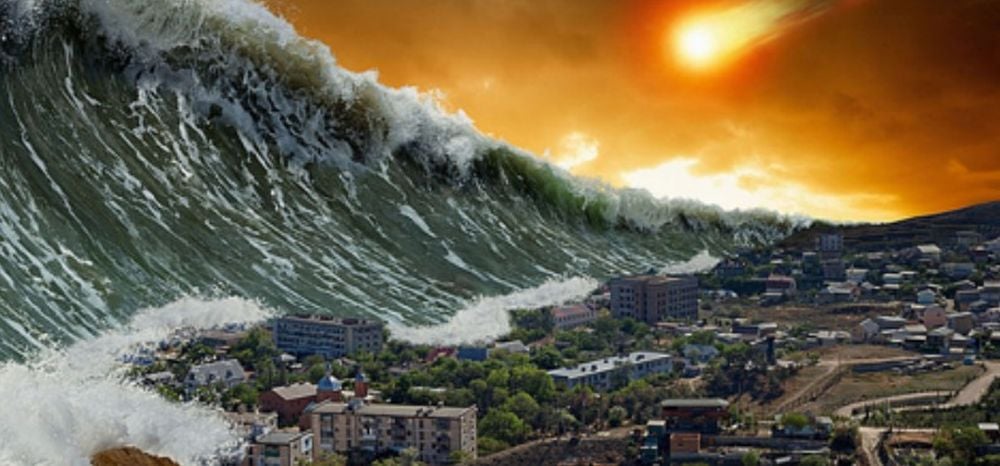
"Such passages may have left strong tidal signatures: giant waves, large volcanic episodes, sea regressions, coherent meteor showers, and major climatic perturbations," Fargion writes. "These mechanisms could have contributed to several major biological mass extinctions over the past 600 million years, as suggested by peculiar correlations in the geological record."
Fargion explains that Earth's major mass extinctions correlate in time with huge changes in the planetary climate, meteoric impacts, and enormous volcanic eruptions. Correlation is one thing, but finding the definitive links between them is more difficult. "The reason for that is not clear. Meteoritic impacts alone, volcanic eruptions alone or sea regressions alone could not have caused all the major mass extinctions," he writes.
While there's plenty of evidence, including the iridium anomaly, that an impact wiped out the dinosaurs and created a mass extinction about 64 million years ago, the causes of other mass extinctions aren't so clear.
The largest known extinction occurred 251 million years ago, and pinpointing its cause continues to be difficult. "But, neither an iridium anomaly, nor a large meteoritic crater have been dated back to the Permian/Triassic (P/T) mass extinction, 251 𝑀 𝑦 ago, which was the largest known extinction in the history of life, where global species extinction ranged between 80% to 95%," the author explains.
"Here we suggest that tidal effects of planetary-mass objects which pass near Earth could have caused all of these and can explain the complex geological records of the major biological mass extinctions," Fargion explains.
There are many anomalies in the inner Solar System that can be attributed to flybys of, collisions with, or captures of planetary mass objects from the outer Solar System. Uranus is tilted on its side, and that could be from a collision. Triton, Neptune's largest moon, appears to be a captured Kuiper Belt Object. And the Late Heavy Bombardment may have been caused by perturbations from a planetary mass flyby. The Solar System also features several retrograde orbit moons, a feature which still waits for an explanation.
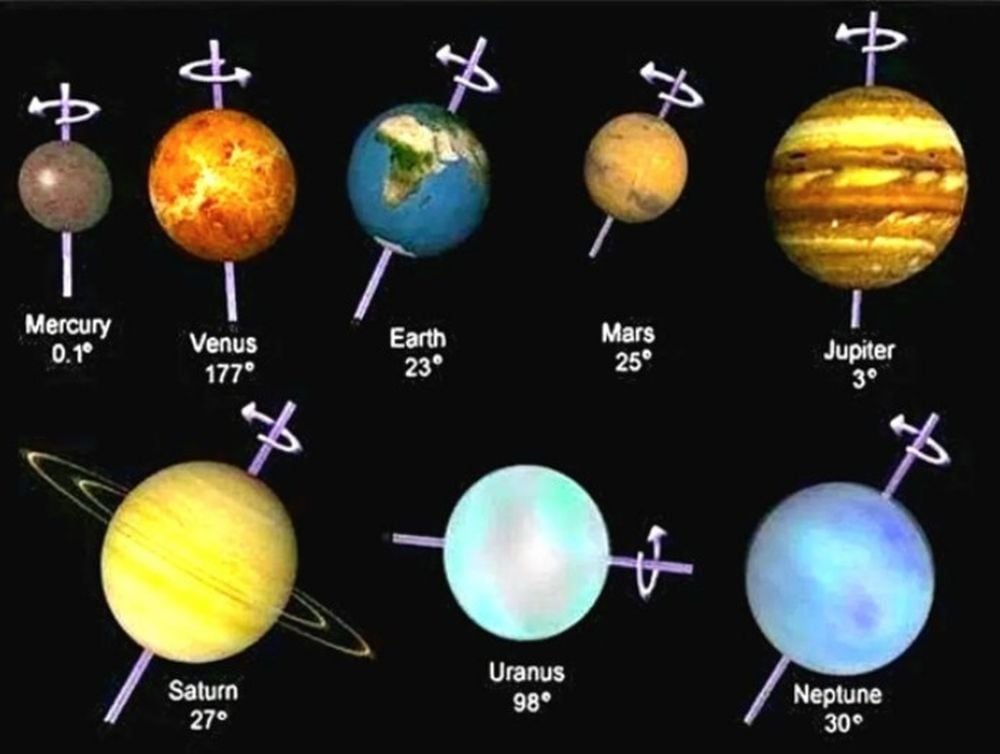 The author says that collisions with planetary mass objects could've created the off-axis spins of the planets. Multiple collisions may have been responsible. Image Credit: Fargion 2026. PoS
It's unreasonable to think that Earth was unaffected by similar events.
"Passage of such objects near Earth could have generated on it gigantic tidal waves, large volcanic eruptions and drastic changes in global climate and sea level," writes Fargion. "Moreover, upon crossing the asteroids and Kuiper belts these planetary mass objects could have diverted large meteorites and asteroids into a collision course with Earth. Thus visits of distant planets may be the common cause for the various catastrophes that were jointly responsible for the major biological mass extinctions."
Some evidence for past flybys can be seen in the Earth-Moon system, according to the author. "Fossil corals show that the rate of decrease in the number of diurnal rings during annual cycles, i.e. the rate of decrease in the number of days in a year, has changed suddenly into a slower rate at the end Devonian," Fargion writes. "Since the lengthening of the day is due to slowing of the rotation of Earth by the well understood Moon’s tidal forces, it implies that at the end Devonian the moon-Earth distance increased suddenly by a significant fraction."
A collision couldn't do that because it's so sudden and would create an instantaneous change. But a flyby could. "Such an increase could have been induced by a tidal pull in a nearby passage of a visiting planet/moon," Fargion explains. That tidal pull could also generate global tsunamis, and generate powerful tides that lasted years. It would also deform the crust and generate tidal heating in the planet's interior, which could have triggered massive volcanic eruptions.
These events were all a long time ago, and it's challenging to estimate how many flybys there were and how massive the objects were. "A reliable estimate of the masses and the flux of the visiting planets/planetesimals is not possible yet," writes Fargion.
But Jupiter may provide a way to understand. Jupiter is slightly tilted on its axis, and also seems to have an unaccounted for energy source that helps it have such a high surface temperature. Fargion calculates that Jupiter has suffered 16 collisions with objects of 0.5 Earth masses in its history. "Similar estimates for other planets, although yielding the correct order of magnitude for the tilts of their spins, are less reliable because the inferred number of accreted planets is too small," Fargion explains. "We note, however that the past dwarf planet population, four billion years ago, could be more heavier than present one, which is mostly dominated by lighter Moon-like dwarf planet mass."
The Solar System's history is a puzzle, and Earth's history is likewise puzzling. Ongoing discoveries of massive objects in the outer Solar System show that they're a part of the puzzle, too. If they visited the inner Solar System, they could've triggered extinctions. And if it happened in the past, it could happen again in the future.
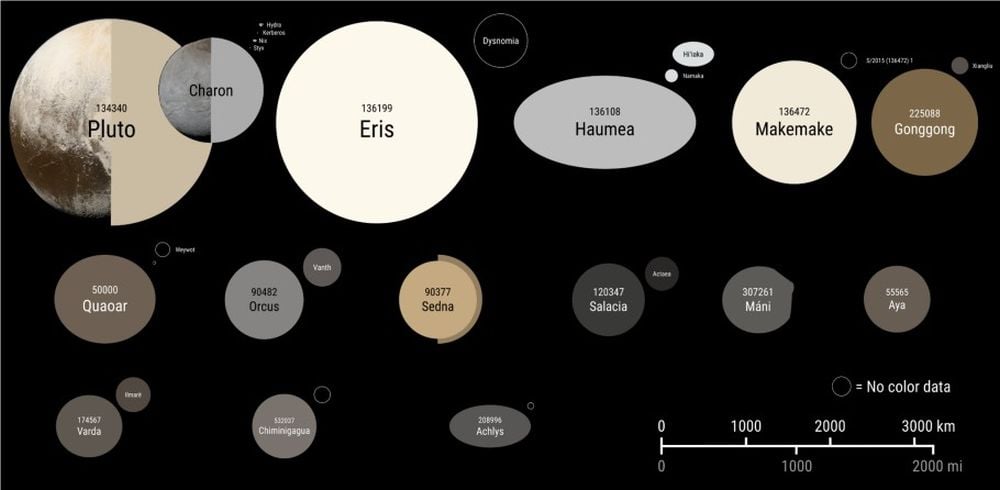 These are some of the planetary mass objects in our Solar System. During flybys, objects with this much mass could've triggered extinctions on Earth. Image Credit: Fargion 2026. PoS
"The consequent lessons for us humans, to overcome such an eventual extinctions are: deep sky inspection to seek weakest far dwarf planet sources, once found, alert the incoming events as soon as possible," the author writes. If it's asteroid sized, try to divert it.
But if it's larger than an asteroid and is a planetary mass object, then we need to prepare differently. The main danger, according to Fargion, would be from massive tidal waves that swept around the planet and persisted for years. In this case, there's only one thing we can do.
"A prevention might be also to organize, on the top of mountains chains (at 2-3 km altitude), secure refuge for human and life for surviving such (rare but not, impossible) events," Fargion writes.
The author also entertains the idea that flybys like this could help explain the Fermi Paradox. "The tidal mass extinction, its rate and form, may also explain the famous Fermi Paradox: Where is everybody, or, why they are not yet here? The answer could be, that life is unstable and short," the author writes.
"Astrophysical tidal extinctions could more rarely cancel any advanced civilization, making a life reset toward a lower, primordial, silent level," Fargion concludes.

