Universe Today
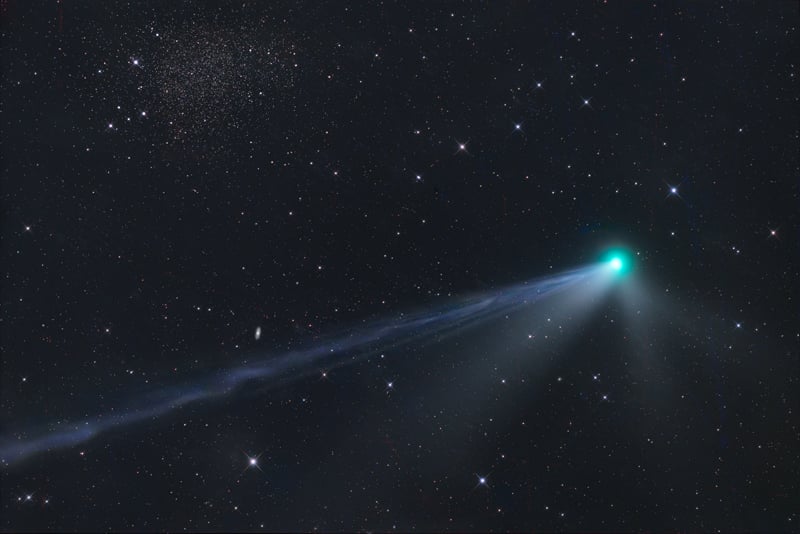
March is the time to catch the encore performance for comet E1 Wierzchos crossing the evening sky.
It seems that the southern hemisphere gets all the good comets. A bashful binocular comet is about to finally leave its southern perch, and briefly come into view for folks up north. Said comet of the moment is C/2023 E1 Wierzchos. Although the comet just passed perihelion last week, it should put on a fine encore show as it heads north in March at dusk.
The comet has spent most of February loitering in the southern constellations of Grus, Phoenix and Sculptor. But the time to act is now, as Comet E1 Wierzchos is fading rapidly this Spring as it heads back out of the inner solar system. E1 Wierzchos joins the half-dozen odd binocular comets anticipated in 2026.
The comet reached a respectable peak +7th magnitude on January 20th at 0.566 Astronomical Units (AU) from the Sun, and passed 1.012 AU from the Earth last week on February 17th. Currently, the comet is at magnitude +8.5 in the constellation Cetus the Whale, near its border with Fornax the Furnace.
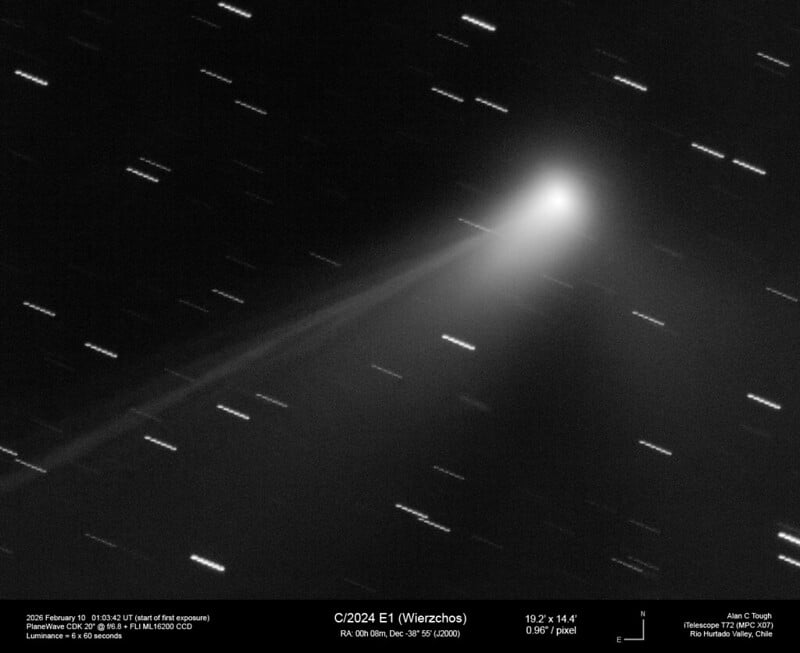 Comet E1 Wierzchos on February 10th. Credit: Alan Tough.
Anatomy of a Comet Discovery
The comet was discovered on the night of March 3rd, 2024 during the Mount Lemmon Sky Survey located just outside of Tucson, Arizona by Polish astronomer Kacper W. Wierzchoś as a +20th magnitude smudge moving slowly through Draco the Dragon. This marks Wierzchoś’ fifth comet discovery.
On a 3 million year orbit inbound, the comet’s 2025-2026 passage through the inner solar system shortened the its path to a 200,000 year orbit outbound, towards an aphelion 7400 AU from the Sun back out in the distant Oort Cloud. Venus had a better view of the comet, as it passed just 0.191 AU (29 million kilometers) from our sister world on New Year’s Day 2026. Had the comet swung by Earth six months prior or later, we would have had a similar close pass, along with a brilliant apparition for the comet.
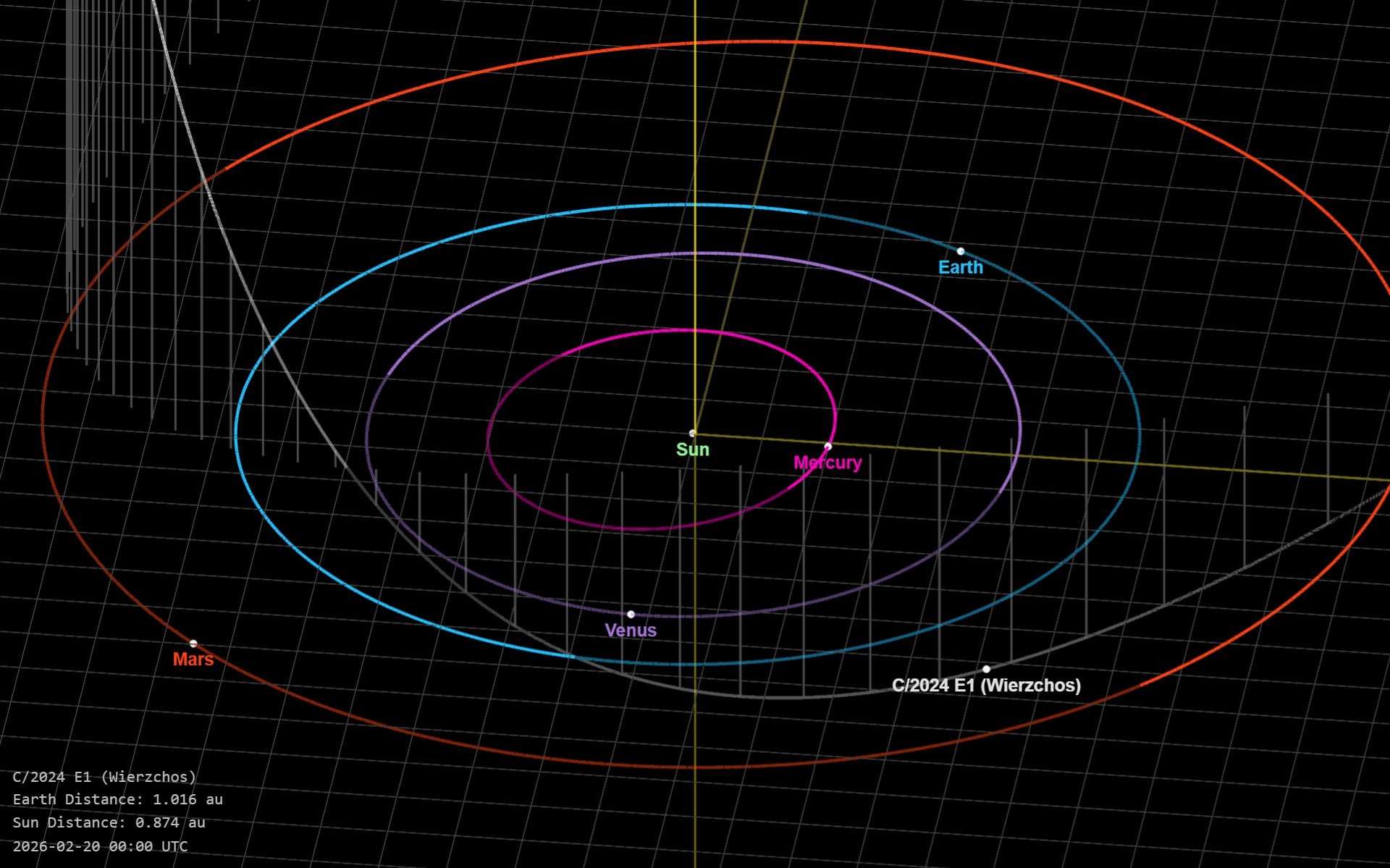 The orbital path of comet C/2024 E1 Wierzchos through the inner solar system. Credit: NASA/JPL.
Current activity sees the comet over-performing by about a magnitude in brightness as it heads back out of the solar system. With such a long orbit, this could well be the comet’s first passage through the inner solar system. A dynamically new comet is always a plus, as there should be lots of activity as it heats up for the very first time.
March sees the situation for the comet improve considerably up north, thanks to its steep 75 degree inclination versus the ecliptic plane.
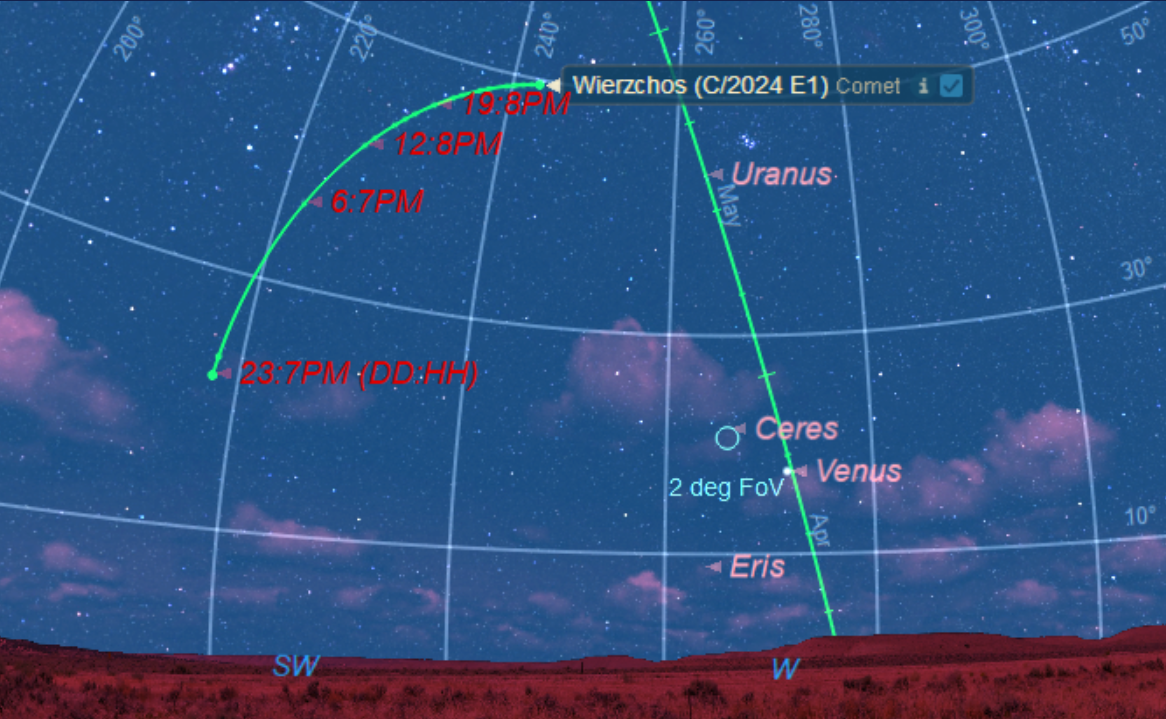 The March dusk path of the comet. Credit: Starry Night.
The comet crosses into the constellation Eridanus the River on March 1st, then nicks Taurus, heading back into Eridanus on the 13th. It then crosses the celestial equator northward on the 14th, and heads back into Taurus on the 15th. The comet may drop back below +10th magnitude by mid-month. March 31st into early April sees the comet crossing into Orion, passing 3 degrees from Aldebaran and the Hyades star cluster.
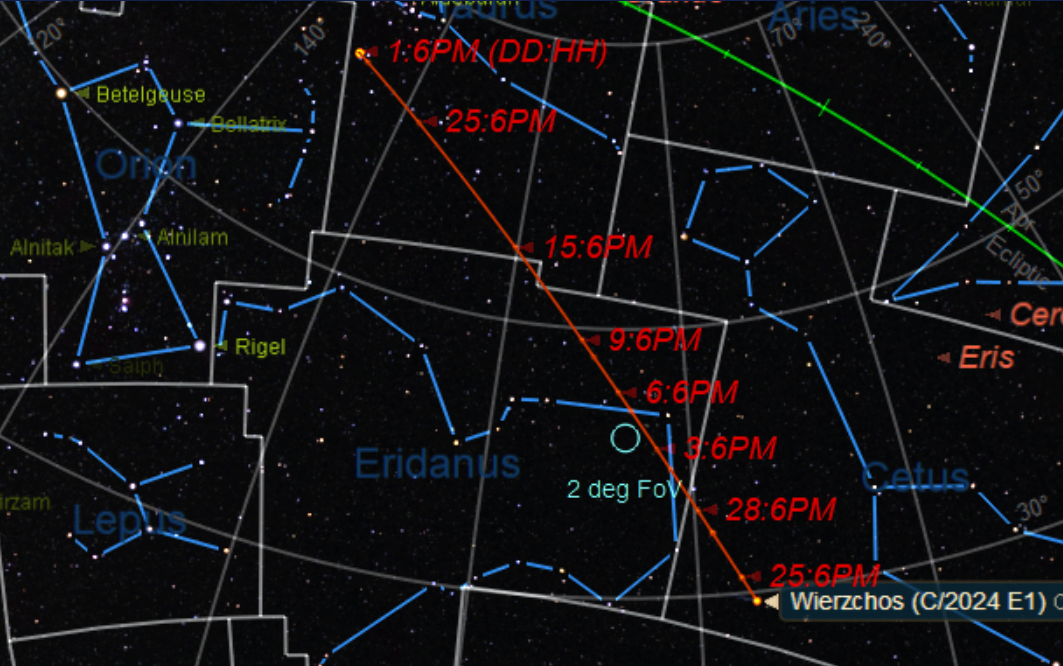 The March 2026 celestial path of the comet towards Orion. Credit: Starry Night.
April into 2027 onward sees the comet fading from view in the direction of the northern constellation Lynx. It’s worth noting that the comet actually transits the open cluster Messier 35 on May 14th, and pairs with the crescent Moon and Venus a degree apart each in quick succession on May 18th and May 23rd respectively, though it’ll be a faint +12th magnitude smudge at this point.
Observing the comet is as simple as aiming at the suspect star field using binoculars or a wide field telescope, sweeping along in a general search pattern, and looking for a fuzzball resembling a globular star cluster that stubbornly refuses to snap into sharp focus. 18th century comet hunter Charles Messier would periodically notice these celestial interlopers resembling fixed fuzzy patches in the sky, which inspired him to compile his famous list of deep-sky objects.
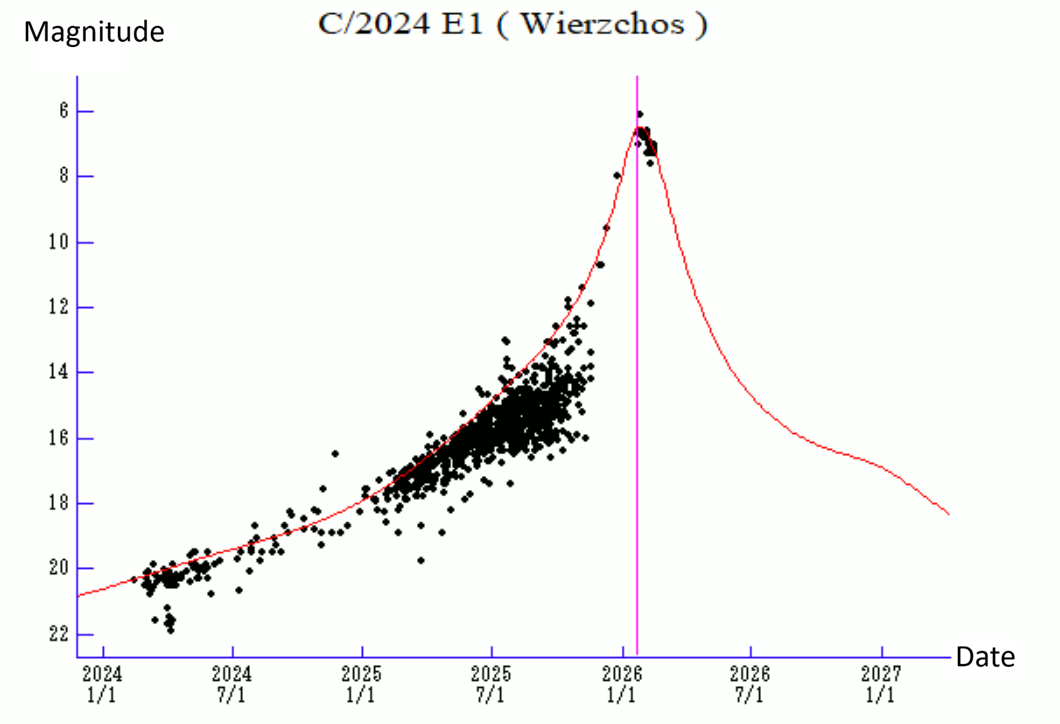 The observed (black dots) versus predicted light curve for Comet E1 Wierzchos. Adapted from Seiichi Yoshida's Weekly Information About Bright Comets.
Meanwhile, we have another wait-and-see comet inbound: sungrazer C/2026 A1 MAPS. The comet is developing nicely, currently shining at +12th magnitude in the constellation Eridanus. The question of the hour is: will it survive its scorching perihelion on April 4th, or simply head off to meet the fiery fate of so many sungrazers before it? Comet A1 MAPS and E1 Wierzchos actually pass just two degrees from one another coming right up on March 1st.
We’re all waiting to see what happens in April. Maybe, it’s finally time to head south on our cometary quest. But for now, be sure to enjoy Comet E1 Wierzchos in March, as it wings its way back out into the great outer depths of the solar system.