Universe Today
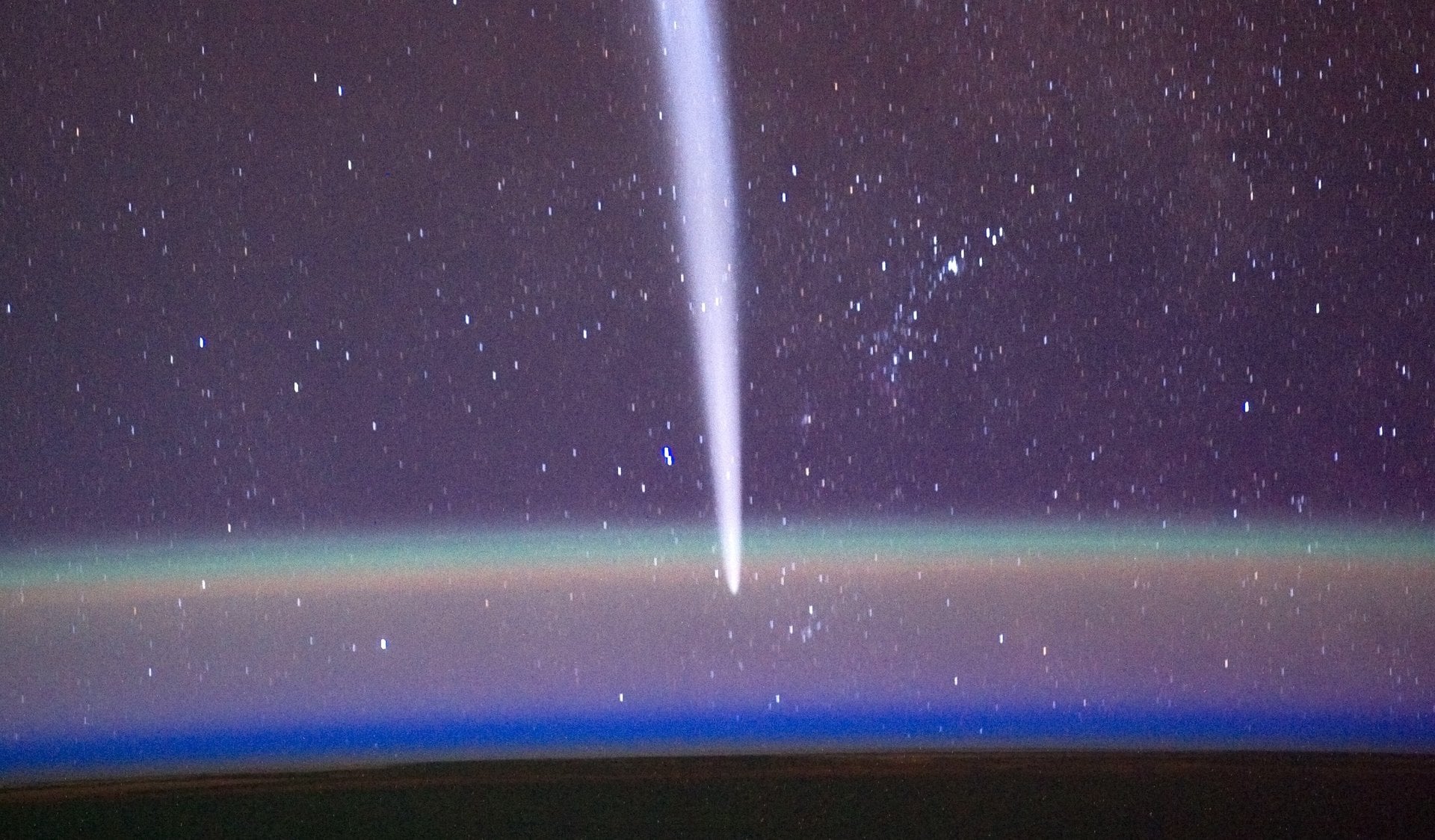
New sungrazing comet C/2026 A1 MAPS could put on a fine show in April… but it will have to survive a blazing close passage near the Sun first.
In a clockwork predictable Universe, comets and how they will ultimately perform is always a big wild card. A new sungrazer comet discovered at the start of this year has given astronomers pause. C/2026 A1 MAPS could put on a memorable if brief show in early April, if it doesn’t join the long list of comets that failed to live up to expectations.
The comet was discovered on the night of January 13th, 2026 and given the tentative designation of 6AC4721. It soon received a formal name as the first comet of 2026: C/2026 A1 MAPS. The name is an acronym of the four discoverer’s last names: Alain Maury, Georges Attard, Daniel Parrott and Florian Signoret. The team runs a collection of remote telescopes based in the Atacama desert in Chile.
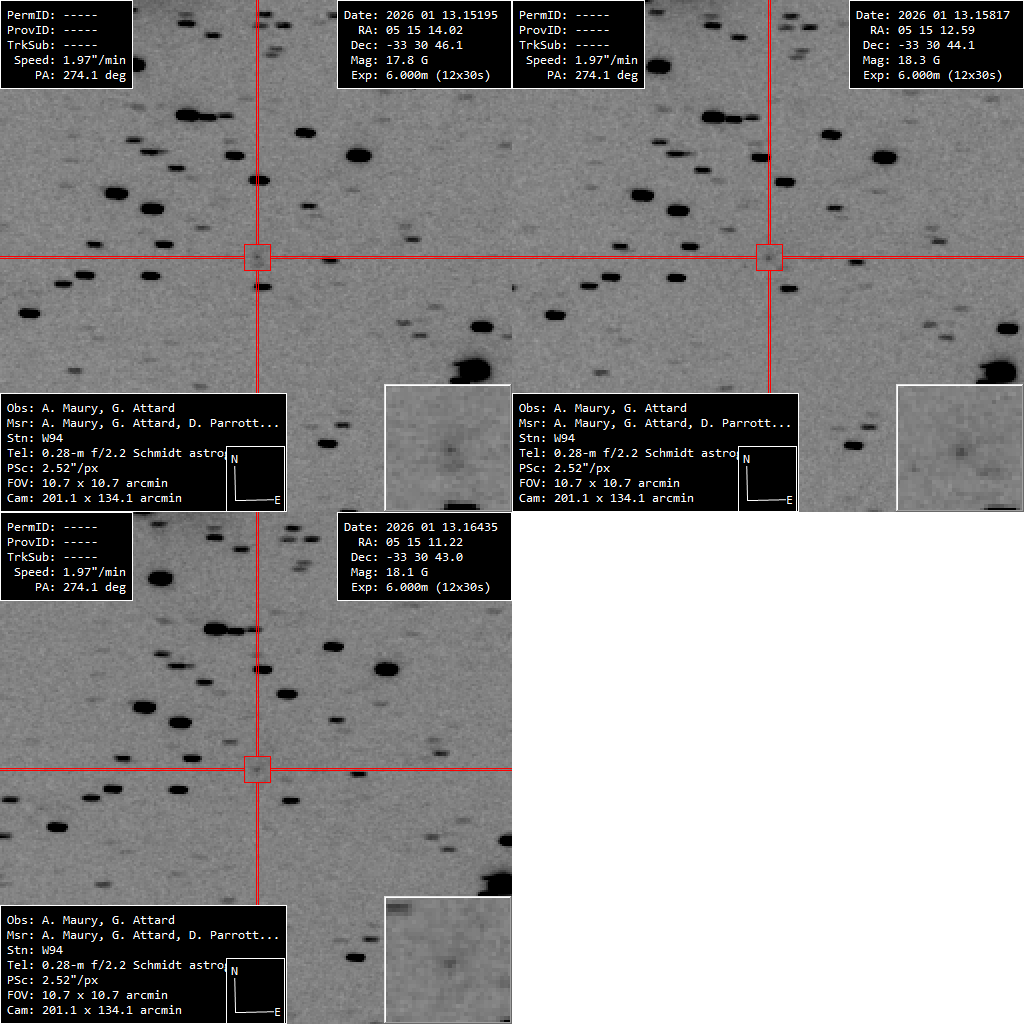 The motion of the comet against the starry background on January 13th. Copyright: MAPS 2026.
This is the seventh comet discovery for the MAPS team. The team also discovered asteroid 2023 DW, which, for a brief time, topped the Torino scale at 1 for a slight chance of an Earth impact in 2046. To date, the MAPS project has discovered 318 Near-Earth asteroids, making it the most effective European-based program in the field, second only to NASA's all-sky surveys.
What really got the comet community abuzz was how far C/2026 A1 MAPS was spotted from the Sun at the time of its discovery. The comet was 2.056 Astronomical Units (AU, or 307.6 million kilometers) out in mid-January, a record distance for the discovery of a sungrazing comet. Shining at a faint +17.8 magnitude, this would suggest a decent-sized nucleus for the comet, perhaps 2.4 kilometers across.
But the comet has a grim perihelion passage ahead. Current estimates based on 154 observations place its pass on April 4th at 1.18 solar radii or about 160,000 kilometers (99,000 miles) above the roiling photosphere surface of the Sun, well within the solar corona. That’s less than half of the Earth-Moon distance. For context, sungrazer C/2011 W3 Lovejoy’s passage on December 16, 2011 was just 140,000 kilometers (87,000 miles) above the Sun’s surface.
Unfortunately, the comet’s prospects for post-perihelion survival aren’t good, though as we saw in the case of W3 Lovejoy, it has happened before. Though we usually think of the Sun as the immovable center of our solar system, it’s actually getting tugged around a barycenter, mostly thanks to Jupiter. Sometimes, the barycenter point even ventures outside the surface of the Sun. While best estimates taking into account precise orbital perturbations still place perihelion for the comet just outside the Sun’s surface, it’ll be a scorcher for sure.
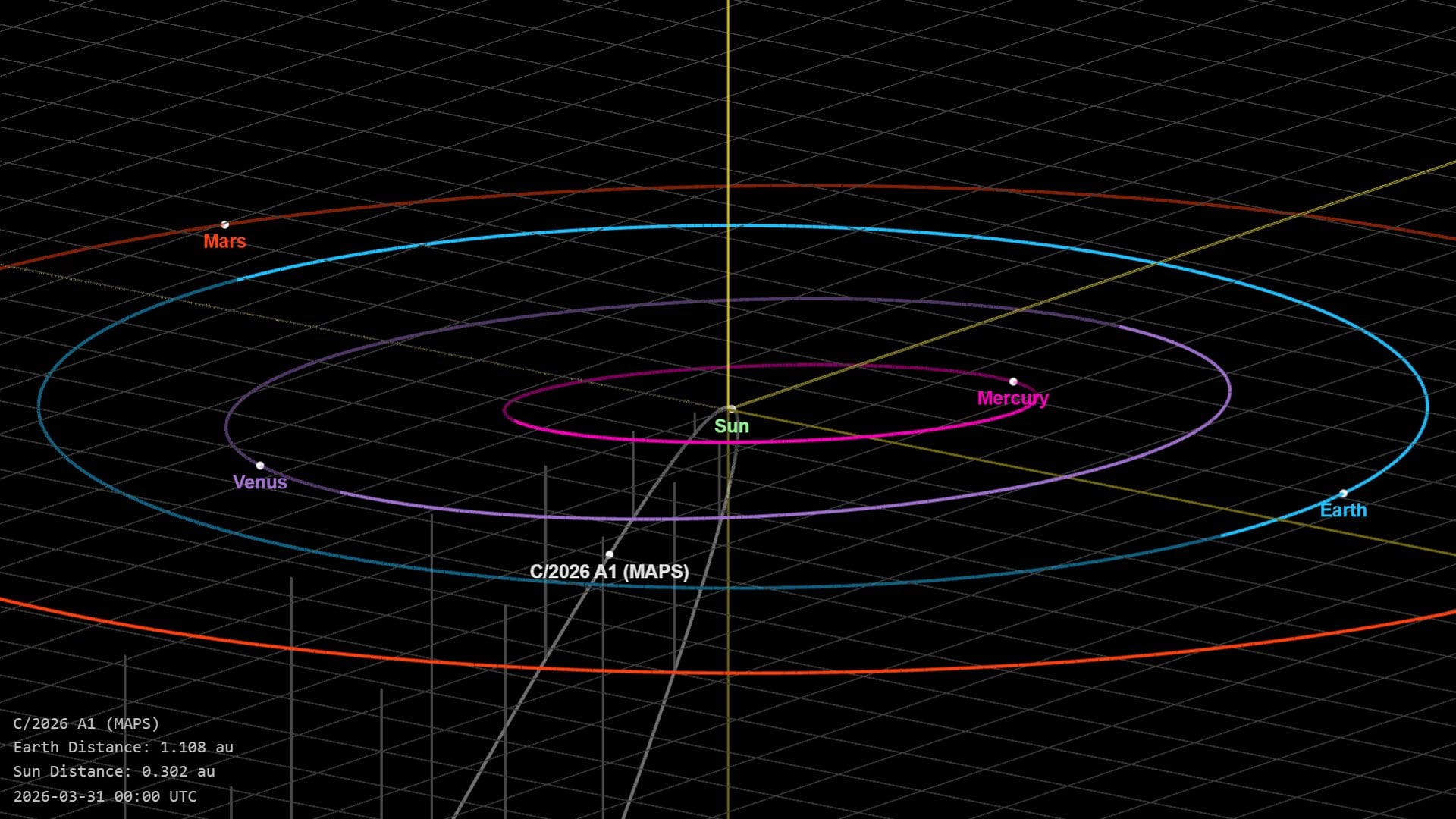 The sun-diving orbit of Comet A1 MAPS. Credit: NASA/JPL.
A1 MAPS is a member of a family of sungrazers known as Kreutz Group comets. The progenitor of this family is thought to be the fragmentation of a large sungrazing comet in 362 BC. This has spawned subsequent breakups, most notably in 1106 and 1138 AD. Other alumni from the stream include the Great Comets of 1843 and 1882. In more recent times, sungrazing comet C/1965 Ikeya-Seki wowed observers with a fine display near perihelion on October 21st, 1965.
More fragments from this stream are out there, and there’s suspicion that we may be due for another fine sungrazer comet by 2050.
Sungrazers in general aren’t all that rare. To date, SOHO has discovered an amazing 5,204 sungrazer comets and counting since its launch in 1995. It’s strange to think, that with the exception of the very few bright members, most sungrazers were actually sliding by, unseen.
In the past, we’ve seen dramatic sungrazers light up the twilight sky as ‘broom stars,’ or ‘headless wonders,’ comets mangled by their torturous perihelion passage before getting finally extinguished for good.
 Charles Piazzi Smyth's depiction of the Great Daytime Comet of 1843. Photo by author. The painting is on display at the National Maritime Museum in London.
Of course, we’ve been here before. Early on in my Universe Today writing career, we covered the much-hyped ‘comet of the century’ Comet C/2012 S1 ISON. Said comet failed to survive perihelion 1.165 million kilometers from the surface of the Sun, falling apart on U.S. Thanksgiving Day 2013. But such is not always the case. W3 Lovejoy Surprised us all, just two short years before, putting on a fine post-perihelion show for southern hemisphere observers in late 2011.
How will Comet A1 MAPS perform? That’s always the question of the hour. My money is on spotting the comet on the days leading up to perihelion, though the window will be brief. Currently 0.746 AU distant in the southern constellation Fornax the Furnace, the comet vaults through Eridanus in late February and Cetus in March before greeting the Sun in Pisces in early April.
The comet is currently approaching from the southern celestial hemisphere, really putting it ‘in the weeds’ for observers up north. It should top +10th magnitude in late March, when the show really begins. The planet Venus will make a great guide to spot A1 MAPS at dusk as it makes its sun dive:
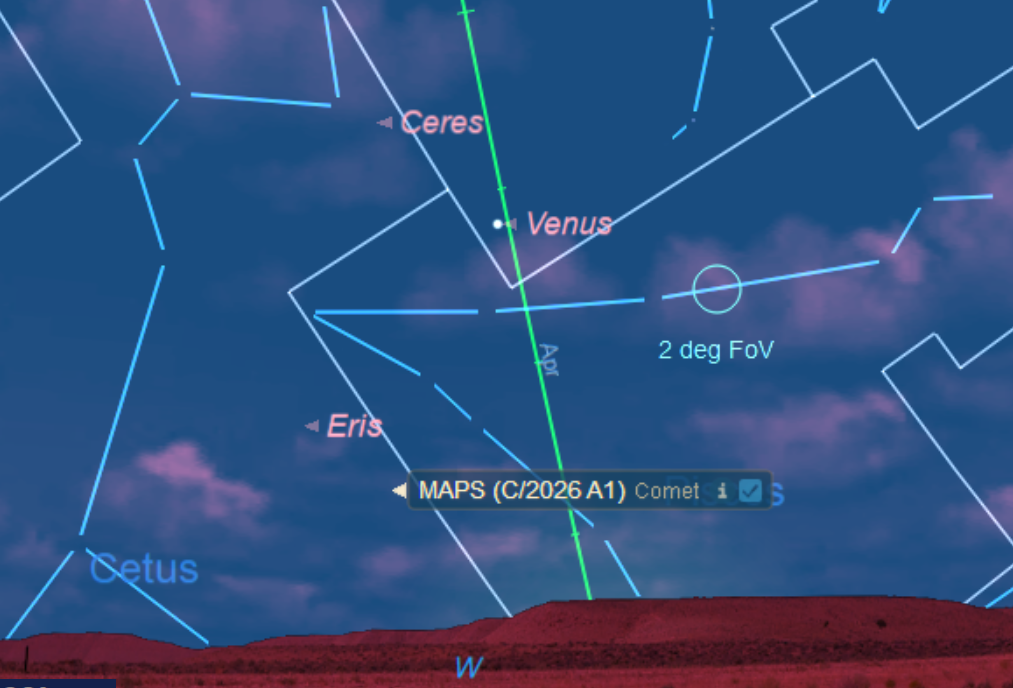 Looking west on the evening of April 1st. Credit: Starry Night.
Assuming this dive isn’t terminal, Comet A1 MAPS nearly reverses its trek on its apparent course in the sky post-perihelion after April 4th, flitting back outward past Venus into Cetus the Whale at dusk. We can only hope it will unfurl a long stately tail swept out ahead of it around this time.
Comet A1 MAPS will make its closest passage versus the Earth on April 5th, at 0.961 AU distant.
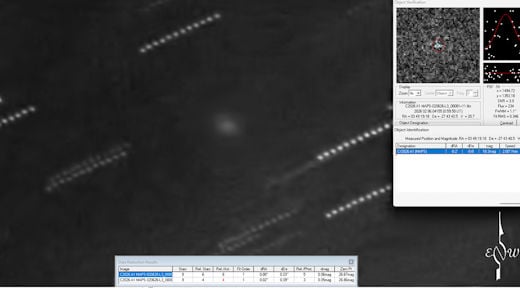 Amateur Astronomer Efrain Morales managed to nab comet A1 MAPS on February 6th.
We’ve seen current peak magnitude predictions for the comet all over the board. 'If' it tops out at magnitude -7, Comet A1 MAPS might reach daytime visibility for dedicated observers who can take the proper precautions to observe such an object, close to the dazzling Sun.
For the rest of us, the joint NASA/ESA Solar Heliospheric Observatory (SOHO) presents the best prospects to spot the comet. A1 MAPS enters SOHO’s LASCO C3 field of view on April 2nd at around 20:50 UT, and enters its LASCO C2 inner view on April 4th at 1:51 UT. Note that Comet A1 MAPS actually disappears behind the Sun as seen from Earth on April 4th at 11:50 UT, and reemerges about an hour and a half later around 13:20 UT. The comet will then transit in front of the Sun from 13:55 to 15:20 UT.
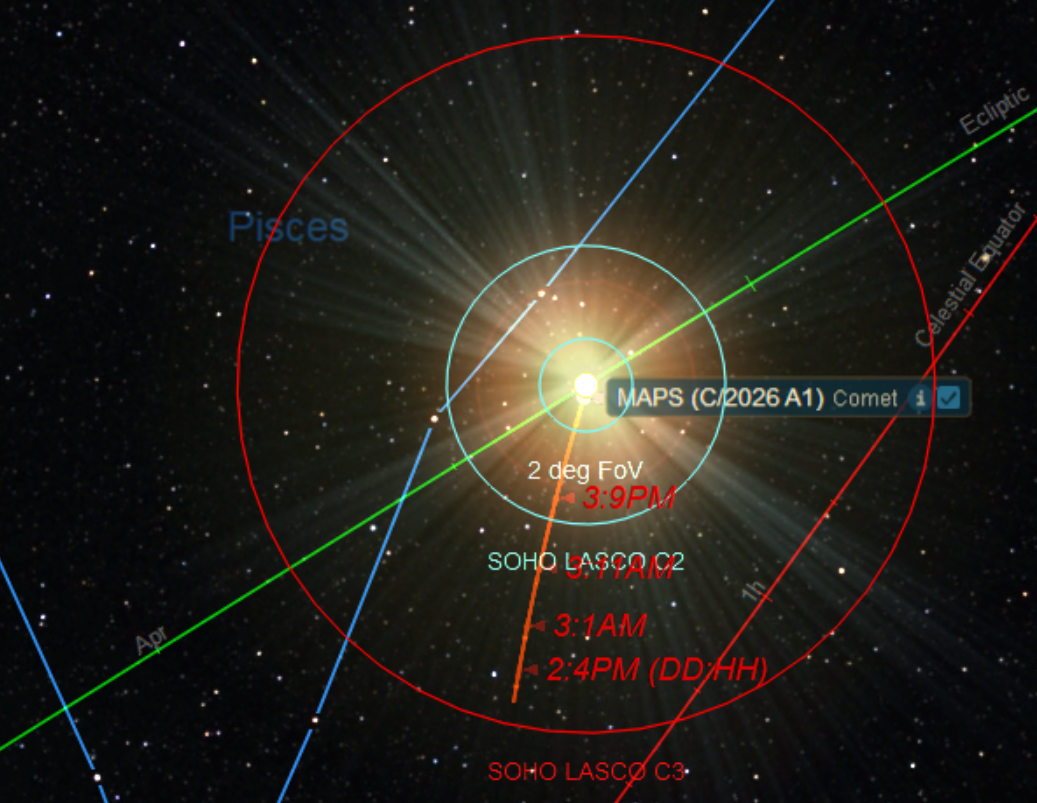 Comet A1 MAPS' path through SOHO's LASCO C3/C2 field of view. Credit: created by the author using Starry Night.
Assuming the comet survives April, Comet A1 MAPS is then back on its way out of the solar system, headed for a distant aphelion 220 AU from the Sun beyond the Kuiper Belt sometime in the 32nd century.
A1 MAPS also has company. Comet C/2024 E1 Wierzchoś is currently a decent binocular object at +7th magnitude in Sculptor. Also, another fine comet we’re currently tracking, C/2025 R3 PanSTARRS reaches perihelion on April 19th and may top out at +2nd magnitude.
Unless C/2026 A1 MAPS has the power to survive passage through the solar corona, I’d say its survival chances are nil. Still, I’d love to be wrong. With any luck, we might have a good sungrazer leading up to perihelion in April. We’ll just have to wait and see.