 Universe Today
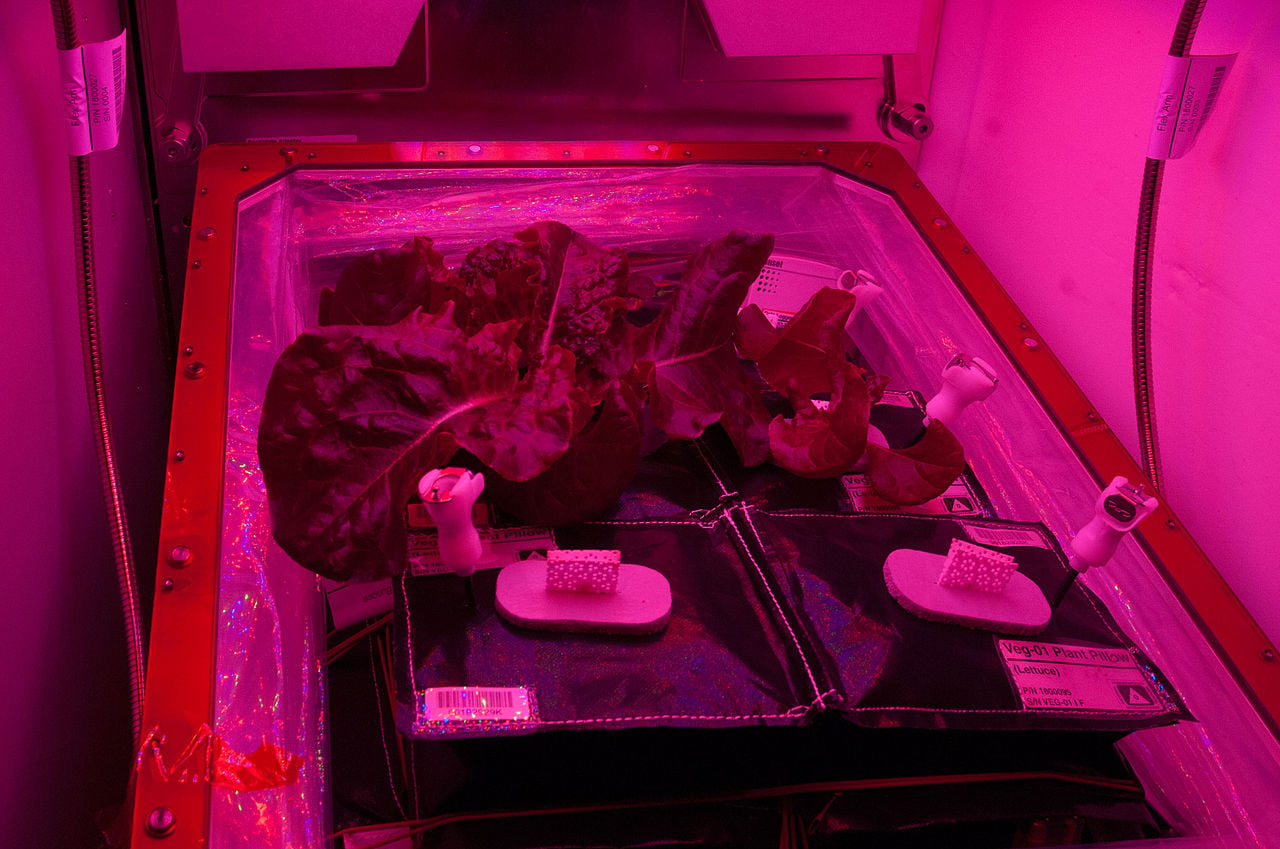
Thinking about food systems in deep space likely brings to mind something like the Martian where an astronaut is scratching barely enough food to survive out of potatoes grown in Martian regolith. Or perhaps a fancy hydroponic system on an interplanetary transport ship, with artificial lighting and all the associated technological wizardry. But a new paper published in Acta Astronautica by Tor Blomqvist and Ralph Fritsche points out that growing food is only one small part of the whole cycle of providing sustenance for astronauts in space. To really get a sense of how difficult it will be, we have to look at the whole picture.
They break a space food system down into five critical elements: Production Post-harvest management Waste management Preparation Socio-cultural (Consumption)
If any one of those elements fails, the whole system can collapse, and literally everyone that uses the system could starve to death as a result. For example, if a new hydroponic system can produce incredible yields of nutrient-dense crops, but the waste from it can't be efficiently recycled by the life support system, the technology itself is only useful for as long as new feedstocks can be supplied to support it - which in deep space is likely not very long.
Fraser discusses how a realistic Mars mission will play out.Production seems relatively straightforward. While we could pack everything we needed for a five-year Mars mission in advance, that would add a ton of weight that could otherwise be utilized for other necessities. Also, without one, waste management becomes much more…wasteful. The organic matter of human waste is a key input to the growing cycle of plants, so closing the loop between those two systems is one of the best ways to create a “closed” food system.
However, there are other inputs to consider. One is the environment. Radiation is pervasive on deep space missions, and most people understand the negative impacts it has on human physiology. But, it also impacts food - and bacteria. Storing food for five years, and trying to make sure it's still edible, while it is constantly being bombarded by radiation is a recipe for disaster. At this point in our exploration journey, we’re not even sure we can actually safely package food for that long in those conditions. Even if we were, radiation can mutate bacteria, making them potentially more dangerous and harder to kill. Good luck maintaining life support systems if everybody on the mission has a bad case of food poisoning.
Another aspect of the environment is the actual act of cooking. While this provides some psychological benefit (which we’ll get to in a minute), physics is different in micro or low gravity. Fluids behave strangely in micro or partial gravity, as do heat and particles, all of which are critical components of cooking. Not only will we have to build systems specifically adapted for use in these environments, but we’ll have to train astronauts in how to cook in an environment no one has ever had to before.
Fraser discusses Martian In-situ Resource UtilizationThe first astronauts to go to Mars will undoubtedly be some of the most psychologically sane (and thoroughly tested) individuals ever. However, even they will need some sort of pick-me-up over the years-long mission to the Red Planet. Food can help with that, as there is evidence that managing crops and cooking provides a psychological boost. However, doing so takes away time from other mission-critical tasks, like exercise or navigation, so there’s a trade-off of how much psychological benefits those systems provide versus the opportunity cost of tending to other mission-critical tasks.
Menu fatigue is another real problem for astronauts. If you’re eating the same nutrient paste every day for five years, it’s very likely that, after some time, you’ll begin to eat less of it simply due to the fact that you’re sick of it. If a food lacks "organoleptic appeal” (i.e. taste, texture, and smell), then it’s highly likely that astronauts will simply dispose of it instead of actually eating it, making it of no value to anyone. In either case, being malnourished while on a years-long deep space mission is a recipe for disaster.
All of these considerations are what makes deep space food systems so challenging. To make sure we develop a functioning one before putting it to the test on a real mission, the authors have a few suggestions. First, we should build a “digital twin” of the food system, including models for how different technologies will interact, and the inputs and outputs of the system itself. This can also be useful to model failures, which can be mitigated by making the system “modular”, with easily replaceable or swappable parts, so that a single failure doesn’t wipe out the entire food network. To truly prove the system works, though, we should test it on the ground first - while it won’t be able to simulate the cooking challenges of microgravity, or the radiation dangers of deep space, at least it’s somewhere to start.
NASA’s Deep Space Food Challenge announcement. Credit - NASA Space Tech YouTube ChannelTo support these efforts, NASA recently launched the Deep Space Food Challenge - a $750,000 prize competition to develop the sort of integrated food systems described in the paper. In fact, one of the authors (Fritsche) is a subject matter expert for the challenge, which is likely at least part of the inspiration for the paper. Upon the challenge’s completion there should be some interesting take-aways that deep space enthusiasts can chew on - hopefully without any radiation-hardened bacteria included.
Learn More:
T. Blomqvist & R. Fritsche - From production to food systems: A systems-level review of drivers, requirements, and integration for Lunar and Martian food systems
UT - Astronauts Struggle To Eat Their Space Food and Scientists Want to Know Why
UT - Add Astronaut Nutrition to the List of Barriers to Long-Duration Spaceflight
UT - How to Make the Food and Water Mars-Bound Astronauts Will Need for Their Mission

