 Universe Today
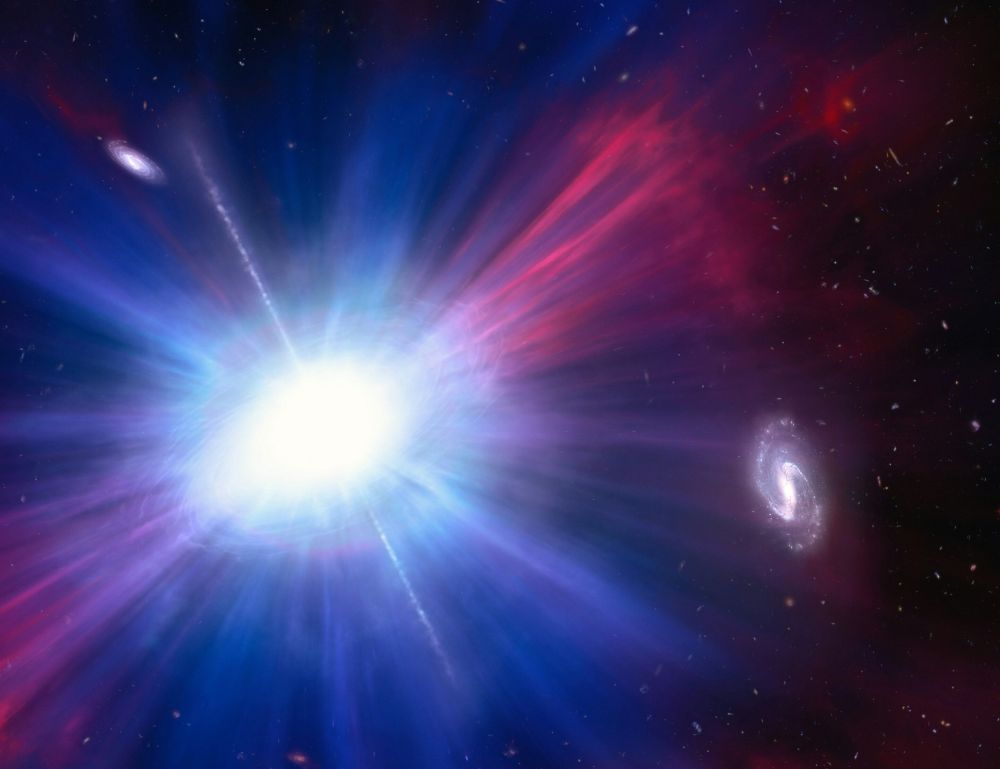
A distant star has captured astronomers' attention over the past decade, teasing them with indications that it will soon explode as a supernova. But new research shows that something else entirely is behind the star's outbursts. Rather than an impending catastrophic explosion, a previously unseen companion may be responsible for the star's behaviour.
The star is named AT 2016blu and is about 29 million light years away. It's an enormous star, about 33 times as massive as the Sun. Stars this massive end their lives in brilliant supernova explosions, leading astronomers to think that the explosion was imminent.
But new research to be published in The Astrophsyical Journal outlines what's actually happening with AT 2016blu. The research is titled "AT 2016blu: Accretion-Powered Outbursts in a Luminous Blue Variable and Compact Object Binary," and is currently available at arxiv.org. The lead author is Mojgan Aghakhanloo, an astronomer at the University of Virginia.
AT 2016blu is a luminous blue variable star discovered in 2012. It exhibits periodic outbursts that are very supernova-like. Since its discovery, it's erupted 27 times. While astronomers now know that not every supernova experiences pre-explosion eruptions, many do, so astronomers rightly thought that AT 2016blu was an impending supernova.
But as time went on, many questioned that interpretation.
This is not lead author Aghakhanloo's first research into AT 2016blu, which has earned the nickname "supernova impostor." Papers published in 2023 and 2025 also focused on the impostor. That research suggested that a binary system was responsible and that no supernova explosion was coming. But it left many unanswered questions.
"AT 2016blu exhibited 27 detected quasiperiodic (~113 day) outbursts between 2012 and June 2026, presumably triggered by periastron passages in an eccentric binary system in which the primary is a ≳33 M⊙ luminous blue variable (LBV)," the authors write.
This latest research presents new x-ray observations of AT 2016blu. These observations, combined with serendipitous x-ray observations of the star from decades ago, show that instead of supernova activity, the star's outbursts are caused by its relationship with a binary companion.
“We knew when the next outburst should be,” Aghakhanloo said in a press release. That knowledge let Aghakhanloo and her fellow researchers schedule more observations. Multiple astronomers at different telescopes helped out, and more than 30 amateur astronomers joined the effort.
The observation effort culminated in March 2026 during AT 2016blu's peak outburst. At that time, the researchers triggered a 'Target of Opportunity" (ToO) request for the Chandra X-ray Telescope. The telescope interrupted its observing schedule to watch the supernova impostor.
Chandra detected an x-ray source during this predicted outburst. Critically, the inadvertent Chandra observations from 2001-2002 showed no x-rays.
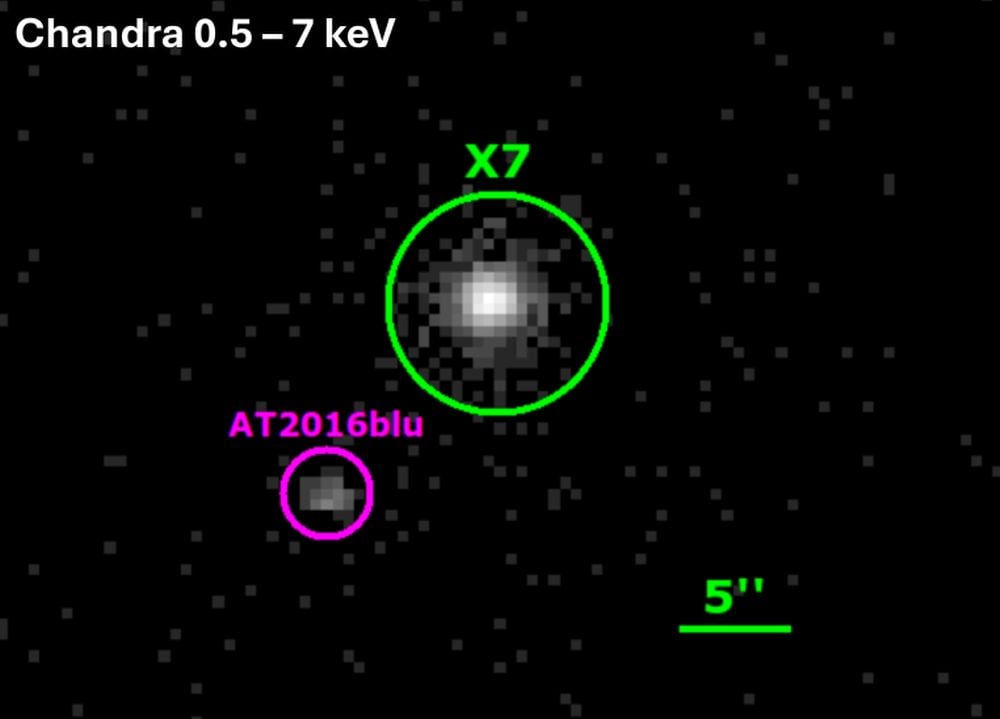 This figure shows all of the stacked Chandra images of AT 2016blu from its observations in March 2026. It also shows the nearby ULX NGC 4559 X7, an ultraluminous x-ray source. Image Credit: Aghakhanloo et al. 2026. ApJ
X-rays are produced when a star accretes material from a binary companion. The material heats up and emits x-rays. Chandra measured the luminosity during the outburst, and researchers calculated the mass accretion rate necessary to produce that luminosity. Together, they are "consistent with the presence of a compact companion," the authors write.
"We therefore conclude that AT 2016blu is the first known case of an LBV SN impostor whose outbursts are driven by intermittent accretion onto a compact object," the researchers explain. "Given that the system consists of a massive star and a compact companion, AT 2016blu is a high-mass X-ray binary," the authors write.
In this case, while AT 2016blu is a luminous blue variable, its companion is compact remnant like a black hole or a neutron star. It's accreting the material and generating the x-rays. So a living star is slowly losing mass to a dead star as they orbit. Each time the orbit allows mass transfer, the system flares in x-rays.
“It’s like having a front row seat to seeing what the star is doing before it dies,” Aghakhanloo said.
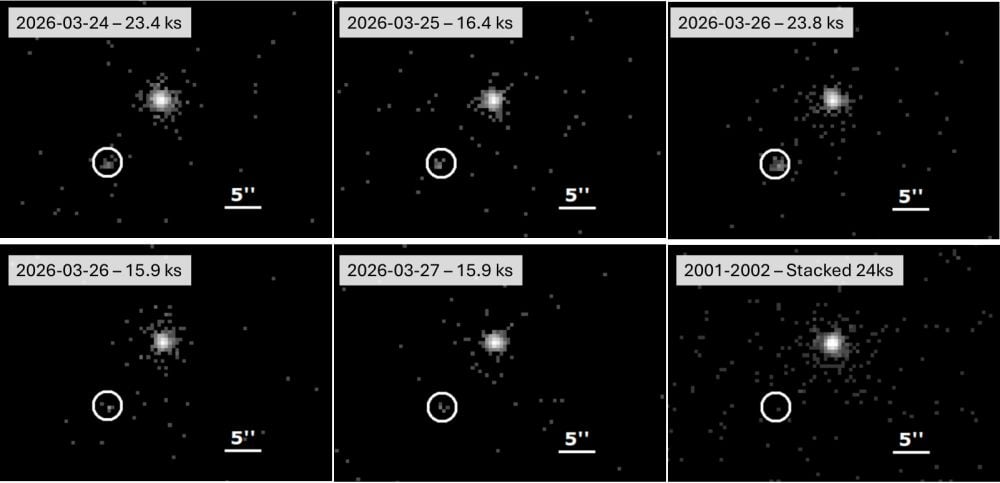 The first five panels are the Chandra's observations from the ToO campaign in March 2026, during the predicted outburst. In each one, AT 2016blu is emitting x-rays. The sixth panel is stacked Chandra data from the early 2000s, when AT 2016blu was a stable system and had produced no outbursts. Image Credit: Aghakhanloo et al. 2026. ApJ
"AT 2016blu represents the first known LBV system with a compact companion," the authors write.
But it isn't the only supernova impostor. Do others behave the same way? Aghakhanloo has acquired more Chandra observing time which she'll use to study more of them. The Vera Rubin Observatory's 10-year sky survey will uncover many more of these types of targets.
"The discovery of an LBV–compact-object binary undergoing accretion-powered outbursts also connects AT 2016blu to a growing class of models in which massive star–compact object binaries explain a variety of pre-SN transient phenomena," the researchers conclude. "Expanding the sample of such systems is therefore essential to better understand the evolutionary pathways and physical mechanisms connecting SN impostors, LBVs, and interacting SNe."
Luminous blue variables are extremely massive stars, and massive stars have an important role in the evolution of the Universe. They forge heavy elements and then spread them out into space, where they're available for more star formation, or perhaps planet formation. So studying these supernova impostors will advance our understanding of these consequential stars.
"We know a lot about them, but also there are a lot of open questions," Aghakhanloo said. "We still don't fully understand how they evolve or how they die."

