Universe Today
Where would you go to watch a star being born? Probably not the heart of the Milky Way, which is about the most violent neighbourhood our galaxy has to offer, a maelstrom of gas churning so fast and so chaotically that you would think nothing could ever settle there long enough to collapse into a star. And yet stars do form in that turmoil and astronomers have just begun to work out how, by finding an unexpected pocket of calm in the chaos.
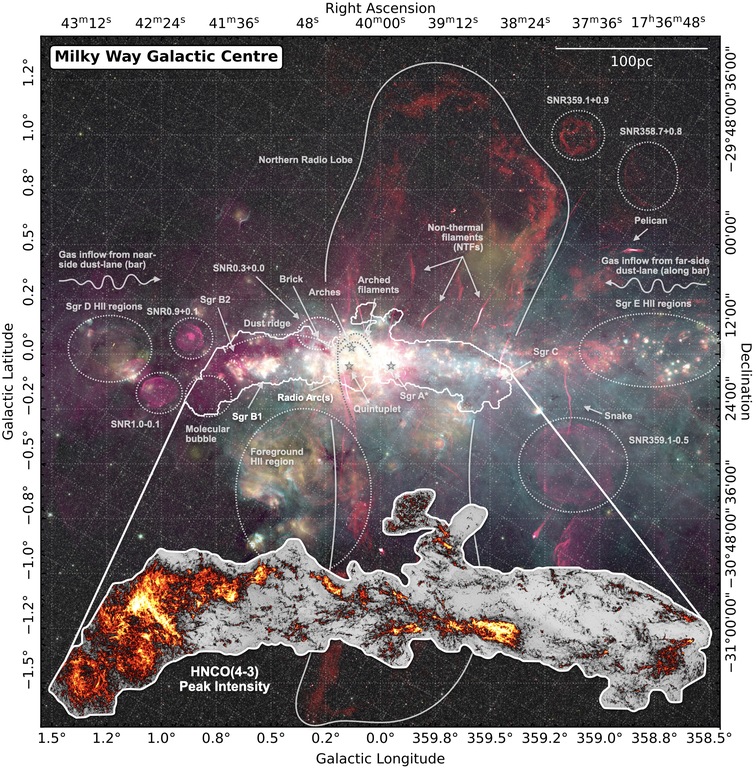 ALMA's largest ever image reveals the molecular gas swirling at the heart of the Milky Way, where a rare island of calm has been found amid the chaos (Credit : ALMA (ESO/NAOJ/NRAO)/S. Longmore et al.; Background: ESO/D. Minniti et al.)
The trouble with the galactic centre is turbulence. In the vast cloud wrapped around the middle of the Milky Way, known as the Central Molecular Zone, the gas usually races faster than the speed of sound, churning far too wildly for gravity to draw it together into the dense knots where stars are born. Picture a stretch of white water rapids, where nothing can stay still long enough to gather.
Then, mapping that turbulent region in extraordinary detail with the ALMA array in Chile, the team found something they did not expect. Their survey of the galactic centre, led by Rojita Buddhacharya, produced the largest image the telescope has ever made, charting dozens of different molecules across the chaos. Tucked inside the roar was a small, quiet pocket where the gas had slowed below the speed of sound and was drifting along gently and smoothly. In the white water, in other words, they had found a still pool.
Better still, threaded through that calm pocket was a long filament of gas, the kind of slender structure in which material can clump together, and here gravity was finally strong enough to hold it in place. Gentle motion and firm gravity are precisely the two ingredients a cloud needs to begin building a star. What surprised the astronomers most was how abruptly the gas switched from chaos to calm, the whole transition playing out across remarkably small distances.
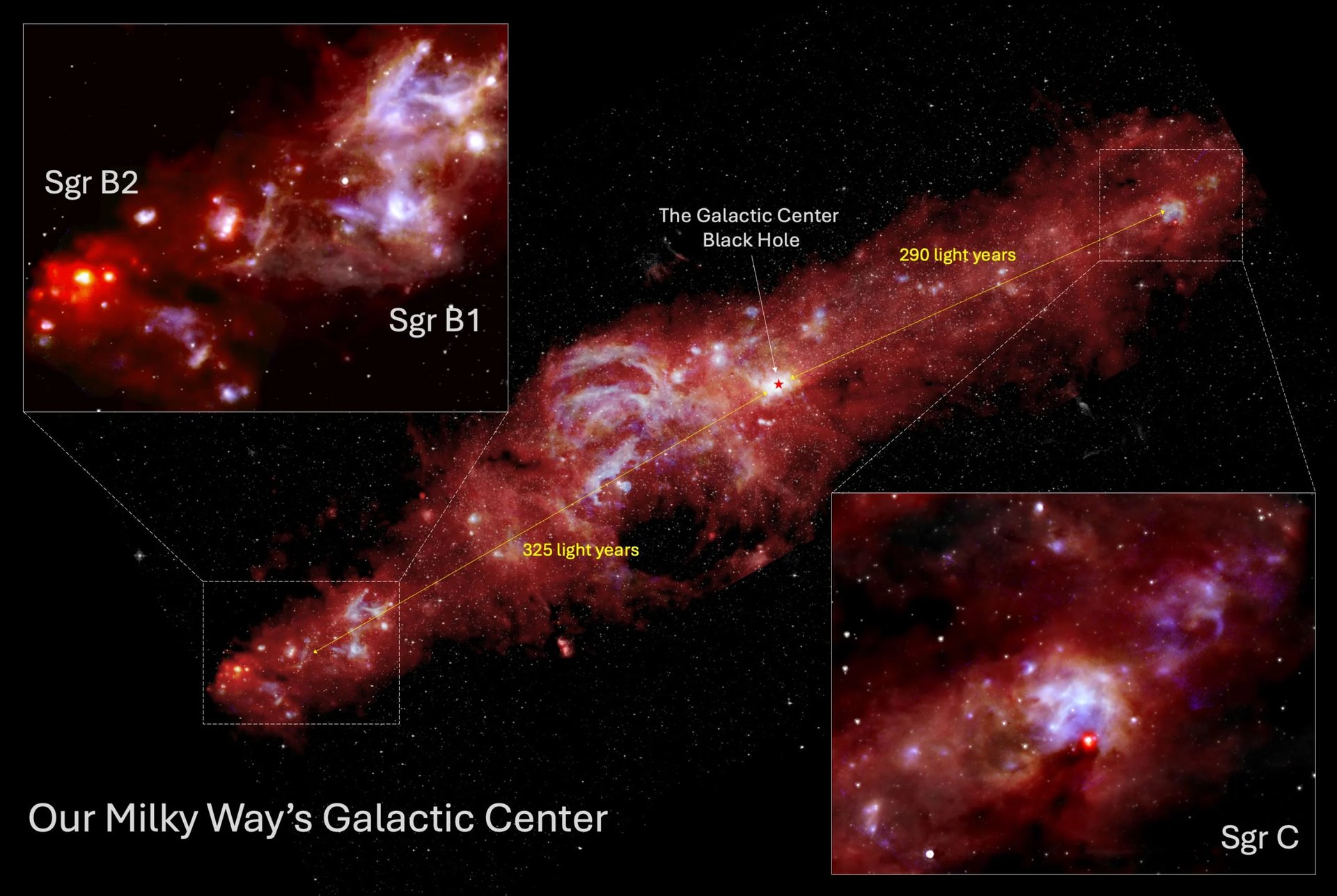 A detailed infrared view of the Galactic Center region of our Milky Way Galaxy. These infrared images are sensitive to the presently forming massive stars there as well as the emission from cool regions of dust and gas orbiting our Galactic Center’s supermassive black hole (marked by the red star symbol). Our Sun lies 26,000 light years from our Galactic Center, but Sgr B1, B2 and C are orbiting the Galactic Center at only about 300 light years. Credit: These images are made from data from the Stratospheric Observatory for Infrared Astronomy (SOFIA), the Spitzer Space Telescope, and the Herschel Space Observatory. (Credit: J. De Buizer (SETI) / SOFIA / Spitzer / Herschel)
Until now, such tranquil nurseries had only been seen in the quiet suburbs of the Galaxy, never in its turbulent core. Finding the same calm conditions even here suggests that stars may begin to form in much the same way wherever they arise, following a single universal recipe. The gas that became our own Sun, billions of years ago, very likely passed through just such a quiet phase, which makes a corner like this, in a sense, a glimpse of our own beginnings.
Now the hunt is on for more of these hidden islands of calm. With machine learning ready to comb through the enormous maps ALMA is producing, astronomers hope to turn up many more pockets of stillness scattered through the chaos. It seems that even in the wildest corner of the Milky Way, the universe still finds a quiet place to make its stars.
Source : A Quiet Corner of the Milky Way Could Hold the Secret to Star Formation