Universe Today
What shape is an asteroid? For (44) Nysa, the honest answer until now has been that nobody knew. It is one of the brightest and largest E-type asteroids in the main belt, a class with a surface rich in enstatite, and its oddness has made it a favourite target for well over a hundred years. Successive observations hinted that it was elongated, perhaps even two lumps stuck together, but the picture stayed frustratingly blurred.
An international team led by Kate Minker at Lowell Observatory has now brought two of the world's heaviest instruments to bear on it: SHARK-VIS on the Large Binocular Telescope in Arizona, and SPHERE/ZIMPOL on the Very Large Telescope in Chile. With adaptive optics correcting for the churn of our atmosphere, and purpose built processing to sharpen what came back, they have produced the finest images of Nysa ever obtained. Minker describes them as close to spacecraft quality, achieved without ever leaving the ground.
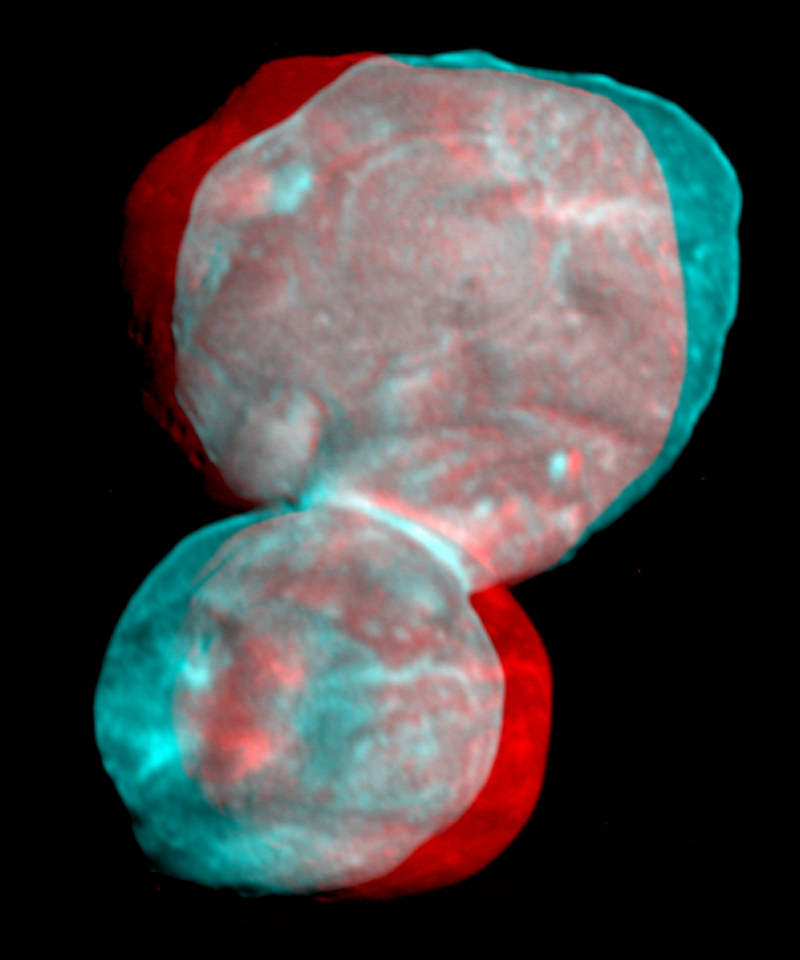 Arrokoth, photographed by New Horizons in 2019 - two bodies that drifted together gently enough to stick rather than shatter. Nysa may be the same trick performed with three. This is a red-blue anaglyph image, view it with 3D glasses and the two lobes separate into real depth (Credit : NASA/Johns Hopkins University Applied Physics Laboratory/Southwest Research Institute/National Optical Astronomy Observatory)
What those images show are two prominent valleys wrapping around the asteroid's circumference. The team read them as necks, the pinched joints where separate bodies have come to rest against one another. Three lobes, gently welded into one.
We have seen this before, but never in triplicate. Comet 67P looks like a rubber duck and the Kuiper Belt object Arrokoth resembles a flattened snowman. Both are contact binaries, two pieces that drifted together slowly enough to stick rather than shatter. Nysa would be the first contact trinary on the books.
The team are careful to leave the door open on the formation theory. The alternative reading is that Nysa is simply a single body so deeply battered and indented that it merely resembles three, which would itself be a first, nothing else known looks like that either. Either way, it’s peculiar.
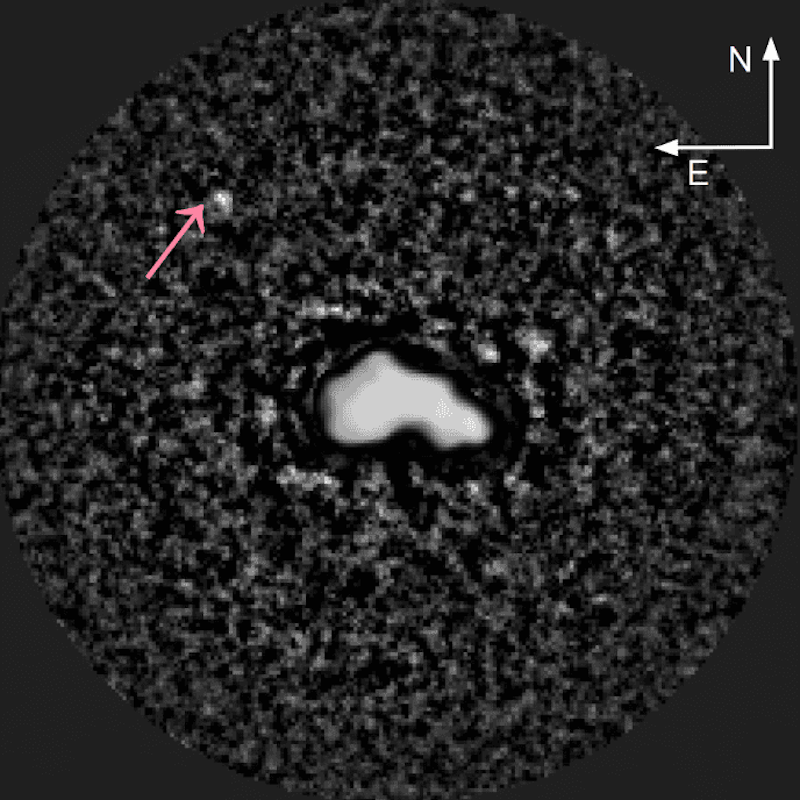
This is where it’s moon comes in. Borrowing high contrast imaging techniques developed for hunting planets around other stars, the team pulled a faint speck out of Nysa's glare, a satellite about a kilometre across, orbiting at least 170 kilometres from the 75 kilometre primary, now designated S/2026 (44) 1. It was spotted independently in two separate observing runs.
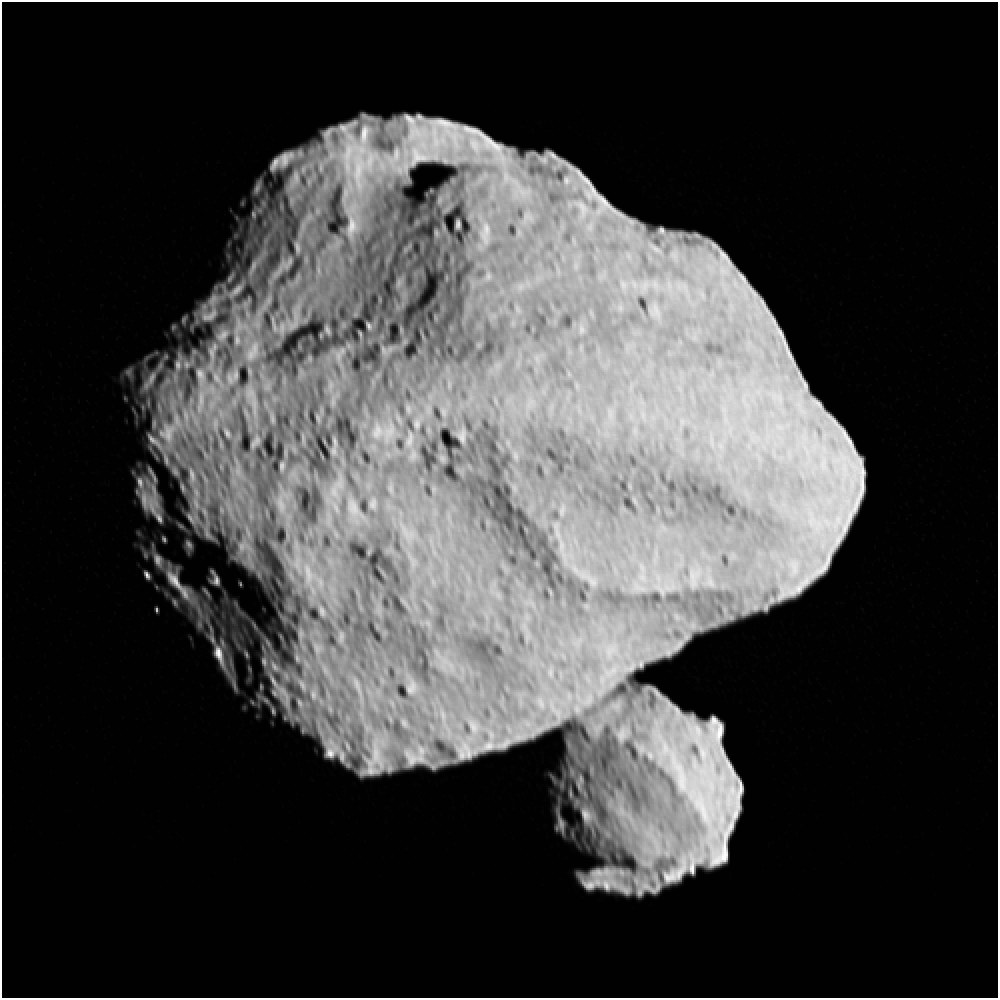 Asteroid Dinkinesh with its satellite Selam, seen by NASA's Lucy spacecraft in 2023. Small asteroids with moons have turned out to be common and each moon helps us to understand the properties of its parent body (Credit : NASA/Goddard/SwRI/Johns Hopkins APL/NOIRLab)
Tracking the moon’s orbit, you get Nysa's mass, and from mass and volume comes density and density is exactly what distinguishes a loose reassembly of collision debris from a solid, coherent rock. The argument about what Nysa is may be settled not by the images that started it, but by the speck of light beside them.
There is a longer game here too. E-type asteroids may be leftovers from the enstatite rich inner Solar System, either primitive building blocks that never grew up or fragments of the crust of something that did. Working out how Nysa came to be shaped like this is, in the end, a question about how the planets were assembled.
Source : Asteroid (44) Nysa May Be the First-Known Three-Lobed World