 Universe Today
Most stars in the Milky Way are binary stars. Binary relationships shape the futures of the stars in them, and astronomers are eager to learn more about the processes that generate binaries and shape outcomes. To do that, they need to find and monitor young binary protostars.
The fraction of binary stars scales with stellar mass. About 25-30% of M-dwarfs, 45-50% of Sun-like stars, and 50-70% of A-type stars are binaries. But for the most massive type of star, O/B stars, the number is at least 75%, and could be greater than 90%.
There are three pathways stars can follow to become binaries: disk fragmentation, capture, and core fragmentation. Astronomers want to understand them in greater detail and determine if theory matches deeper observations. Since massive stars play a critical role in the Universe by synthesizing heavy elements and spreading them out into space, researchers have reason to learn how they form and evolve in binaries.
In new research published in Nature Astronomy, astronomers used ALMA to observe a massive binary system while its still forming. The research is titled "An eccentric massive protobinary assembled via a core-merger parabolic encounter." The first author is Yao Wang, from the Department of Astronomy in the School of Physics and Astronomy, at Shanghai Jiao Tong University in China.
"Most massive stars form in binary systems, which profoundly influence their subsequent evolution," the authors write. "However, how such systems form remains poorly understood, with several competing scenarios proposed, including disk fragmentation, core fragmentation and capture."
In disk fragmenation, a single star forms first, which causes the disk to fragment, producing a binary companion. This process produces close binaries with very similar masses.
In core fragmentation, a collapsing gas cloud fragments into more than one core, and a binary star forms. This is the primary way that binaries on wider orbits are produced.
The third pathway involves post-formation dynamics. Sometimes several stars will be in a system, and interactions and migrations can shrink distances between stars, forming binaries.
"This study demonstrates that the early lives of stars can be quite chaotic, with a chance encounter leading to this gravitational dance and stellar coupling." - Jonathan C. Tan, University of Virginia.
"Determining the orbital architectures of massive binaries, particularly during their earliest embedded phases, is therefore crucial for distinguishing among these formation pathways, but direct measurements of their three-dimensional motions have remained exceptionally challenging," the authors explain.
This research is focused on IRAS 07299−1651, a binary system of massive young stars about 5,500 light years away. The researchers first observed it back in 2019 with ALMA. Those observations supported the idea that the pair of stars formed from the fragmentation of one disk. But there was uncertainty because the disks around both stars appeared to be misaligned.
That led to the current work. They used radio observations from ALMA and the Very Large Array, and combined them with infrared observations from JWST and the VLT. The infrared observations were critical. They let the astronomers detect the jets from their stars, orienting them in space relative to their disks. They tracked the movements of both stars for almost 8 years, and created detailed, 3D images of the system.
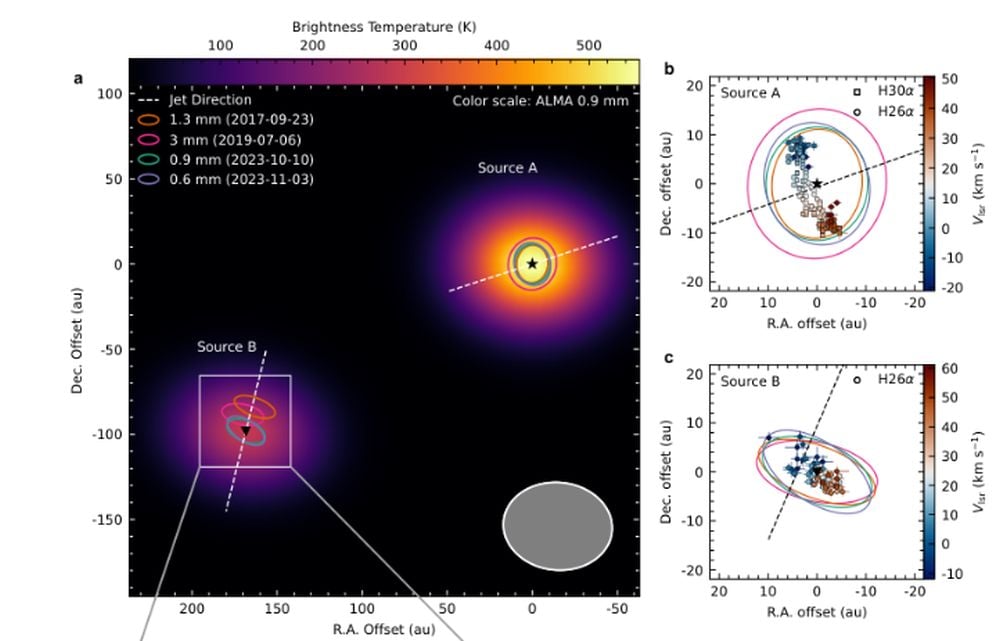 These panels show some of the data used in the study. Determining the direction of the jets was a critical part of the research. Image Credit: Wang et al. 2026. NatAstr.
"For the first time, we were able to watch two massive stars move around one another while they were still being born," said Yichen Zhang, corresponding author of the study.
These detailed images show that the pair of stars follows an elongated orbit and is surrounded by gas disks with strong tilts. The disks are doubly-tilted: in relation to the orbit of the stars, and also relative to each other.
"Each telescope revealed a different piece of the puzzle," said Rubén Fedriani, a co-author of the study. "The combination of radio and infrared observations provides the most exquisite detail on the formation of this massive protobinary system."
"It felt like solving a three-dimensional puzzle," said Yao Wang, the study's first author. "Each new observation added another piece, and eventually the orbit, disks, and jets all came together into a single, coherent picture."
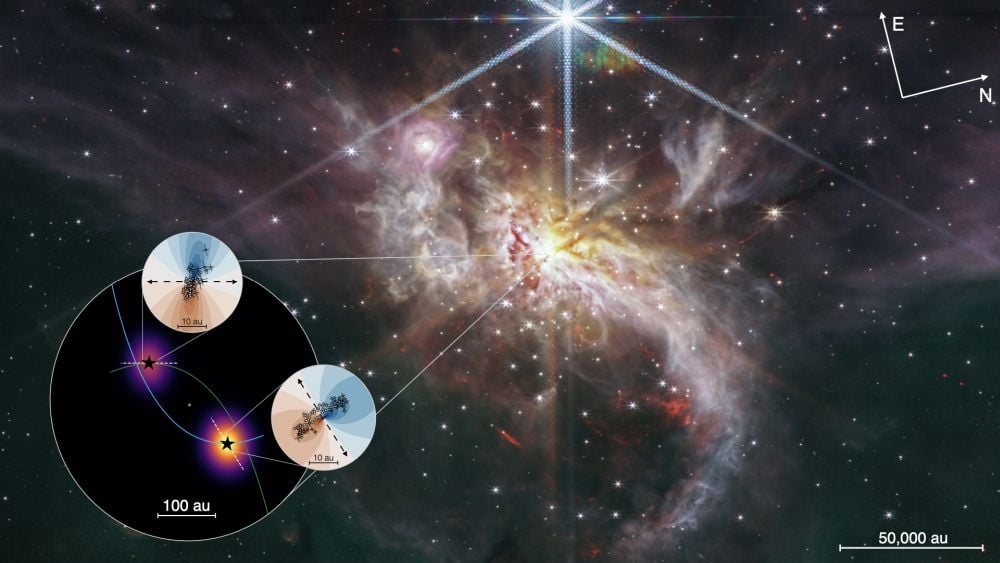 The inset circle shows an ALMA image of the central binary system of IRAS 07299−1651, overlain with the reconstructed orbital trajectories. The red- and blue-shifted hydrogen recombination line emission traces the rotation of the ionized circumstellar disks around the two forming stars. The arrows indicate the directions of the bipolar jets. Background: Mid-infrared image of the region obtained with JWST. Image Credit: NASA, ESA, CSA, STScI, J. DePasquale (STScI), ALMA (ESO/NAOJ/NRAO), Y. Zhang
The authors explain that disk fragmentation can't really explain these findings. Despite some uncertainty in their orbita solutions, they write that the orbit is is highly eccentric, almost parabolic. There's also strong misalignment between both stellar disks and between the binary orbital plane. There's also no circumbinary disk, which form after the individual stellar disks. "These properties are difficult to reconcile with a disk fragmentation origin," they write.
The researchers say that the "preferred orbital solutions" mean the binary system is close to an important boundary. On one side the system would be unbound, on the other it's bound. This is consistent with the stars forming in one of two ways: "through fragmentation within marginally bound regions of a common cloud or from initially unbound cores, before undergoing a recent close encounter," the write.
Digging deeper, the researchers say that the cloud or core fragmentation solution "requires synchronization of the massive star formation events within a relatively short period." But that's not likely what happened in IRAS 07299−1651. Instead, post-formation, the unbound cores had an encounter that shaped their orbits and their disks.
Taken together, the researchers settle on a version of events behind the formation of the massive binary system.
"These properties are naturally explained by a ‘core-merger’ scenario in which the two protostars originated independently from initially unbound cores that recently underwent a near-parabolic encounter, producing an eccentric binary with a current separation of about 200 au," the authors write. That encounter may have been as little as 60 years before these observations, the blink of an eye in astronomy.
"This study demonstrates that the early lives of stars can be quite chaotic, with a chance encounter leading to this gravitational dance and stellar coupling," said co-author Jonathan C. Tan from the Department of Astronomy at University of Virginia.
"These findings suggest that the core-merger process may represent an important pathway for forming eccentric massive binaries," the researchers conclude.

