 Universe Today
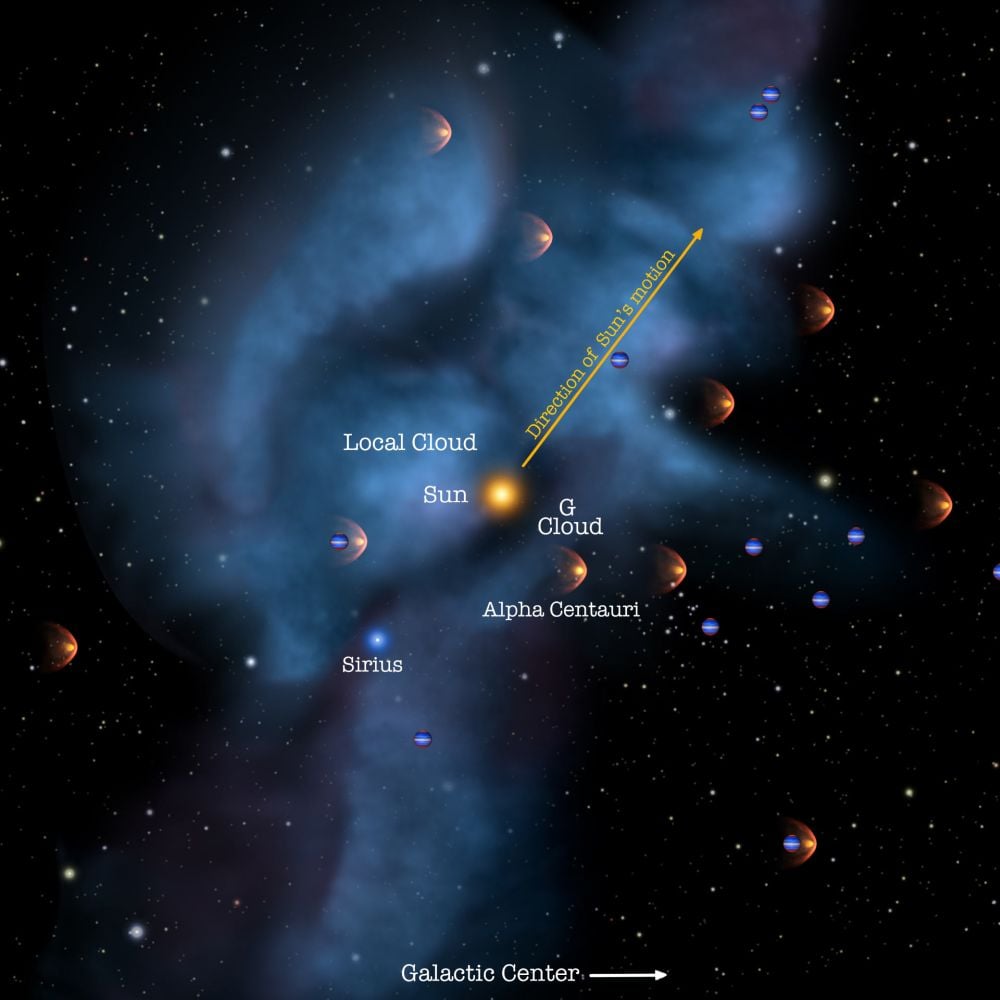
Iron-60 is a radioactive isotope of iron that's found in Antarctic ice and in deep-sea crusts. It's only source is nucleosynthesis in the cataclysmic explosive destruction of massive stars—supernovae. Since its half-life is about 2.6 million years, and since it's not produced on Earth, its presence serves as a tracer of events beyond Earth millions of years ago.
New research in Physical Review Letters examines iron-60 in Antarctic ice to help understand Earth's passage through a massive interstellar dust cloud. It's titled "Local Interstellar Cloud Structure Imprinted in Antarctic Ice by Supernova 60 Fe." The lead author is Dominik Koll from the Institute of Ion Beam Physics and Materials Research at HZDR (Helmholtz Zentrum Dresden Rossendorf).
Koll was also the lead author of a 2019 paper that presented the very first detection of 60Fe in Antarctica. The authors of that paper determined that it had no Earthly source. "After elimination of possible terrestrial sources, such as global fallout, the excess of 60Fe could only be attributed to interstellar 60Fe which might originate from the solar neighborhood," the authors wrote in their paper.
In this new research, the authors are digging more deeply into the 60Fe to determine its source.
"The solar system currently traverses the Local Interstellar Cloud (LIC), one of several warm cloudlets of the Complex of Local Interstellar Clouds (CLIC) in the solar neighborhood," they write. Nobody knows the origin of these cloudlets, but one distinct possibility is supernovae shocks. "If supernovae are the source of these cloudlets or influence their properties, the CLIC may act as a cosmic archive for the supernova-produced radionuclide 60Fe."
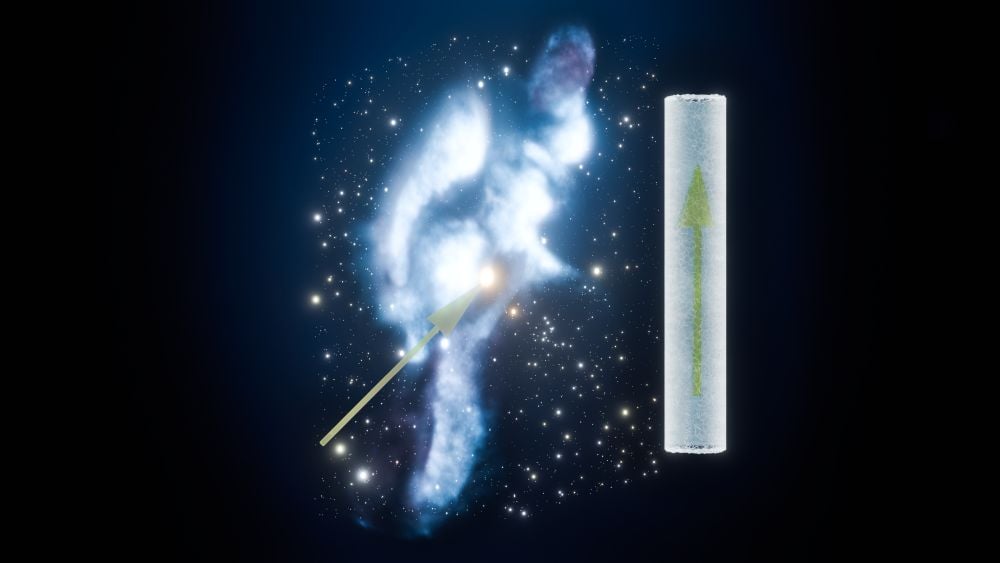 This illustration shows the path the Solar System follows through the Local Interstellar Cloud. The cloud’s profile is preserved as an interstellar fingerprint in Antarctic ice. Image Credit: B. Schröder/HZDR/ NASA/Goddard/Adler/U.Chicago/Wesleyan
“Our idea (in 2019) was that the Local Interstellar Cloud contains iron-60 and can store it over long time periods. As the Solar System moves through the cloud, Earth could collect this material. However, we couldn’t prove this at the time,” explained lead author Koll in a press release.
Iron-60 is also found in deep-sea sediments up to 30,000 years old. There were competing explanations for its presence centered on supernovae. One explanation is that the Iron-60 is the very end of the decaying isotope from one of the known supernovae that exploded in Earth's vicinity millions of years ago. That explanation doesn't rely on the LIC. In this view, the decaying 60Fe is just the remnant from that supernova slowly fading in time.
In this work, the researchers examined Antarctic ice samples from 40,000 to 80,000 years ago. By comparing them with other samples, including deep-sea samples, they learned that Earth is receiving more iron-60 today and in more recent times, while at older times it received less. These changing abundances rule out the potential explanation that the iron-60 is from the gradual fading of a single supernovae. The amount of the isotope on Earth can't change so much in only a few tens of thousands of years by that hypothesis.
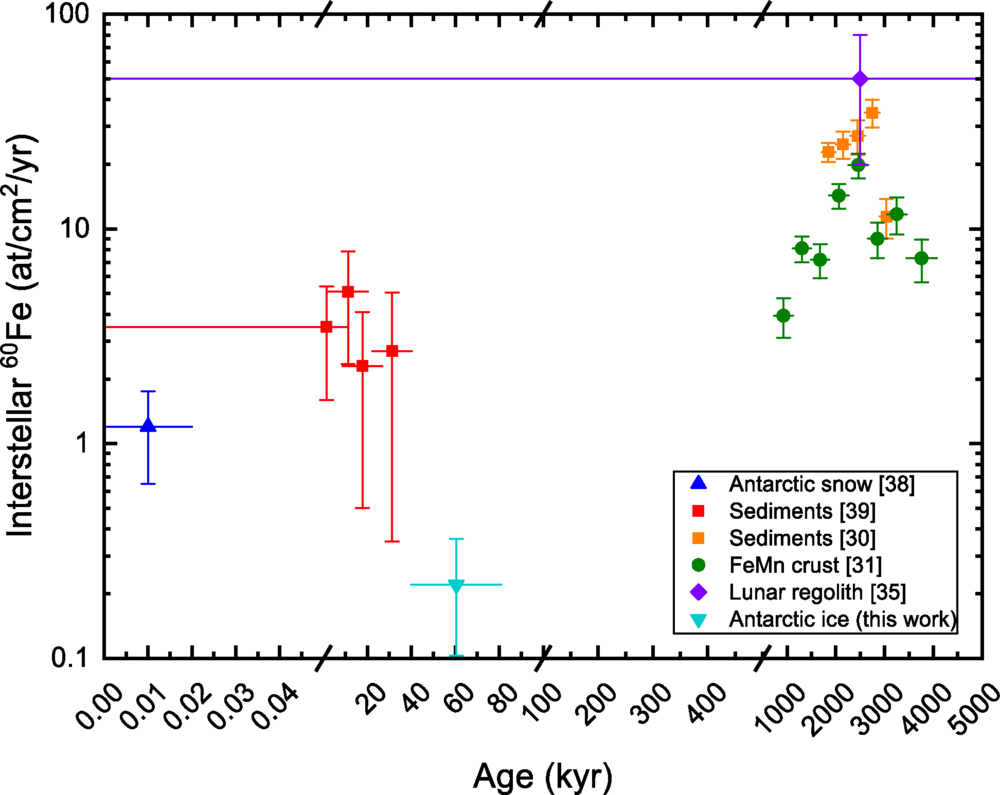 This figure from the study shows measuread abundances of interstellar iron-60 on the x-axis, at different points in Earth's history on the y-axis. Each coloured marker represents different sources of measure iron-60. Overall, it shows that the amount of the isotope deposited has changed over time with separate peaks. If it was all from one fading supernovae, the amounts should slow a gradual downward trend. Image Credit: Koll et al., 2026. PRL. DOI: https://doi.org/10.1103/nxjq-jwgp
"This suggests that we were previously in a medium with lower iron-60 content, or that the cloud itself exhibits strong density variations," explained Koll.
Scientists think that the LIC was created by multiple supernova explosions, up to 20 of them, between 15 and 20 million years ago. Multiple supernova explosions create separate bursts of 60Fe production. Not only that, but supernovae generate powerful shock waves, and with multiple explosions over millions of years, these interacting waves would create regions with different abundances of the isotope. As the Solar System travels through the clouds, differing amounts of 60Fe reach Earth, explaining the changing abundances.
"These results suggest that the LIC is a cosmic archive for supernova-produced 60Fe," the authors write in their paper. "The imprinted 60Fe time profile is evidence for a changing local interstellar environment over the last 80 kyr."

