New Model Predicts That We’re Probably the Only Advanced Civilization in the Observable Universe
The Fermi Paradox remains a stumbling block when it comes to the search for extra-terrestrial intelligence (SETI). Named in honor of the famed physicist Enrico Fermi who first proposed it, this paradox addresses the apparent disparity between the expected probability that intelligent life is plentiful in the Universe, and the apparent lack of evidence of extra-terrestrial intelligence (ETI).
In the decades since Enrico Fermi first posed the question that encapsulates this paradox (“Where is everybody?”), scientists have attempted to explain this disparity one way or another. But in a new study conducted by three famed scholars from the Future of Humanity Institute (FHI) at Oxford University, the paradox is reevaluated in such a way that it makes it seem likely that humanity is alone in the observable Universe.
The study, titled “Dissolving the Fermi Paradox“, recently appeared online. The study was jointly-conducted by Anders Sandberg, a Research Fellow at the Future of Humanity Institute and a Martin Senior Fellow at Oxford University; Eric Drexler, the famed engineer who popularized the concept of nanotechnology; and Tod Ord, the famous Australian moral philosopher at Oxford University.
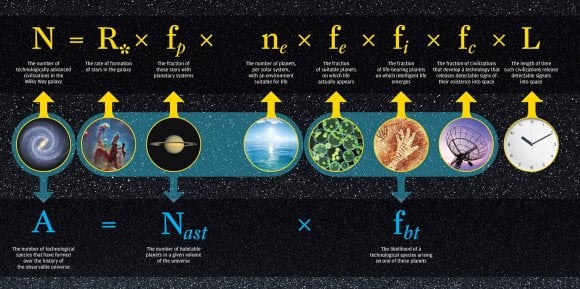
The Drake Equation, a mathematical formula for the probability of finding life or advanced civilizations in the universe. Credit: University of Rochester
For the sake of their study, the team took a fresh look at the Drake Equation, the famous equation proposed by astronomer Dr. Frank Drake in the 1960s. Based on hypothetical values for a number of factors, this equation has traditionally been used to demonstrate that – even if the amount of life developing at any given site is small – the sheer multitude of possible sites should yield a large number of potentially observable civilizations.
This equation states that the number of civilizations (N) in our galaxy that we might able to communicate can be determined by multiplying the average rate of star formation in our galaxy (R*), the fraction of those stars which have planets (fp), the number of planets that can actually support life (ne), the number of planets that will develop life (fl), the number of planets that will develop intelligent life (fi), the number civilizations that would develop transmission technologies (fc), and the length of time that these civilizations would have to transmit their signals into space (L). Mathematically, this is expressed as:
N = R* x fp x ne x fl x fi x fc x L
Dr. Sandberg is no stranger to the Fermi Paradox, nor is he shy about attempting to resolve it. In a previous study, titled “That is not dead which can eternal lie: the aestivation hypothesis for resolving Fermi’s paradox“, Sandberg and his associates proposed that the Fermi Paradox arises from the fact that ETIs are not dead, but currently in a state of hibernation – what they called “aestivation” – and awaiting better conditions in the Universe.
In a study conducted back in 2013, Sandberg and Stuart Armstrong (also a research associate with the FHI and one of the co-authors on this study) extended the Fermi Paradox to look beyond our own galaxy, addressing how more advanced civilizations would feasibly be able to launch colonization projects with relative ease (and even travel between galaxies without difficulty).
As Dr. Sandberg told Universe Today via email:
“One can answer [the Fermi Paradox] by saying intelligence is very rare, but then it needs to be tremendously rare. Another possibility is that intelligence doesn’t last very long, but it is enough that one civilization survives for it to become visible. Attempts at explaining it by having all intelligences acting in the same way (staying quiet, avoiding contact with us, transcending) fail since they require every individual belonging to every society in every civilization to behave in the same way, the strongest sociological claim ever. Claiming long-range settlement or communication are impossible requires assuming a surprisingly low technology ceiling. Whatever the answer is, it more or less has to be strange.”
In this latest study, Sandberg, Drexler and Ord reconsider the parameters of the Drake Equation by incorporating models of chemical and genetic transitions on paths to the origin of life. From this, they show that there is a considerable amount of scientific uncertainties that span multiple orders of magnitude. Or as Dr. Sandberg explained it:
“Many parameters are very uncertain given current knowledge. While we have learned a lot more about the astrophysical ones since Drake and Sagan in the 1960s, we are still very uncertain about the probability of life and intelligence. When people discuss the equation it is not uncommon to hear them say something like: “this parameter is uncertain, but let’s make a guess and remember that it is a guess”, finally reaching a result that they admit is based on guesses. But this result will be stated as single number, and that anchors us to an *apparently* exact estimate – when it should have a proper uncertainty range. This often leads to overconfidence, and worse, the Drake equation is very sensitive to bias: if you are hopeful a small nudge upwards in several uncertain estimates will give a hopeful result, and if you are a pessimist you can easily get a low result.”
As such, Sandberg, Drexler and Ord looked at the equation’s parameters as uncertainty ranges. Instead of focusing on what value they might have, they looked at what the largest and smallest values they could have based on current knowledge. Whereas some values have become well constrained – such as the number of planets in our galaxy based on exoplanet studies and the number that exist within a star’s habitable zone – others remain far more uncertain.
When they combined these uncertainties, rather than the guesswork that often go into the Fermi Paradox, the team got a distribution as a result. Naturally, this resulted in a broad spread due to the number of uncertainties involved. But as Dr. Sandberg explained, it did provide them with an estimate of the likelihood that humanity (given what we know) is alone in the galaxy:
“We found that even using the guesstimates in the literature (we took them and randomly combined the parameter estimates) one can have a situation where the mean number of civilizations in the galaxy might be fairly high – say a hundred – and yet the probability that we are alone in the galaxy is 30%! The reason is that there is a very skew distribution of likelihood.
“If we instead try to review the scientific knowledge, things get even more extreme. This is because the probability of getting life and intelligence on a planet has an *extreme* uncertainty given what we know – we cannot rule out that it happens nearly everywhere there is the right conditions, but we cannot rule out that it is astronomically rare. This leads to an even stronger uncertainty about the number of civilizations, drawing us to conclude that there is a fairly high likelihood that we are alone. However, we *also* conclude that we shouldn’t be too surprised if we find intelligence!”

Is anybody out there? Anybody at all? Credit: UCLA SETI Group/Yuri Beletsky, Carnegie Las Campanas Observatory
In the end, the team’s conclusions do not mean that humanity is alone in the Universe, or that the odds of finding evidence of extra-terrestrial civilizations (both past and present) is unlikely. Instead, it simply means that we can say with greater confidence – based on what we know – that humanity is most likely the only intelligent species in the Milky Way Galaxy at present.
And of course, this all comes down to the uncertainties we currently have to contend with when it comes to SETI and the Drake Equation. In that respect, the study conducted by Sandberg, Drexler and Ord is an indication that much more needs to be learned before we can attempt to determine just how likely ETI is out there.
“What we are not showing is that SETI is pointless – quite the opposite!” said Dr. Sandberg. “There is a tremendous level of uncertainty to reduce. The paper shows that astrobiology and SETI can play a big role in reducing the uncertainty about some of the parameters. Even terrestrial biology may give us important information about the probability of life emerging and the conditions leading to intelligence. Finally, one important conclusion we find is that lack of observed intelligence does not strongly make us conclude that intelligence doesn’t last long: the stars are not foretelling our doom!”
So take heart, SETI enthusiasts! While the Drake Equation may not be something we can produce accurate values for anytime soon, the more we learn, the more refined the values will be. And remember, we only need to find intelligent life once in order for the Fermi Paradox to be resolved!
Further Reading: arXiv

ETI, extra-terrestrial intelligence, Featured, fermi paradox, observable universe, search for extra-terrestrial intelligence, SETI
20 Responses
Leave a Reply
You must be logged in to post a comment.


I don’t believe it to be so, but if it were true that we are the only advanced civilization in the observable universe, what a disappointment that we are the “best” that the universe has to offer.
Btw, MANY people have suggested the hibernation theory and even voluntary extinction. It’s not new.
The “reasonable conclusion” is that we are the only intelligent civilization in the Milk Way galaxy at the present? Yet the whole article, while fascinating and informative, seems to really state that no one has a clue what’s out there. Given the massive distances involved between galaxies, it’s not too hard to extrapolate that civilizations could come and go without our ever being aware. Indeed, we may disappear without anyone ever knowing that we existed. Really sad, when you think about it.
I leave a comment with trepidation, but . . . . for people in these articles, smack of advertising for their profession, and it’s how they monetize their lives, like YouTube videographers
there should be a reality check involved: for how long this universe has been around or burped out of a black hole how many times, and the time span for each burp, what small time span has “intelligent” life been part of these iterations and what small time span has that “intelligent” life managed to try to communicate out into the stars to other “intelligent” life forms at a similar stage of evolution . . . . . and to what end?
humans, as “intelligent” animals have only been around for a few hundred thousand years, developed “science” (the mathematics of measurement, compared to philosophy) for about 500+ years, and how long does it take for a “message” (at the speed of light) to get from here, to there, and back again? would we still be around? probably not
and to get there (again at the speed of light or FTL) would we still be around as a species?
NO
so, who cares? let’s just deal with the planet we’ve been dealt and hang in there appreciating our position in the cosmos; we should investigate what that position is, but not try to populate another planet or solar system like locusts hunting for it’s next Eden to strip bare and poison
“just saying” . . . . and for you guys: get another gig ! !
The same argument has been made, likely since we all lived in caves. “We’ve got plenty of Auroch’s, so who cares what’s out there”. Yet exploration has been a benefit to humanity as whole (while admittedly being a detriment to pockets of us) since the exploring began. We learned from each other. We gathered more data for our science. We found new resources to exploit for our benefit..and on and on.
We will explore the stars too. We we live on new planets. Our species will survive our sun’s nova. Hopefully we’ll run across some other folks along the way, just because it’d be interesting. Maybe we’ll become the other folks as pockets of humanity take different technologically driven evolutionary paths. We are human, there is no shame in behaving as such.
The model is absurd, but leave it to bubble room ivy league academics who couldn’t think of soft-landing a booster, to come up with such an arrogant and anthropocentric perspective..
I have no idea if we’re “alone” (and neither does or can anyone else, so why we keep obsessing on this I don’t know), but here’s a point I never hear mentioned:
There are over a million species on earth just now, and since the beginning of time it’s estimated there have been over a BILLION species, from the tiniest, most insignificant lifeforms to us. But how many have made it to intelligence, and by intelligence I don’t mean able to communicate with sign language or sing songs under water, though these are impressive, but I mean sending spaceships to the stars and building radio telescopes that can listen to the cosmos? Just ONE. Out of a BILLION. Now, earth is just a sample of one, so it may not be significant or typical, but just judging by our own planet, intelligence is very rare. Maybe not life, but intelligent life. This is a distinction that gets blurred when people say there’s “no way” we could be “alone” in the universe. Alone, almost certainly not, but lonely when looking for technological intelligence…quite possibly.
The article should specify that we are most likely the only intelligent civilization in this galaxy. This was already self-evident when considering that it would only take 50 million years to colonize the entire galaxy, even with our current primitive propulsion systems. Any advanced civilization already present in this galaxy would quite literally be everywhere by now, yet we have found no tangible evidence of anything.
A really advanced civilization would have no need to colonize. If you had everything you ever wanted at home, and if you could go anywhere at the blink of an eye, why would you want to live somewhere else other than home? Also, a really advanced civilization probably would know how to handle immortality, so there would be no need to multiply/ reproduce. And if you don’t reproduce, there is no overpopulation to move to other planets.
I believe that an advanced civilization capable of colonizing other star systems in their home galaxy will inevitably colonize their whole galaxy. Most likely such a civilization will display a fair degree of heterogeneity in its behavior and political thinking. Reasons are that different colonies separated by vast distances will diverge in thought from the mother colony much like what happened in the U.S. where the colonies rebelled successfully against the crown and went their own way politically. Just over the vast time scales some portion of the civilization will decide to expand into the frontier until nothing is left. Eventually some will want to move on to other galaxies but the effort and leap is much greater. It is harder to imagine a civilization that is so uniformly monolithic in thought, as well as so resource efficient, over vast time scales that it never expands outward to encompass the whole galaxy.
I would go further because once a galaxy has been colonized in 50 million years, it is only 2.5 million light years to the next one. Assuming 10% to 20% light speed, they will be here colonizing in 10 to 25 million years
we don’t know what’s in our oceans yet we are bold enough to state that an unimaginable vast universe is void of evolved life. go figure 🙂
Fermi’s ‘Paradox’ requires that ‘Intelligent Life’ should invade nearby star systems, and then distant start systems, and to carry on doing this one thing for the next fifty million years, in order to be considered ‘intelligent’.
I like Drake’s equation. We do not have a good handle of many of the constants, but every time one of the constants is changed by a new discovery, we can tell whether it is more or less likely. But, anyone multiplying all of them together and claiming ‘to 30% probability’ is fooling no-one but themselves.
Matt Williams seems to ignore the presence of UFOs. There is a lot of fraud out there, but I imagine the USAF would not be scrambled for some imaginary targets. If they are not from this galaxy, them they must come from a different galaxy/ neighborhood.
Quoting Dr. Sanberg:
“…Attempts at explaining it by having all intelligences acting in the same way (staying quiet, avoiding contact with us, transcending) fail since they require every individual belonging to every society in every civilization to behave in the same way, the strongest sociological claim ever. ..”
Why is that the strongest sociological clam ever? I disagree for two possible reasons:
1. Any Intelligent society that had the means to travel such vast distances would likely also be able to observe long range and also probably have developed rules / laws that prohibit contact as not to alter the course of human development (a ‘prime directive’)…
2. If you were an alien conducting long-range observation of our society, would you really want risk your neck visiting and being captured, turned into an experiment and your technology transferred? Any scientist who thinks we humans with our millitaries and war machines would not behave in this way is being truly naive.
The ‘sociological claim’ is not so strong! Just common sense from an imagined alien viewpoint.
Dare I say it? The Drake Equation has some problems. What we want from the Drake Equation is a probability of intelligent life in our galaxy. If all the terms were fractions or probabilities, it would be a simple matter of multiplying them together as the Drake Equation does. However not all the terms can be expressed as probabilities. Look at the first term, R*, the rate of star formation. Why do we even need R* anyway? We already have an estimate of how many stars there are and what percentage have planets that can support life life. Why not start there? The last term, L, is another problem. It is not a fraction or a probability but the length of time the civilizations would have to transmit their signals. Nearer civilizations would naturally have less time than farther ones. But farther ones may have only a few centuries before they go extinct and that window of a few centuries would have to coincide with their distance from us such that their signal arrives when we’re listening. So in order for L to be a meaningful number we would somehow have to combine a planet’s distance with the potential of having a civilization at a stage in their development when they are capable of sending messages into space. This would be a very difficult calculation as the number of potential civilizations goes up with the square of distance. This complexity is not reflected in the Equation.
One only has to visit different countries on earth to discover that what is common sense in one society is foolish in another. It is unimaginable how different another civilization might be.
I just turned 60 and maybe I’ve watched too many Alien moves over my life, but what if we find intelligence that is not friendly or indifferent to other intelligent life? Until very recently, we’ve managed to wipe out other intelligent life on this planet – like the whales and gorillas. What if these other Alien intelligence decides to put Galactic Hyperspace Bypass through our Solar System? Our star and the orbiting planets could be bulldozed out of existence by this Alien intelligence in order to provide a passageway through space. There are worse things like becoming food for Aliens. We harvest cows, pigs, sheep and other herbivores for food, don’t we?
Any alien that dominates its area is the meanest toughest son of a bitch there.
If an advance civilization is far enough away we might now know about it for billions of years. The farthest observable star is currently 55 million light years away. They could have mastered intergalactic travel 54 million years ago and we still wouldn’t know about it for a million years.
So, basically you can fill in this equation with whatever you want, to come up with whatever result you think is fun. Reading about the Drake equation makes you dumber.