Ares I-X Launch Image Gallery
There are some great images of Wednesday's Ares I-X launch. Most notable is this one of the Prandtl–Glauert singularity
Click to continue…
Filed under: Constellation | 5 Comments »
Far away in the constellation of Aries, in a 14th magnitude barred spiral galaxy designated as NGC 918… a star exploded with enough candlepower to briefly outshine its home. Discovered independently by Lick Observatory Supernova Search (LOSS) and Koichi Itagaki (Japan) on October 11, 2009, this Type II supernova might be hiding in the intergalactic dust, but it isn't hiding from Joe Brimacombe. Click to continue…
Filed under: Astronomy, Astrophotos | 11 Comments »
."]![The Apollo 17 Lunar Module Challenger descent stage comes into focus from the new lower 50-km mapping orbit, image width is 102 meters [NASA/GSFC/Arizona State University]. The Apollo 17 Lunar Module Challenger descent stage comes into focus from the new lower 50-km mapping orbit, image width is 102 meters [NASA/GSFC/Arizona State University].](http://www.universetoday.com/wp-content/uploads/2009/10/Apollo-17-580x580.jpg)
The Lunar Reconnaissance Orbiter maneuvered into its 50-km mapping orbit on September 15, which enables it to take a closer look at the Moon than any previous orbiter. This also allows for comparing previous images taken by LRO when it was at its higher orbit. Here's the Apollo 17 landing site: just look at what is all visible, especially in the image below! These images have more than two times better resolution than the previously acquired images.
Filed under: Moon | 21 Comments »

This image shows the afterglow of GRB 090423 (red source in the centre) and was created from images taken in the z, Y and J filters at Gemini-South and VLT (credit: A. J. Levan).
On April 23, 2009 the Swift satellite detected a gamma ray burst and as we reported back in April, scientists soon realized that it was more than 13 billion light-years from Earth. GRB 090423 occurred 630 million years after the Big Bang, when the Universe was only four percent of its current age of 13.7 billion years. Now, continued observations of the GRB by astronomers around the world have yielded more information about this dramatic and ancient event: the GRB didn't come from a monster star, but it produced a fairly sizable explosion.
Click to continue…
Filed under: Gamma Ray Bursts | 29 Comments »
While the Fermi Space Telescope has mapped the gamma ray sky with unprecedented resolution and sensitivity, it now has been able to take a measurement that has provided rare experimental evidence about the very structure of space and time, unified as space-time. Einstein's theory of relativity states that all electromagnetic radiation travels through a vacuum at the same speed. Fermi detected two gamma ray photons which varied widely in energy; yet even after traveling 7 billion years, the two different photons arrived almost simultaneously.
Click to continue…
Filed under: Gamma Ray Bursts | 31 Comments »
After waiting out weather and triboelectrification issues, the Arex I-X rocket thundered and crackled away from the launch pad at 11:30 am EDT with a successful (and beautiful) launch. The vehicle ran through the entire 2-minute test flight with no obvious problems or issues, ending with the stages separating and parachuting down to the Atlantic Ocean. This marks the first time a new vehicle has launched from Kennedy Space Center since the first space shuttle launch in 1981. "The only thing we were waiting for was weather," said a jubilant test flight director Ed Mango to his team after the flight, "and that means all of you did fricking fantastic!"
Click to continue…
Filed under: Constellation | 13 Comments »
Filed under: Space Flight | 24 Comments »

Need to get away from it all? If you have a background in medicine, computers or engineering and can speak a little Russian and English, this might be just what you are looking for. The European Space Agency and the Russian Institute of Medical and Biological Problems are still looking for volunteers to participate in a 520-day simulation of an expedition to Mars. The institute announced last week the opening of registration, but haven't yet gotten enough applicants. The nearly two-year experiment will simulate all aspects of a journey to the Red Planet, with a 250-day outward trip, a 30-day stay on its surface, and a 240-day return flight.
Click to continue…
Filed under: Mars | 2 Comments »

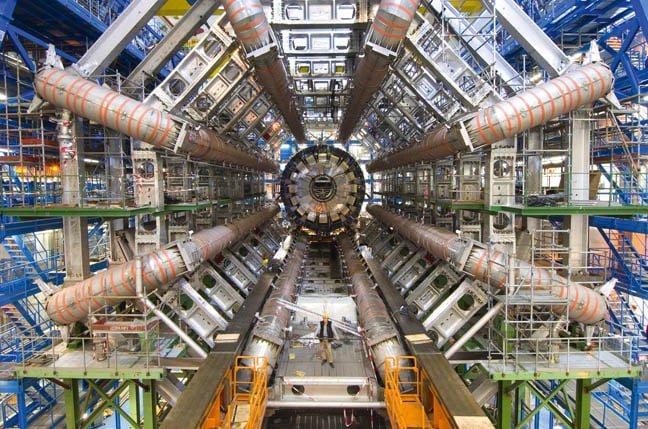
The first ion beam entering point 2 of the LHC, just before the ALICE detector (23 October 2009). Credit: CERN
Filed under: Physics | 6 Comments »
JPL has a fun article on their website detailing what future robotic exploration might entail: an armada of robots could one day fly above the mountain tops of Saturn's moon Titan, cross its vast dunes and sail in its liquid lakes. This is the vision of Wolfgang Fink, from the California Institute of Technology. He says we are on the brink of a great paradigm shift in planetary exploration, and the next round of robotic explorers will be nothing like what we see today.
Click to continue…
Filed under: Space Exploration | 10 Comments »
Did you get a chance to check out the IYA Live Telescope? Our last object was Messier 50 (also known as M 50 or NGC 2323) is an open cluster in the constellation Monoceros. It was perhaps discovered by G. D. Cassini before 1711 and independently discovered by Charles Messier in 1772. M50 is at a distance of about 3,000 light-years away from Earth. It is described as a 'heart-shaped' figure. You'll find the video inside! Click to continue…
Filed under: IYA 2009, IYA Live Telescope Library | No Comments »
NASA announced last week they had developed the first iPhone application geared specifically for keeping track of all things NASA. I don't have an iPhone, so I didn't look into it, but the iPhone users I know seem to be very excited about it. So here's all the info you should need to hook up with NASA via your iPhone:
The NASA App is available free of charge on the App Store from Apple directly to the iPhone and iPod Touch or within iTunes.
What does it do?
Click to continue…
Filed under: NASA | 3 Comments »

The test flight for the Ares I-X rocket was scrubbed on Tuesday after a roller coaster of repeated delays which included weather, a stuck cover on a probe, a cargo ship straying into the launch hazard zone, weather, and weather. "We had some opportunities, but just couldn't get there," launch test director Ed Mango said to the team. "Weather didn't cooperate." The biggest issue with weather was the launch commit criteria of avoiding possible static discharge called “triboelectrification” created by the outer coating of the rocket rubbing against cloud vapor or precipitation that is colder than -10 degrees C (14 deg. F). This static electricity could disrupt the transmission of flight test data from the rocket, and getting data is one of the main desired outcomes for the test flight.
Another 4-hour launch window opens at 8 am EDT (1200 GMT) on Wednesday.
Click to continue…
Filed under: Constellation | 6 Comments »
Filed under: Earth | 96 Comments »

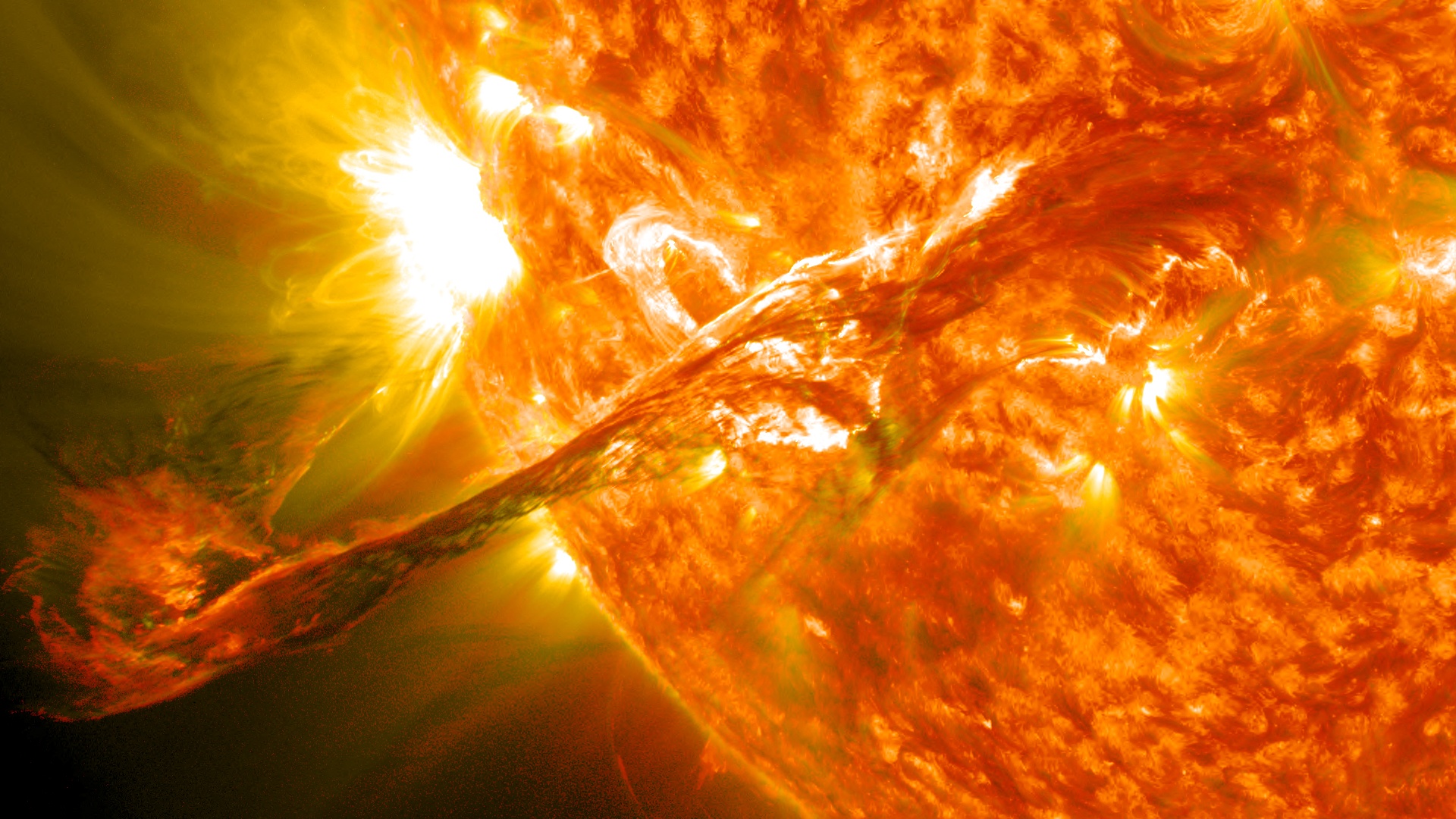
In a case of being in the right place at the right time, the MESSENGER spacecraft was able to capture a average-sized solar flare, allowing astronomers to study high-energy solar neutrons at less than 1 astronomical unit (AU) from the sun for the first time. When the flare erupted on Dec. 31, 2007, MESSENGER – on course for entering orbit around Mercury — was flying at about half an AU, said William C. Feldman, a scientist at the Planetary Science Institute. Previously, only the neutron bursts from the most powerful solar flares have been recorded on neutron spectrometers on Earth or in near-Earth orbit. The MESSENGER results help solve a mystery of why some coronal mass ejections produce almost no energetic protons that reach the Earth, while others produce huge amounts.
Click to continue…
Filed under: Missions, Solar Astronomy | 15 Comments »