
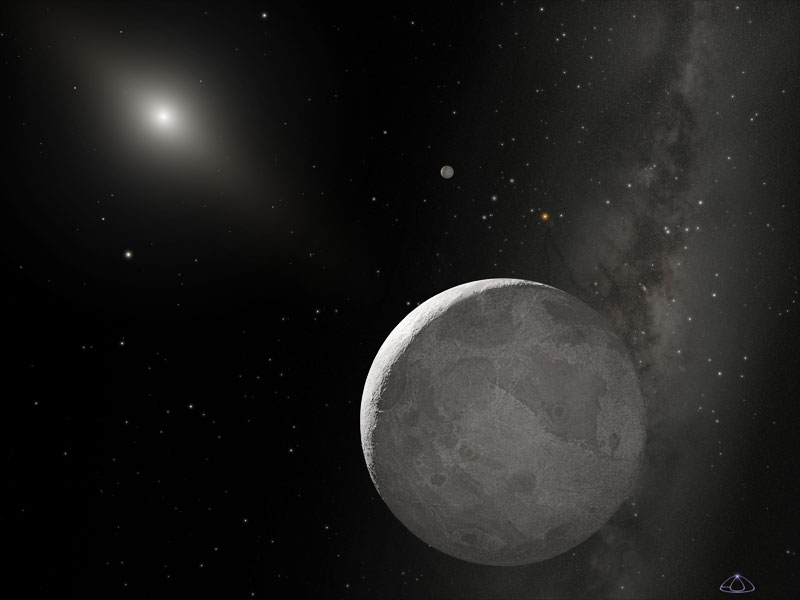
Eris is the largest dwarf planet in the Solar System, and the ninth largest body orbiting our Sun. Sometimes referred to as the “tenth planet”, it’s discovery is responsible for upsetting the traditional count of nine planets in our Solar System, as well as leading the way to the creation of a whole new astronomical category.
Located beyond the orbit of Pluto, this “dwarf planet” is both a trans-Neptunian object (TNO), which refers to any planetary object that orbits the Sun at a greater distance than Neptune – or 30 astronomical units (AU). Because of this distance, and the eccentricity of its orbit, it is also a member of a the population of objects (mostly comets) known as the “scattered disk”.
The discovery of Eris was so important because it was a celestial body larger than Pluto, which forced astronomers to consider, for the first time in history, what the definition of a planet truly is.
Discovery:
Eris, which has the full title of 136199 Eris, was first observed in 2003 during a Palomar Observatory survey of the outer solar system by a team led by Mike Brown, a professor of planetary astronomy at the California Institute of Technology. The discovery was confirmed in January 2005 after the team examined the pictures obtained from the survey in detail.
Classification:
At the time of it’s discovery, Brown and his colleagues believed that they had located the 10th planet of our solar system, since it was the first object in the Kuiper Belt found to be bigger than Pluto. Some astronomers agreed and liked the designation, but others objected since they claimed that Eris was not a true planet. At the time, the definition of “planet” was not a clear-cut since there had never been an official definition issued by the International Astronomical Union (IAU).
The matter was settled by the IAU in the summer of 2006. They defined a planet as an object that orbits the Sun, which is large enough to make itself roughly spherical. Additionally, it would have to be able to clear its neighborhood – meaning it has enough gravity to force any objects of similar size or that are not under its gravitational control out of its orbit.
In addition to finally defining what a planet is, the IAU also created a new category of “dwarf planets“. The only difference between a planet and a dwarf planet is that a dwarf planet has not cleared its neighborhood. Eris was assigned to this new category, and Pluto lost its status as a planet. Other celestial bodies, including Haumea, Ceres, and Makemake, have been classified as dwarf planets.
Naming:
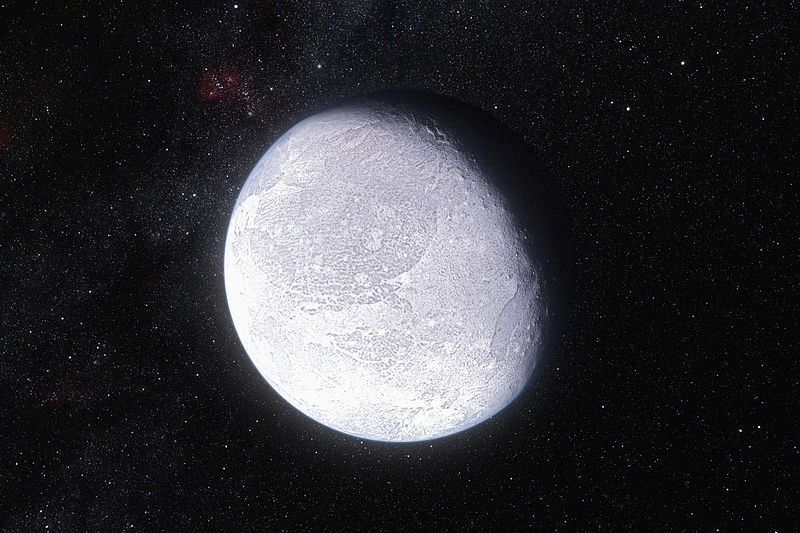
Eris is named after the Greek goddess of strife and discord. The name was assigned on September 13th, 2006, following an unusually long consideration period that arose over the issue of classification. During this time, the object became known to the wider public as Xena, which was the name given to it by the discovery team.
The team had been saving this name, which was inspired by the title character of the television series Xena: Warrior Princess, for the first body they discovered that was larger than Pluto. They also chose it because it started with the letter X, a reference to Percival Lowell’s hunt for a planet he believed to exist the edge of the Solar System (which he referred to as “Planet X“).
According to fellow astronomer and science writer Govert Schilling, Brown initially wanted to call the object “Lila”. This name was inspired by a concept in Hindu mythology that described the cosmos as the outcome of a game played by Brahma, and also because it was similar to “Lilah” – the name of Brown’s newborn daughter.
Size and Orbit:
The actual size and mass of Eris has been the subject of debate, as official estimates have changed with time and subsequent viewing. In 2005, using images from the Hubble Space Telescope. the diameter of Eris was measured to be 2397 ± 100 km (1,489 miles). In 2007, a series of observations of the largest trans-Neptunian objects with the Spitzer Space Telescope estimated Eris’s diameter at 2600 (+400/-200) km (1616 miles).

The most recent observation took place in November of 2010, when Eris was the subject of one of the most distant stellar occultations yet achieved from Earth. The teams findings were announced on October 2011, and contradicted previous findings with an estimated diameter of 2326 ± 12 km (1445 miles).
Because of these differences, astronomers have been hard-pressed to maintain that Eris is more massive than Pluto. According to the latest estimates, the Solar System’s “ninth planet” has a diameter of 2368 km (1471 miles), placing it on par with Eris. Part of the difficulty in accurately assessing the planet’s size comes from interference from Pluto’s atmosphere. Astronomers expect a more accurate appraisal when the New Horizons space probe arrives at Pluto in July 2015.
Eris has an orbital period of 558 years. Its maximum possible distance from the Sun (aphelion) is 97.65 AU, and its closest (perihelion) is 37.91 AU. This means that Eris and its moon are currently the most distant known objects in the Solar System, apart from long-period comets and space probes.
Eris’s orbit is highly eccentric, and brings Eris to within 37.9 AU of the Sun, a typical perihelion for scattered objects. This is within the orbit of Pluto, but still safe from direct interaction with Neptune (29.8-30.4 AU). Unlike the eight planets, whose orbits all lie roughly in the same plane as the Earth’s, Eris’s orbit is highly inclined – the planet is tilted at an angle of about 44° to the ecliptic.
Moons:
Eris has one moon called Dysnomia, which is named after the daughter of Eris in Greek mythology, which was first observed on September 10th, 2005 – a few months after the discovery of Eris. The moon was spotted by a team using the Keck telescopes in Hawaii, who were busy carrying out observations of the four brightest TNOs (Pluto, Makemake, Haumea, and Eris) at the time.

Interesting Facts:
The dwarf planet is rather bright and can be detected using something as simple as a small telescope. Models of internal heating via radioactive decay suggest that Eris may be capable of sustaining an internal ocean of liquid water at the mantle-core boundary. These studies were conducted by Hauke Hussmann and colleagues from the Institute of Astronomy, Geophysics and Atmospheric Sciences (IAG) at the University of São Paulo.
Brown and the discovery team followed up their initial identification of Eris with spectroscopic observations of the planet, which were made on January 25th, 2005. Infrared light from the object revealed the presence of methane ice, indicating that the surface may be similar to that of Pluto and of Neptune’s moon Triton.
Due to Eris’s distant eccentric orbit, its surface temperature is estimated to vary between about 30 and 56 K (?243.2 and ?217.2 °C). This places it on par with Pluto’s surface temperature, which ranges from 33 to 55 K (-240.15 and -218.15 °C).
We have many interesting articles on planets here at Universe Today, including this article on What is the newest planet and the 10th planet.
If you are looking for more information, try Eris and NASA’s Solar System Exploration entry.
Astronomy Cast has an episode on Pluto’s planetary identity crisis.
Source:
“astronomers have been hard-pressed to maintain that Eris is more massive than Pluto.” What? Both Eris and Pluto have a moon, so we know the masses by Kepler’s Laws. Perhaps “maintain that Eris is larger than Pluto”?
What a great article! Thank you. It’s so informative and enlightening.
Eris is NOT the largest dwarf planet in our solar system. It was initially thought to be so, but in November 2010, a team of astronomers led by Bruno Sicardy observed Eris occult a star and determined it is marginally smaller than Pluto though 27 percent more massive. It is hard to believe that nearly five years after Sicardy’s discovery, astronomy writers are still stating–erroneously–that Eris is larger than Pluto when this is not the case.
Eris should absolutely NOT have a minor planet number, meaning the “136199” needs to be dropped. The term “minor planet” is a synonym for asteroids, comets, and centaurs, small bodies not large enough to be rounded by their own gravity. Dwarf planets are spherical and therefore are not minor planets.
Additionally, the matter of what is a planet was NOT settled by the IAU in the summer of 2006. Only four percent of the IAU even voted on this, and most are not planetary scientists. Their decision was immediately opposed by hundreds of professional astronomers in a formal petition led by New Horizons Principal Investigator Alan Stern. One of the petition signatories was David Rabinowitz, a member of the team that discovered Eris.
Eight-and-a-half years later, the debate on how to define a planet and whether dwarf planets count as a subclass of planets remains ongoing–meaning the matter is far from “settled.”
Saying Pluto lost its status of planet is misleading the public by taking one view in this ongoing debate and presenting it as gospel truth when that is far from the case. Stern, the person who coined the term “dwarf planet,” did so with the intention of creating a third subclass of planet in addition to terrestrials and jovians. He never meant for dwarf planets to not be considered planets at all.
For the same reason, you should not use the term “the eight planets” in discussing our solar system because there is no consensus among planetary scientists that our solar system has only eight planets. To those who adhere to the geophysical planet definition, according to which a planet is any non-self luminous spheroidal body orbiting a star or free floating in space, our solar system has a minimum of 13 planets and counting, and this number includes Ceres, Pluto, Haumea, Makemake, and Eris.
The notion that objects have to “clear their orbits” to be planets is highly problematic for many reasons. It is inherently biased against objects further from their parent stars, which have bigger orbits to “clear.” If Earth were in Pluto’s or Eris’s orbit, it would not clear that orbit either. That means this definition could result in the same object being a planet in one location and not a planet in another location.
Additionally, no solar system planet fully clears its orbit of asteroids. Jupiter orbits with a large number of Trojans, and Neptune has not cleared its orbit of Pluto.
A major weakness of this requirement is it defines an object first and foremost by its location rather than by its intrinsic properties.
Brown’s newborn daughter has absolutely nothing to do with any of this and should not be mentioned here. Consensus among astronomers is to not name planets for living people, including relatives, “celebrities,” or politicians. Govert Schilling is well aware of this.
Please present a more balanced view next time and include references to podcasts or articles that present the pro-dwarf planets-as-planets side of this debate.
Very good points. I would also like to question why mercury is given immunity from the new dwarf designation. Has it really “cleared its orbit”. To say the Sun did not clear that space and not mercury is a mockery of the law of gravity.
Mercury is more a moon of the sun than a planet: not even a dwarf planet. There are two moons Ganymede and Titan larger than Mercury in our Solar System. If not a moon, Mercury is every bit a dwarf planet. It’s only real justification for full fledged planet is that it’s not orbiting out where there are more objects. (Read Suns gravity).
Since we won’t except ten planets and want to categorize them; lets be real about it and except that we can only truly have seven planets in our solar system.
If Mercury was eliminated as a planet, this small rocky anomaly would be out of the other planet standards and we would be left with only large bodies with expansive atmospheres (Mars being the smallest of which we may move to).
I can and will except more planets as they are discovered. Something that seems to be the main problem; But, we must be consistent in our definition.
It is a blog with entertaining ambitions, hence mentions of family and occasional use of a few years old sources. It’s not supposed to be a textbook.
One needs a nomenclature which captures multiple aspects of an object, such as size, shape, composition, orbit, company. The combinations of it all would require many new unique words. So I think that the solution is to name those aspects which are of interest in the specific context. “A gas giant in a non-cleared orbit”, or “An atmospheric moon”, or “A spherical KBO”.
Even Earth has been generally accepted as a planet since only 400 years. “Planet” is culturally defined and has and will change, astronomers can’t touch that. “A road” is also poorly defined but people can use and talk about them anyway. A planet is simply a lump of mass between that of an asteroid and a star, with fuzzy overlaps for which one can specify “a brown dwarf” or “a dwarf planet” when needed. Besides, IAU’s definition puts eccentric little Mercury and huge gaseous Jupiter in the same class of objects. “A planet” still gives little clue about what is meant, so what has been achieved? It is perceived as an anti-Pluto definition for good reasons.
Wow, you know so much… why NOT write articles yourself?
Why don’t you write a comment yourself?
Because I don”t know enough to do so.
If your comment is meant for me, I do write articles myself on astronomy and planetary science. My articles appear on the web sites Spaceflight Insider and The Space Reporter, as well as on my own Laurel’s Pluto Blog.
Thank you Laurel.
It’s refreshing to see a class A zing backed up by credentials.
😀
You’re welcome! 🙂
ICEBURN!
What a load of codswallop if you think Mercury is just a Moon of the Sun then ALL the other Planets including Earth are ALSO MOONS of the Sun…and all the Moons are Moons of Moons 🙂 Ha Ha Ha……
The article does mention the various estimates in size but appears hastily written with several repetitions and at least one “both” in the wrong place.
Furthermore it continues UT’s tradition to supinely accept the IAU’s definition of a planet, not even bothering to remind readers how weak it is. Luckily us commenters are here to help 😎
Astronomy is a science where anyone with a scope can contribute, and inspires a following of self taught experts with extremely accurate knowledge of this or that aspect of the field. The idea that a bunch of tired delegates meeting once among themselves can say the last word on any topic, is risible.
Another excellent article by Matt Williams. To clear one point it must be remembered that UT articles are always written very quickly, they need to be to keep up todate. Hence odd errors do occur, and must be expected, they are generally very quickly corrected.
I think if we classified objects in a different way it would help – I prefer Main Asteroid Belt and Outer Asteroid Belt for example.
The reasons I advance for placing Pluto as a Outer Asteroid Belt object is that its orbit is inclined at 17 degrees to the rest of the Solar System and also that for a number of years it is actually closer to the Sun than Neptune. I have just returned from Nigeria talking to school children and they are just as concerned with the “fate of Pluto” as the rest of us.
When first Main Asteroid Belt objects were discovered, early 19th cent., they were called planets ……
Roseland Observatory
If you put asteroids and Pluto in the same category, then it no longer forms a Belt. Unless the International Accessories Union has suddenly redefined what “a belt” is 😀
Pluto is NOT an asteroid. You are making the same mistake the four percent of the IAU did in 2006, which is defining an object by its location rather than by its intrinsic properties. Asteroids are tiny rocks shaped only by their chemical bonds. In contrast, objects in hydrostatic equilibrium (squeezed by their own gravity into a spherical or nearly spherical shape) are complex worlds, often with geology and weather, layered into core, mantle, and crust just like the terrestrial planets. Calling objects like Pluto asteroids is bad science because it lumps together two completely different types of objects.
Pluto’s orbit is inclined 17 degrees not to the plane of the solar system but to the plane of Earth’s orbit (the ecliptic). Mercury is inclined 7 degrees to Earth’s orbit. So why should Mercury be considered a planet? While most planets in our solar system orbit almost on the same plane, this is not the case in other solar systems, where several giant exoplanets orbit one star all on different planes. If we used the same logic on those systems, none of these objects could be considered planets.
The comparison with the reclassification of asteroids in the 19th century, while often cited to support the IAU decision, is not really appropriate here. When these objects were discovered, none could be resolved into a disk by the telescopes of the time. It turns out that the first object discovered, Ceres, is spherical after all, and is a complex world that is geologically active and may have a subsurface ocean. Two other objects in the asteroid belt, Vesta and Pallas, are not quite spherical but are much more larger and more complex than the rest of the asteroids. The Dawn mission showed Vesta to be layered into core, mantle, and crust, just like Earth. Some planetary scientists argue that based on Dawn’s data, Vesta should be considered the smallest terrestrial planet. Others rightfully argue that Vesta and Pallas deserve their own category in between asteroid and dwarf planet.
In the 19th century, all these objects appeared simply as points of light. None could be distinguished from any other, and no one knew anything about the compositions of these worlds. Now that we do know these things, it is clear that the demotion of Ceres was an error, as was the demotion of Vesta and Pallas.
Why are scientist scared of having more than 10 planets in the solar system?
No scientist should decide what the public should say. For me Pluto is a planet and it will always be a planet. If Eris is the size of Pluto then for me Eris is also a planet.
Scientists are sometimes hypocrites. They are offended that Pluto is called a planet, but at the same time they use the word “Big Bang”, “Dark energy”, “Dark Matter”, Ligh-speed, which are all wrongly used.
Even the word “Planet” is misused.
It comes from “Wandering Star”, and none of the planets are even remotely a “star”.
Bring back Pluto!
Deal with it scientists.
“Scared” and “offended” are silly and demeaning words to use and per the other “misused words”, you’re really being picayune… Why is this such an issue for some… oh, wait… I forget control freaks are usually anal retentive and like to sound like they know more than experts to inflate their actually lacking self-esteem. It’s simply for simplicity’s sake. We could find 10’s or hundreds of objects of reasonable size out there in the K belt and having them all be planets would be sloppy and confusing. BTW, it’s all semantics, people. Calm the F down, for Grod’s sake! The IAU is the governing body in charge of this so let them do what they think makes most sense for the science and live with it!
The control freaks are the ones that insists that Pluto must be called a “dwarf planet’ while the rest of the world does not agree. The control freaks are the ones that acts like Intelligent Design scientists and try to sneak in “Pluto is only a dwarf planet” in children text books.
If Pluto would have the mass of Jupiter, would it have cleared its orbit? Would you down degrade Jupiter as a planet when if it is at the distance of Pluto?
If you really do not want to call Pluto a planet then just cal it a KBO, but don’t call it a “dwarf” planet.
Repeat the consensus but this time with enough scientists to vote what a planet is.
Simply saying the ones in charge should be the ones deciding, not the peanut gallery. Either way, this is all semantic based rhetoric and however they go is the way it should be.
No one is “in charge” of science. The data is the determining factor in science, not a person or group of people. If we go with the notion that “the way those in charge go is the way it should be,” then Copernicus and Galileo should have been deemed wrong because they went with the evidence they had and did not follow those “in charge.”
” I forget control freaks are usually anal retentive and like to sound like they know more than experts to inflate their actually lacking self-esteem.”
Here we go with the ad hominem attacks. This is what people typically do when they do not have a credible response to an argument.
There is no need to make the universe artificially “simple.” That insults people’s intelligence and seems downright medieval, as if one “elite” group of scholars want to keep all the detailed knowledge to themselves and have everyone else just learn a “dumbed down” version of astronomy.
Look at the Herzsprung-Russell classification system for stars. Our Sun is a G2 V yellow star. Stars are classed into subcategories of subcategories. Why can’t we do the same with planets? Could it be because we are comfortable with the knowledge that there are billions of stars out there but have not yet grown accustomed to the fact that there are a also billions of planets, including possibly hundreds in our solar system?
If we find hundreds of spherical objects in the Kuiper Belt, then yes, we have hundreds of planets. Once we learn more about them, we will likely be able to distinguish their varying characteristics and create a classifications system with multiple subcategories. Why is this “sloppy and confusing?” Do you find the existence of billions of galaxies and billions of stars confusing?
It’s not just semantics. It’s about an attempt by a tiny group of people to impose their view, which is one view in an ongoing debate, on the entire world.
Those 424 IAU members who voted in 2006 are NOT experts in this area, as most are not even planetary scientists but other types of astronomers. Planetary scientists offered to help the IAU create a sound planet definition, and their efforts were rebuffed. As Alan Stern often says, both a podiatrist and a brain surgeon are doctors, but one wouldn’t go to the podiatrist to treat a brain tumor. Similarly, we should not be asking scientists who do not study planets to define what a planet is.
Finally, the notion of a “governing body” in science is ridiculous. Science does not work by decree from “on high.” Decrees and dogmas everyone has to accept are typical of a church, not of scientific bodies. Why should we “let them do what they think makes the most sense?” What they did was come up with a horribly flawed definition that caused more confusion than clarity. They then compounded their bad decision by absolutely refusing to revisit the discussion even when asked to do so by other scientists on multiple occasions. It seems they want their decision to stand as the last word for all eternity.
FYI, according to the IAU definition, none of the nearly 2,000 exoplanets discovered are “real” planets. That is because the IAU definition specifically states a planet must orbit the Sun rather than a star.
Jeffrey, most times, I would agree with you somewhat, but knowing what I know, I cannot accept the IAU’s new definition as being credible. Luckily, there are triennial general assemblies and eventually dwarf planets will get their due. Our sun is a dwarf star and yet a star. Same with dwarf galaxies. The shenanigans at the Prague GA are well-documented, as is the petition opposing the new definition signed by over 400 planetary scientists. To suggest everyone should just accept the IAU’s cloak of authority on this just doesn’t hold water, or ice.
By the way, Matt you have a grammatical error in the first sentence of your article. It’s “its,” not it’s.
Also, Matt, the latest science has Pluto as being larger than Eris. You can verify this with Bruno Sicardy or Alan Stern. However, New Horizons should settle this question for good on July 14th.
Lastly, you might want to ask the co-discoverers of Eris besides Mike, viz., Chad Trujillo and David Rabinowitz what they think of Mike saying he “led” them. It makes them sound like donkeys being led with a carrot attached to their nose.
Exactly, the sun is a “star” and compared to others it is a “dwarf star”. And yet it is still accepted a “star”.
The Sun did not get downgraded as a star because the number of stars exceeded the number of 10.
1st lucid information I’ve heard on this side of the topic. You’ve swayed me. Hadn’t thought on the topic with that info. Thanks! 🙂