
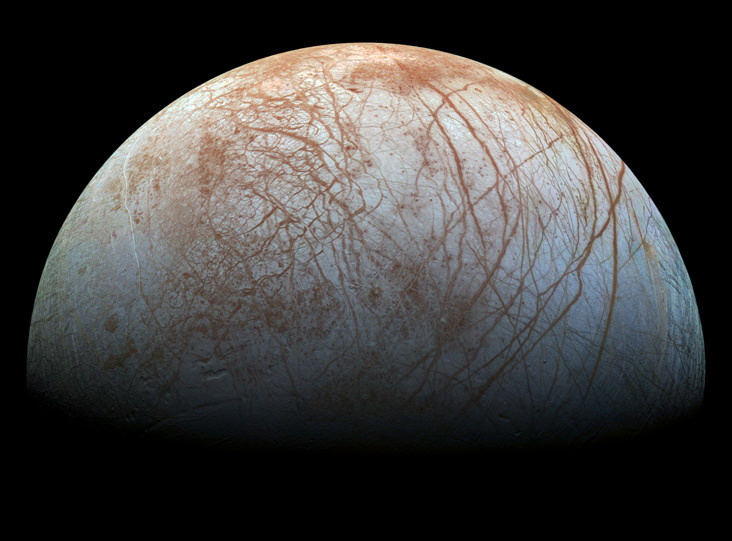
Jupiter‘s four largest moons – aka. the Galilean Moons, consisting of Io, Europa, Ganymede, and Callisto – are nothing if not fascinating. Ever since their discovery over four centuries ago, these moons have been a source of many great discoveries. These include the possibility of internal oceans, the presence of atmospheres, volcanic activity, a magnetosphere (Ganymede), and the possibility of having more water than Earth.
But arguably, the most fascinating of the Galilean Moons is Europa: the sixth closest moon to Jupiter, the smallest of the four, and the sixth-largest moon in the Solar System. In addition to having an icy surface and a possible warm-water interior, this moon is considered to be one of the most likely places for finding life beyond Earth.
Discovery and Naming:
Europa, along with Io, Ganymede, and Callisto, were discovered by Galileo Galilei in January of 1610, using a telescope of his own design. At the time, he mistook these four luminous objects for “fixed stars”, but ongoing observation showed that they were orbiting Jupiter in a way that could only be explained by the existence of satellites.
Like all the Galilean satellites, Europa was named after a lover of Zeus, the Greek equivalent to Jupiter. Europa was a Phoenician noblewoman and the daughter of the king of Tyre, who later became a lover to Zeus and the queen of Crete. The naming scheme was suggested by Simon Marius – a German astronomer who is thought to have discovered the four satellites independently – who in turn attributed the proposal to Johannes Kepler.

These names were not initially popular and Galileo refused to use them, opting instead for the naming scheme of Jupiter I – IV – with Europa being Jupiter II since it was believed to be the second closest to Jupiter. However, by the mid-20th century, the names suggested by Marius were revived and entered common usage.
The discovery of Amalthea in 1892, whose orbit lies closer to Jupiter than the Galileans, pushed Europa to the third position. With the Voyager probes, three more inner satellites were discovered around Jupiter in 1979. Since that time. Europa has been recognized as being the sixth satellite in terms of distance from Jupiter.
Size, Mass and Orbit:
With a mean radius of about 1560 km and a mass of 4.7998 ×10²² kg, Europa is 0.245 the size of Earth and 0.008 times as massive. It is also slightly smaller than Earth’s Moon, which makes it the sixth-largest moon and fifteenth largest object in the Solar System. Its orbit is nearly circular, with an eccentricity of 0.09, and lies at an average distance of 670 900 km from Jupiter – 664,862 km at Periapsis (i.e. when it is closest), and 676,938 km at Apoapsis (farthest).
Like its fellow Galilean satellites, Europa is tidally locked to Jupiter, with one hemisphere of Europa constantly facing towards the gas giant. However, other research suggests that the tidal locking may not be full, as a non-synchronous rotation may be present. Basically, this means that Europa could spin faster than it orbits Jupiter (or did so in the past) due to an asymmetry in its internal mass distribution where the rocky interior spins slower than its icy crust. This theory supports the notion that Europa may have a liquid ocean separating the crust from the core.
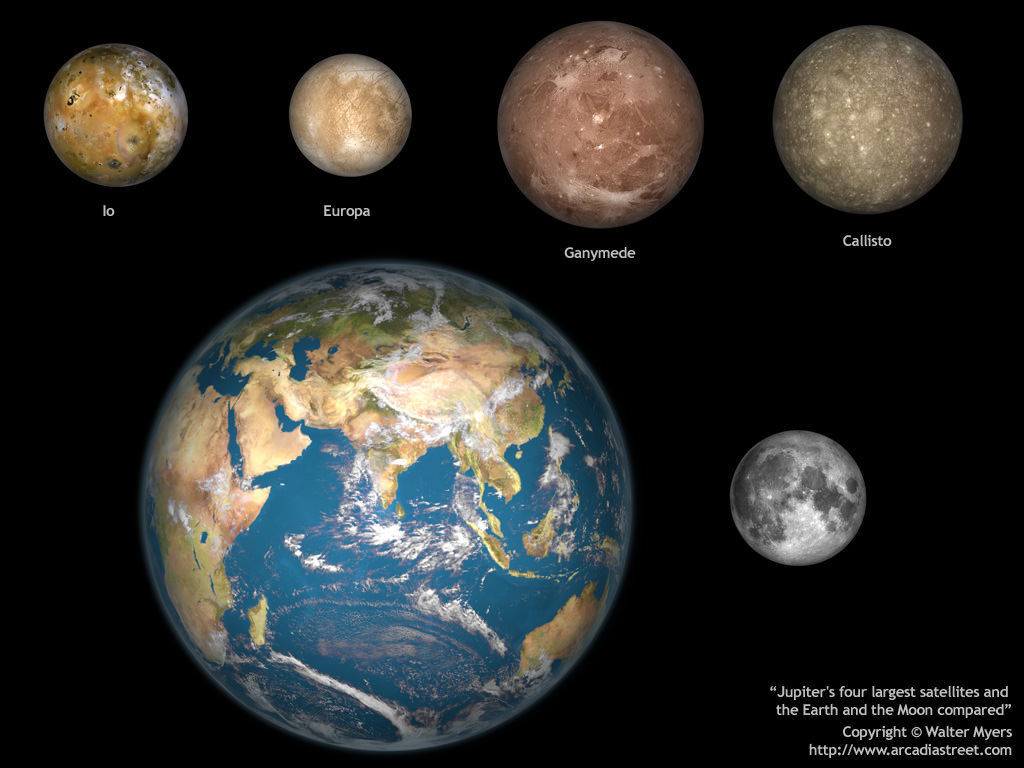
Europa takes 3.55 Earth days to complete a single orbit around Jupiter and is ever-so-slightly inclined towards Jupiter’s equator (0.470°), and to the ecliptic (1.791°). Europa also maintains a 2:1 orbital resonance with Io, orbiting once around Jupiter for every two orbits of the innermost Galilean. Outside it, Ganymede maintains a 4:1 resonance with Io, orbiting once around Jupiter for every two rotations of Europa.
This slight eccentricity of Europa’s orbit, maintained by the gravitational disturbances from the other Galileans, causes Europa’s position to oscillate slightly. As it nears Jupiter, Jupiter’s gravitational attraction increases, causing Europa to elongate towards and away from it. As Europa moves away from Jupiter, the gravitational force decreases, creating tides in its ocean and causing Europa to relax back into a more spherical shape.
The orbital eccentricity of Europa is also continuously pumped by its orbital resonance with Io. Thus, tidal flexing kneads Europa’s interior and gives it a source of heat, possibly allowing its ocean to stay liquid while driving subsurface geological processes. The ultimate source of this energy is Jupiter’s rotation, which is tapped by Io through the tides it raises on Jupiter and is transferred to Europa and Ganymede by the orbital resonance.
Composition and Surface Features:
With a mean density of 3.013 ± 0.005 g/cm3, Europa is significantly less dense than any of the other Galilean Moons. Nevertheless, its density indicates that its composition is similar to most moons in the outer Solar System, being differentiated between a rock interior composed of silicate rock and a possible iron core.
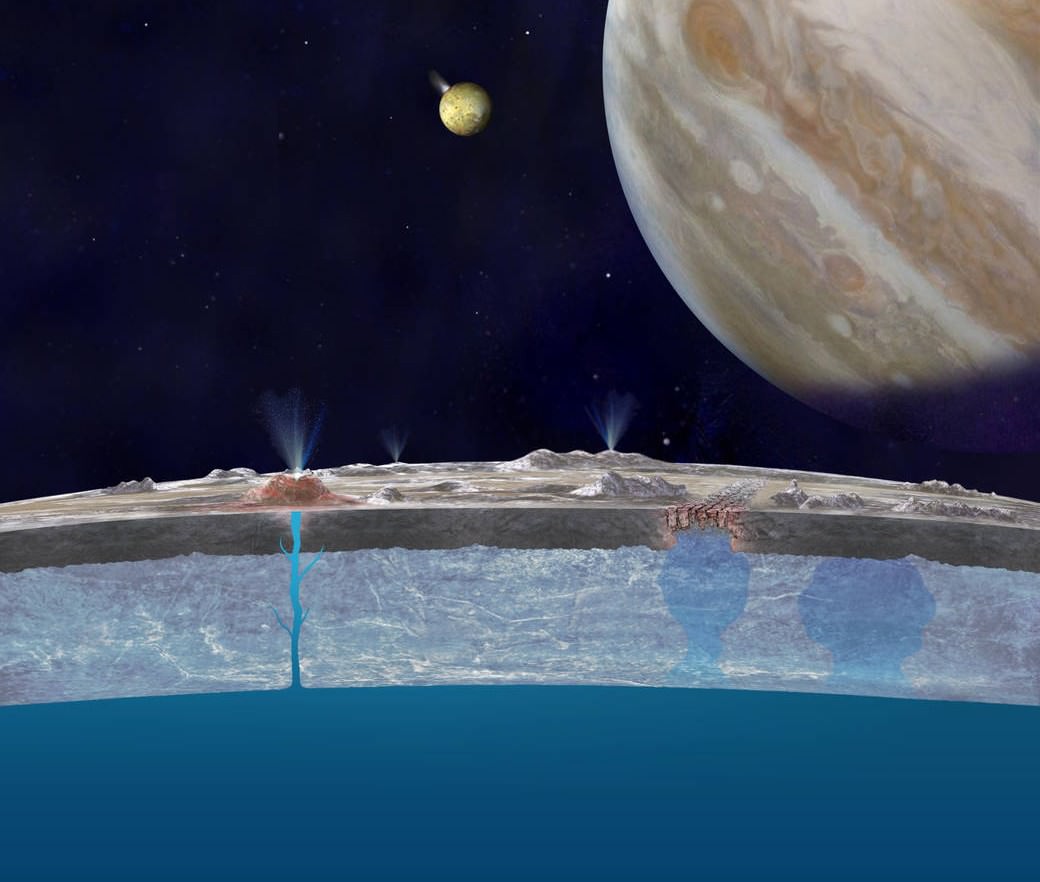
Above this rocky interior is a layer of water ice that is estimated to be around 100 km (62 mi) thick. This layer is likely differentiated between a frozen upper crust and a liquid water ocean beneath. If present, this ocean is likely a warm-water, salty ocean that contains organic molecules, is oxygenated and heated by Europa’s geologically-active core.
In terms of its surface, Europa is one of the smoothest objects in the Solar System, with very few large-scale features (i.e. mountains and craters) to speak of. This is due largely to the fact that Europa’s surface is tectonically active and young, with endogenic resurfacing leading to periodic renewals. Based on estimates of the frequency of cometary bombardment, the surface is believed to be about 20 to 180 million years old.
However, on a smaller scale, Europa’s equator has been theorized to be covered by 10 meter-tall icy spikes called penitentes, which are caused by the effect of direct overhead sunlight on the equator melting vertical cracks. The prominent markings crisscrossing Europa (called lineae) are another major feature, which is thought to be mainly albedo features.
The larger bands are more than 20 km (12 mi) across, often with dark, diffuse outer edges, regular striations, and a central band of lighter material. The most likely hypothesis states that these lineae may have been produced by a series of eruptions of warm ice as the Europan crust spread open to expose warmer layers beneath – similar to what takes place in Earth’s oceanic ridges.
Another possibility is that the icy crust rotates slightly faster than its interior, an effect that is possible due to the subsurface ocean separating Europa’s surface from its rocky mantle and the effects of Jupiter’s gravity tugging on Europa’s outer ice crust. Combined with photographic evidence that suggests subduction on Europa’s surface, this could mean that Europa’s icy outer layer behaves like tectonic plates here on Earth.
Other features include circular and elliptical lenticulae (Latin for “freckles”), which refer to the many domes, pits, and smooth or rough-textured dark spots that permeate the surface. The dome tops look like pieces of the older plains around them, suggesting that the domes formed when the plains were pushed up from below.
One hypothesis for these features is that they are the result of warm ice pushing up through the outer icy layer, much in the same way that magma chambers break through the Earth’s crust. Smooth features could be formed by meltwater coming to the surface, while rough textures are the result of small fragments of darker material being carried along. Another explanation is that these features sit atop vast lakes of liquid water that are encased in the crust – distinct from its interior ocean.
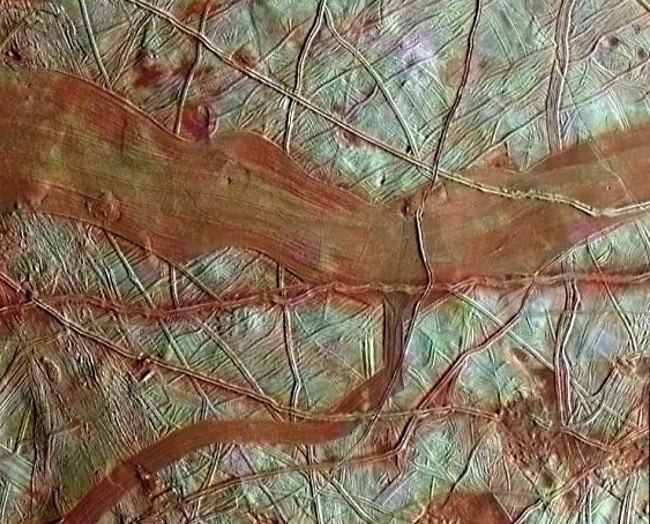
Since the Voyager missions flew past Europa in 1979, scientists have also been aware of the many steaks of reddish-brown material that coat fractures and other geologically youthful features on Europa’s surface. Spectrographic evidence suggests that these streaks and other similar features are rich in salts (such as magnesium sulfate or sulfuric acid hydrate) and were deposited by evaporating water that emerged from within.
Europa’s icy crust gives it an albedo (light reflectivity) of 0.64, one of the highest of all moons. The radiation level at the surface is equivalent to a dose of about 5400 mSv (540 rem) per day, an amount that would cause severe illness or death in human beings exposed for a single day. The surface temperature is about 110 K (-160 °C; -260 °F) at the equator and 50 K (-220 °C; -370 °F) at the poles, keeping Europa’s icy crust as hard as granite.
Subsurface Ocean:
The scientific consensus is that a layer of liquid water exists beneath Europa’s surface, and that heat from tidal flexing allows the subsurface ocean to remain liquid. The presence of this ocean is supported by multiple lines of evidence, the first of which are models where internal heating is caused by tidal flexing through the interaction of Europa with Jupiter’s magnetic field and the other moons.
The Voyager and Galileo missions also provided indications of an interior ocean, as both probes provided images of so-called “chaos terrain” features, which were believed to be the result of the subsurface ocean melting through the icy crust. According to this “thin-ice” model, Europa’s ice shell may be only a few kilometers thick, or as thin as 200 meters (660 ft), which would mean that regular contact between the liquid interior and the surface could occur through open ridges.
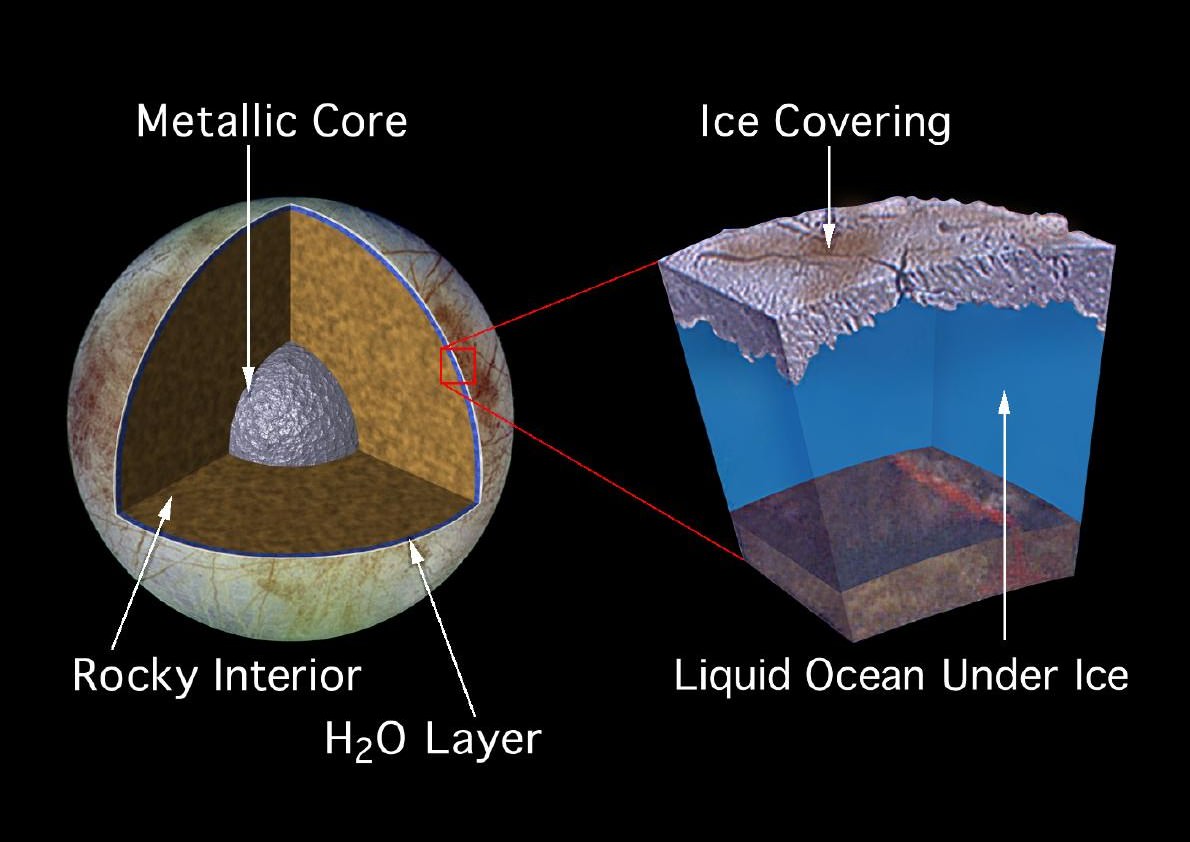
However, this interpretation is controversial, as most geologists who have studied Europa have favored the “thick ice” model, where the ocean has rarely (if ever) interacted with the surface. The best evidence for this model is a study of Europa’s large craters, the largest of which is surrounded by concentric rings and appears to be filled with relatively flat, fresh ice.
Based on this and on the calculated amount of heat generated by Europan tides, it is estimated that the outer crust of solid ice is approximately 10–30 km (6–19 mi) thick, including a ductile “warm ice” layer, which could mean that the liquid ocean underneath could be about 100 km (60 mi) deep.
This has led to volume estimates of Europa’s oceans that are as high as 3 × 10¹⁸ m3 – or three quadrillion cubic kilometers; 719.7 trillion cubic miles. This is slightly more than twice the combined volume of all of Earth’s oceans.
Further evidence of subsurface ocean was provided by the Galileo orbiter, which determined that Europa has a weak magnetic moment that is induced by the varying part of the Jovian magnetic field. The field strength created by this magnetic moment is about one-sixth the strength of Ganymede’s field and six times the value of Callisto’s. The existence of the induced moment requires a layer of highly electrically-conductive material in Europa’s interior, and the most plausible explanation is a large subsurface ocean of liquid saltwater.

Europa may also have periodically occurring plumes of water that breach the surface and reach up to 200 km (120 mi) in height, which is over 20 times the height of Mt. Everest. These plumes appear when Europa is at its farthest point from Jupiter, and are not seen when Europa is at its closest point to Jupiter.
The only other moon in the Solar System exhibiting similar types of water vapor plumes is Enceladus, though the estimated eruption rate at Europa is about 7000 kg/s compared to about 200 kg/s for Enceladus.
Atmosphere:
In 1995, the Galileo mission revealed that Europa has a thin atmosphere composed mostly of molecular oxygen (O2). The surface pressure of Europa’s atmosphere is 0.1 micro Pascals or 10-12 times that of the Earth. The existence of a tenuous ionosphere (an upper-atmospheric layer of charged particles) was confirmed in 1997 by Galileo, which appeared to be created by solar radiation and energetic particles from Jupiter’s magnetosphere.
Unlike the oxygen in Earth’s atmosphere, Europa’s is not of biological origin. Instead, it is formed through the process of radiolysis, where ultraviolet radiation from the Jovian magnetosphere collides with the icy surface, splitting water into oxygen and hydrogen. The same radiation also creates collisional ejections of these products from the surface, and the balance of these two processes forms an atmosphere.

Observations of the surface have revealed that some of the molecular oxygen produced by radiolysis is not ejected from the surface and is retained due to its mass and the planet’s gravity. Because the surface may interact with the subsurface ocean, this molecular oxygen may make its way to the ocean, where it could aid in biological processes.
The hydrogen, meanwhile, lacks the mass needed to be retained as part of the atmosphere, and most is lost to space. This escapes hydrogen, along with portions of atomic and molecular oxygen that are ejected, forms a gas torus in the vicinity of Europa’s orbit around Jupiter.
This “neutral cloud” has been detected by both the Cassini and Galileo spacecraft and has a greater content (number of atoms and molecules) than the neutral cloud surrounding Jupiter’s inner moon Io. Models predict that almost every atom or molecule in Europa’s torus is eventually ionized, thus providing a source to Jupiter’s magnetospheric plasma.
Exploration:
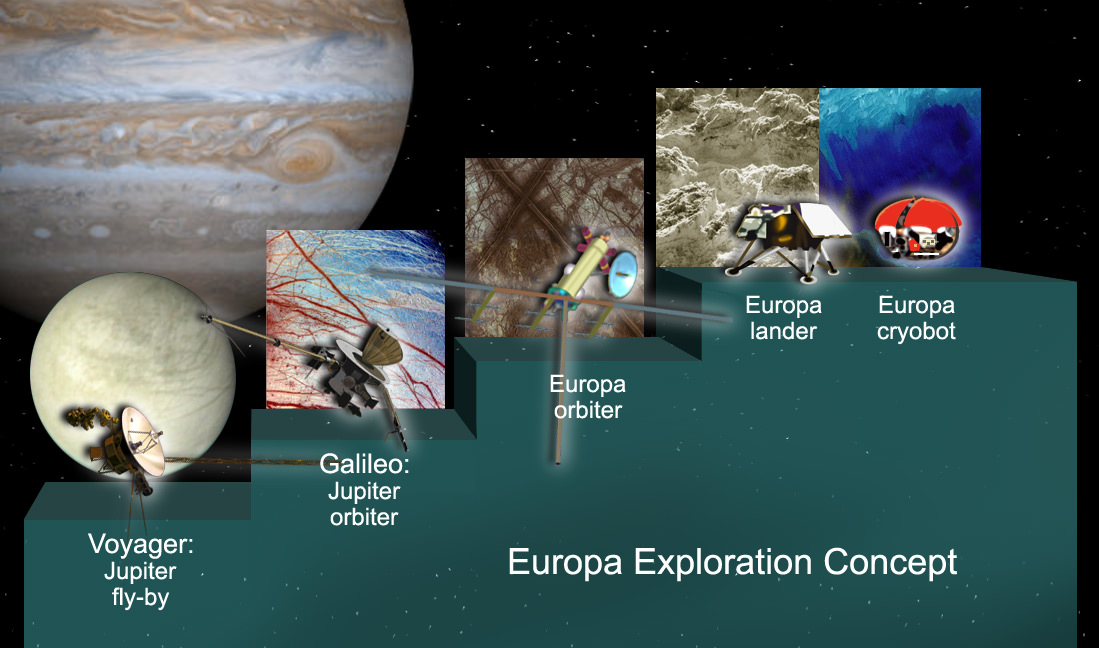
The exploration of Europa began with the Jupiter flybys of the Pioneer 10 and 11 spacecraft in 1973 and 1974, respectively. The first close-up photos were of low resolution compared to later missions. The two Voyager probes traveled through the Jovian system in 1979 providing more detailed images of Europa’s icy surface. These images resulted in many scientists speculating about the possibility of a liquid ocean underneath.
In 1995, the Galileo space probe began its eight-year mission that would see it orbit Jupiter and provide the most detailed examination of the Galilean moons to date. It included the Galileo Europa Mission and Galileo Millennium Mission, which performed numerous close flybys of Europa. These were the last missions to Europa performed by any space agency to date.
However, conjecture about an interior ocean and the possibility of finding extraterrestrial life have ensured a high profile for Europa and have led to steady lobbying for future missions. The aims of these missions have ranged from examining Europa’s chemical composition to searching for extraterrestrial life in its hypothesized subsurface oceans.
In 2011, a Europa mission was recommended by the U.S. Planetary Science Decadal Survey. In response, NASA commissioned studies to research the possibility of Europa lander in 2012, along with concepts for a Europa flyby, and a Europa orbiter. The orbiter element option concentrates on the “ocean” science, while the multiple-flyby element concentrates on chemistry and energy science.
On January 13th, 2014, the House Appropriations Committee announced a new bipartisan bill that included $80 million worth of funding to continue the Europa mission concept studies. In July 2013, NASA’s Jet Propulsion Lab and Applied Physics Laboratory presented an updated concept for a flyby Europa mission (called the Europa Clipper).
In May 2015, NASA officially announced that it had accepted the Europa Clipper mission, and revealed the instruments it will use. These would include an ice-penetrating radar, short-wave infrared spectrometer, a topographical imager, and an ion- and neutral mass spectrometer.
The aim of the mission will be to explore Europa in order to investigate its habitability and select sites for a future lander. It would not orbit Europa, but orbit Jupiter and conduct 45 low-altitude flybys of Europa during the mission.
Plans for a mission to Europa also contained details about a possible Europa Orbiter, a robotic space probe whose objective would be to characterize the extent of the ocean and its relation to the deeper interior. The instrument payload for this mission would include a radio subsystem, laser altimeter, magnetometer, Langmuir probe, and a mapping camera.
Plans were also made for a potential Europa Lander, a robotic vehicle similar to the Viking, Mars Pathfinder, Spirit, Opportunity, and Curiosity rovers that have been exploring Mars for several decades. Like its predecessors, the Europa Lander would investigate Europa’s habitability and assess its astrobiological potential by confirming the existence and determining the characteristics of water within and below Europa’s icy shell.
In 2012, the Jupiter Icy Moon Explorer (JUICE) concept was selected by the European Space Agency (ESA) as a planned mission. This mission would include some flybys of Europa but is more focused on Ganymede. Many other proposals have been considered and shelved due to issues of budgets and changing priorities (such as exploring Mars). However, the ongoing demand for future missions is an indication of just how lucrative the astronomical community considers the exploration of Europa to be.
Habitability:
Europa has emerged as one of the top locations in the Solar System in terms of its potential for hosting life. Life could exist in its under-ice ocean, perhaps subsisting in an environment similar to Earth’s deep-ocean hydrothermal vents.
On May 12th, 2015, NASA announced that sea salt from a subsurface ocean may likely be coating some geological features on Europa, suggesting that the ocean is interacting with the seafloor. This may be important in determining if Europa could be habitable for life since it would mean that the interior ocean may be oxygenated.
The energy provided by tidal flexing drives active geological processes within Europa’s interior. However, the energy from tidal flexing could never support an ecosystem in Europa’s ocean as large and diverse as the photosynthesis-based ecosystem on Earth’s surface. Instead, life on Europa would likely be clustered around hydrothermal vents on the ocean floor, or below the ocean floor.
Alternatively, it could exist clinging to the lower surface of Europa’s ice layer, much like algae and bacteria in Earth’s polar regions, or float freely in Europa’s ocean. However, if Europa’s ocean were too cold, biological processes similar to those known on Earth could not take place. Similarly, if it were too salty, only extreme lifeforms could survive in its environment.
There is also evidence supporting the existence of liquid water lakes within Europa’s icy outer shell that is distinct from a liquid ocean thought to exist farther down. If confirmed, the lakes could be yet another potential habitat for life. But again, this would depend on their average temperatures and their salt content.
Also, there is evidence suggesting that hydrogen peroxide is abundant across Europa’s surface. Because hydrogen peroxide decays into oxygen and water when combined with liquid water, scientists argue that it could be an important energy supply for simple life forms.
In 2013, and based on data from the Galileo probe, NASA announced the discovery of “clay-like minerals” – which are often associated with organic materials – on the surface of Europa. The presence of these minerals may have been the result of a collision with an asteroid or comet according, they claim, which may have even come from Earth.
Colonization:
The possibility of humans colonizing Europa, which also includes plans of terraforming it, has been explored at length in both science fiction and as a scientific pursuit. Proponents of using the moon as a place for human settlement emphasize the numerous advantages that Europa has over other extra-terrestrial bodies in the Solar System (such as Mars).
Chief among these is the presence of water. Though accessing it would be difficult, and could require drilling to depths of several kilometers, the sheer abundance of water on Europa would be a boon for colonists. In addition to providing drinking water, Europa’s interior ocean could also be used to manufacture breathable air through the process of radiolysis and rocket fuel for additional missions.
The presence of this water and water ice is also considered as a reason for terraforming the planet. Using nuclear devices, cometary impacts, or some other means to increase the surface temperature, the ice could be sublimated and form a massive atmosphere of water vapor. This vapor would then undergo radiolysis due to exposure to Jupiter’s magnetic field, converting it into oxygen gas (which would stay close to the planet) and hydrogen that would escape into space.
However, colonizing and/or terraforming Europa also presents several problems. First and foremost is the high amount of radiation coming from Jupiter (540 rems), which is enough to kill a human being within a single day. Colonies on Europa’s surface would therefore have to be extensively shielded or would have to use the ice shield as protection by descending beneath the crust and living in subsurface habitats.

Then there is the low gravity of Europa – 1.314 m/s or 0.134 times the Earth standard (0.134 g) – also presents challenges for human settlement. The effects of low gravity are an active field of study, based largely on the extended stays of astronauts in low Earth orbit. Symptoms of extended exposure to microgravity include loss of bone density, muscle atrophy, and a weakened immune system.
Effective countermeasures for the negative effects of low gravity are well-established, including an aggressive regimen of daily physical exercise. However, this research has all been conducted in zero-gravity conditions. So the effects of diminished gravity on permanent occupants, not to mention on the development of fetal tissue and childhood development for those colonists born on Europa, is currently unknown.
It is also speculated that alien organisms may exist on Europa, possibly in the water underlying the moon’s ice shell. If this is true, human colonists may come into conflict with harmful microbes, or aggressive native life forms. An unstable surface could represent another problem. Given that the surface ice is subject to regular plumes and endogenic resurfacing, natural disasters could be a common occurrence.
In 1997, the Artemis Project – a private space venture that supports establishing a permanent presence on the Moon – also announced plans to colonize Europa. According to this plan, explorers would first establish a small base on the surface, then drill down into the Europan ice crust to create a subsurface colony protected from radiation. So far, this company has met with no success in either venture.
In 2013, a team of architects, designers, former NASA specialists, and celebrities (such as Jacques Cousteau), came together to form Objective Europa. Similar in concept to Mars One, this crowdsourced organization hopes to recruit the necessary expertise, raise the money needed to mount a one-way mission to the Jovian moon, and establish a colony.
Objective Europa began Phase I of its venture – the “theoretical research and concept phase” – in September of 2013. If and when this phase is completed, they will begin the subsequent phases – which call for detailed mission planning, preparation and crew selection, and the launch and arrival of the mission itself. Their intent is to accomplish all of this and land a mission on Europa between 2045 and 2065.
Regardless of whether or not humans could ever call Europa home, it is obvious to us that there is more going on there than outward appearances would suggest. In the coming decades, we will likely be sending many probes, orbiters, and landers to the planet in the hopes of learning what mysteries it holds.
And if the current budget environment doesn’t hold up for space agencies, it’s not unlikely that private ventures will step in to get their first. With luck, we might just find that Earth is not the only body in our Solar System that is capable of supporting life – perhaps even complex life!
We’ve had many stories about Europa on Universe Today, including a story about a possible submarine that could be used to explore Europa, and an article debating whether Europa’s ocean is thick or thin. We also have articles on Jupiter’s Moons and the Galilean Moons.
For more information, NASA’s Galileo project has great information and images about Europa.
We’ve also recorded an entire show just on Jupiter for Astronomy Cast. Listen to it here, Episode 56: Jupiter, and Episode 57: Jupiter’s Moons.
a one way trip… broadcast for all of earth to watch. i’d be riveted.
Mg Sulfate (aka Epsom salt) is white. There are no mineral sulfates that are that ruddy red color. Why cant we run a reflectance spec to analyze?
Yes, but there’s also sulfuric acid hydrate. And scientists suspect that the presence of sulfur compounds is what causes that color, which is why I included it.
What a comprehensive and detailed article once again. Thanks Matt.
Thank you! Stand by for Titan!