Universe Today
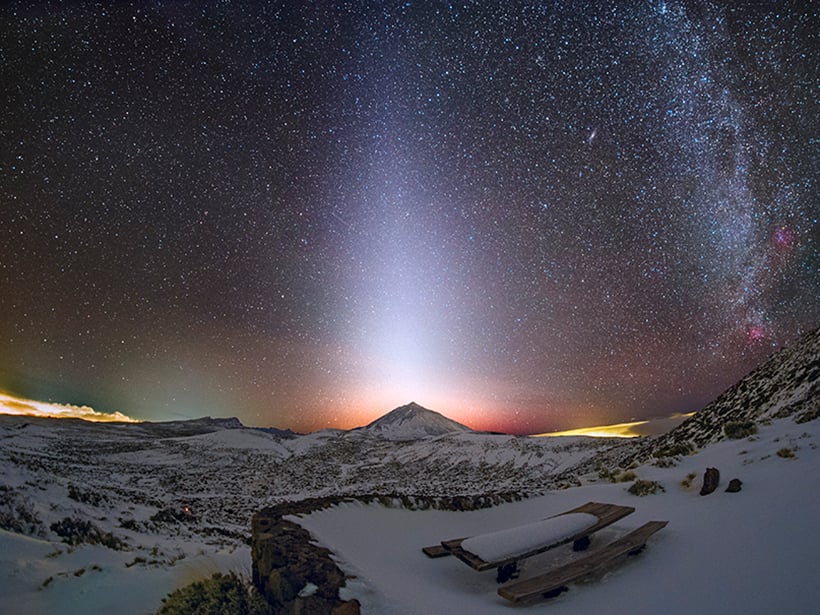
If you've ever been under a dark sky in the early morning before dawn, you may have seen a faint glow, almost like a column of light rising from the east. It's sometimes known as the false dawn, since it appears before true dawn. It can also appear in the west after sunset, though it typically isn't as noticeable. The glow is caused by dust in the inner solar system. A diffuse plane of tiny particles that aligns with the plane of the inner planets. Since the planets move through the zodiac constellations, so does this plane of dust. Which is why it is also known as the zodiacal light.
Most exoplanetary systems likely have a similar plane of zodiacal dust, particularly systems with rocky, potentially habitable worlds. If we see zodiacal dust around a star, that could indicate that rocky inner planets orbit the star. But since this dust reflects starlight, it could also hamper our search for exo-life, as a new study shows.
The article starts by looking at a simulated exo-Earth within a system that has similar zodiacal dust to our solar system. Astronomers search for life on other worlds by looking at the atmospheres of exoplanets. As the planet passes in front of its star, the atmosphere absorbs certain wavelengths of light depending on its molecular composition. By looking at the absorption spectra, we can identify molecules that suggest the presence of life. The authors note that zodiacal dust can scatter much of that light, weakening the absorption spectra by up to 50%. The scattering becomes stronger at longer wavelengths, so it introduces a bias to the data.
In most systems, the masking caused by zodiacal dust is even stronger. A survey of nearby stars finds that the zodiacal dust of most systems is three times that of ours. This means that to study the atmospheric spectra of potentially habitable planets, astronomers will first need to determine the scattering and absorption effects of the system's zodiacal dust. This can then be adjusted for to give accurate readings of exo-worlds.
Fortunately, with higher resolution spectral observations and longer observation times, most of the effects of exozodiacal dust can be mitigated. The presence of dust doesn't make the search for life impossible. It will just take more careful observations and data analysis.
Reference: Currie, Miles H., et al. "The exozodi spectral effect: Residual habitable zone dust may bias exoEarth characterization." arXiv preprint arXiv:2607.14329 (2026).