Universe Today
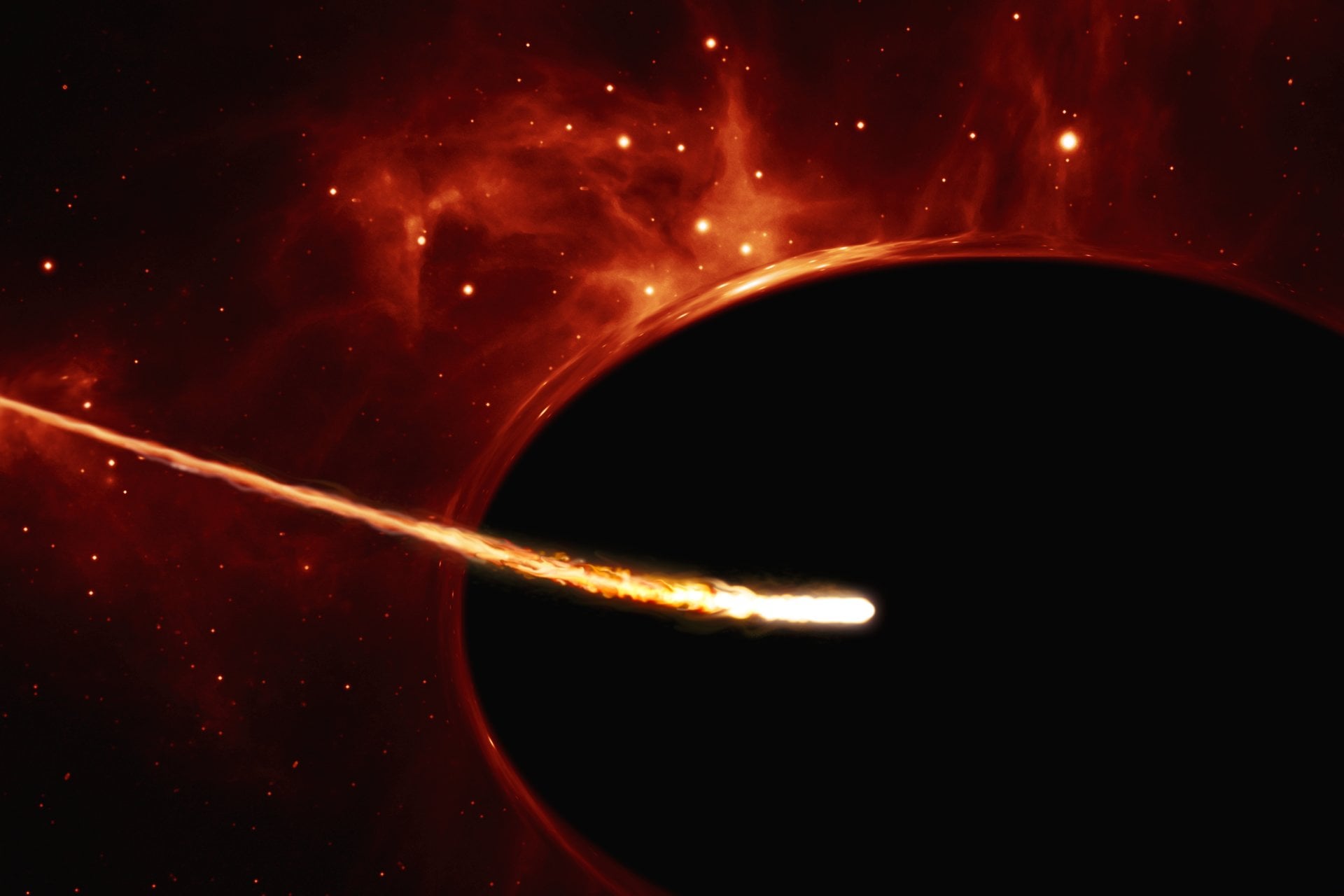
Although general relativity is an elegant theory of gravity, we don't often need to use it. For most gravitational interactions, Newton's theory of universal gravity works just fine. Newton's model is good enough to navigate spacecraft through the solar system and even just fine for most of the stars orbiting Sag A*, the supermassive black hole at the center of the Milky Way. There are gravitational effects Newton didn't predict, such as gravitational waves, but for most things there is no effective difference between Newton's and Einstein's models. Even more subtle are the differences between Einstein and alternative models of relativistic gravity. Testing these limits is extremely difficult. But a newly discovered star could help.
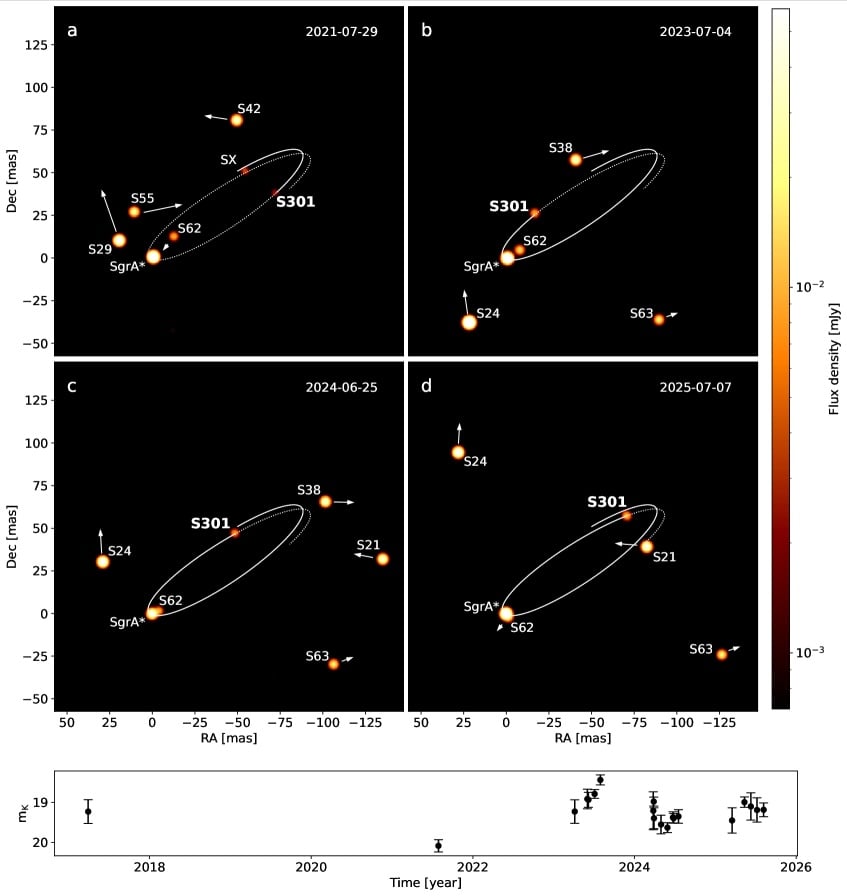 The observed orbit of the star S301. Credit: Dayem, et al.
The star has the unassuming name S301, since it is 301 on the list of recognized S-stars, which orbit Sag A*. It is a bit more massive than the Sun and orbits Sag A* every 8.7 years. That is the shortest known period of any S-star, and S301 has an extremely elliptical orbit. At its closest approach, it comes within about 140 radii of Sag A*, or about 24 AU. In other words, if Sag A* were at the center of our solar system, its event horizon would be just inside the orbit of Mercury, and at closest approach S301 would pass between the orbits of Uranus and Neptune. It would also be moving at more than 8% of the speed of light.
This makes S301 the most relativistic star we have observed. It will allow us to test some of the limits of general relativity. For example, we have already observed that the orbit of S301 precesses. We've observed orbital precession in the motion of Mercury. It was one of the classic tests of GR. But the precession of Mercury is tiny. The difference in motion between Einstein's prediction and Newton's is less than the span of a human heartbeat with each orbit. For S301, its perihelion advances about 2° with each orbit.
This motion is so extreme that secondary relativistic effects come into play. For example, gravitational redshift and the transverse Doppler effect. We've observed these effects in the lab, but S301 gives us a chance to study them in nature. But more significantly, in time we can use S301 to study alternatives to general relativity.
One of the big difficulties with GR is that it doesn't play well with quantum theory. There are several models that try to unify the two, but they only differ from GR in extreme cases. Some of these differences might be seen at relativistic speeds, since the effects are at the order of (v/c)2 or (v/c)3. The effects of the black hole's spin and its interaction with the rotation of the star also come into play on these orders of magnitude. Future large telescopes such as the Giant Magellan Telescope (GMT) will be able to observe the spectra of S301 with enough precision to measure second- and third-order effects.
For now, however, observing S301 remains a challenge. The center of our galaxy is veiled in cloud and dust, meaning we can't observe it in optical light. Since S301 is a Sun-like star, it isn't particularly bright, even in the infrared. We can observe its motion, but we can't yet gather any significant spectral data.
But as with all things relativity, it's only a matter of time.
Reference: Dayem, K., et al. "Discovery of a star sensitive to the spin of Sgr A*." arXiv preprint arXiv:2607.12664 (2026).