Universe Today
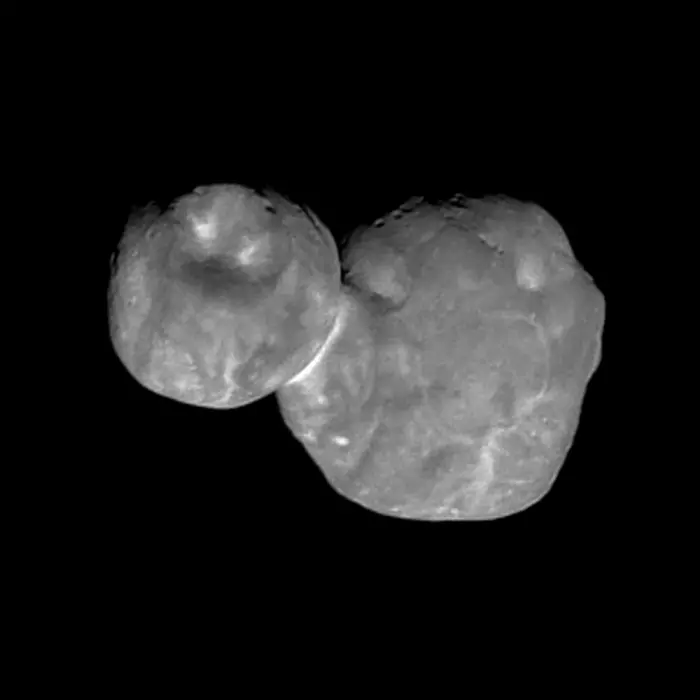
The New Horizons mission made history on Jan. 1st, 2019, when it became the first spacecraft to conduct a close flyby with Arrokoth, a Kuiper Belt Object (KBO) beyond the orbit of Pluto. The images it captured of this object, revealing a snowman-shaped profile, surprised and perplexed astronomers. Since then, astronomers have debated how such objects could form in the outer reaches of the Solar System. And now, researchers at Michigan State University (MSU) believe they have found the answer, and it's really quite simple: gravitational collapse.
Much like objects in the Main Asteroid Belt, the icy objects of the Kuiper Belt (aka "iceteroids") are material leftover from the formation of the Solar System. After the Sun formed from gas and dust that underwent gravitational collapse, the remaining matter settled into a disk that slowly accreted into larger bodies. Planetesimals were the first large planetary objects to form from the disk as aggregates of dust and pebbles. Based on follow-up observations after the discovery of Arrokoth, scientists estimate that about 1 in 10 of these objects are two connected planetesimals, known as contact binaries.
Earlier computational models of these objects were based on fluid dynamics, which ruled out the possibility of them forming unique shapes. Other formation theories involve unique events or phenomena that cannot account for how common these objects are. Led by Jackson Barnes, an MSU graduate student, the team developed its simulations using MSU's high-performance computing cluster at the Institute for Cyber-Enabled Research (ICER). These simulations, the first based on gravitational collapse, not only reproduced the snowman profile but also created a more realistic scenario in which these objects form regularly.
"If we think 10 percent of planetesimal objects are contact binaries, the process that forms them can’t be rare," Earth and Environmental Science Professor Seth Jacobson, a senior author on the paper, explained in an MSU press release. "Gravitational collapse fits nicely with what we’ve observed." According to their simulations, planetesimals are sometimes torn apart by the disk's rotational force, forming two separate objects that orbit one another. Over time, the orbits of these objects will spiral inward until they make contact and fuse together, while retaining their round shapes.
Their results also showed that the contact binaries remain intact by avoiding collisions with other objects, which fits with observations since most binaries show no indication of craters. This confirms something scientists have suspected for some time, but were unable to test. The model created by Barnes and his colleagues is the first to reproduce contact binaries by accounting for the necessary physics. The team is also working on a new simulation to better model the gravitational collapse process, which they hope will predict other exotic objects discovered in the outer Solar System.
Their study, "Direct contact binary planetesimal formation from gravitational collapse," appeared in the Monthly Notices of the Royal Astronomical Society (MNRAS).
Further Reading: EurekaAlert!, MNRAS