Universe Today
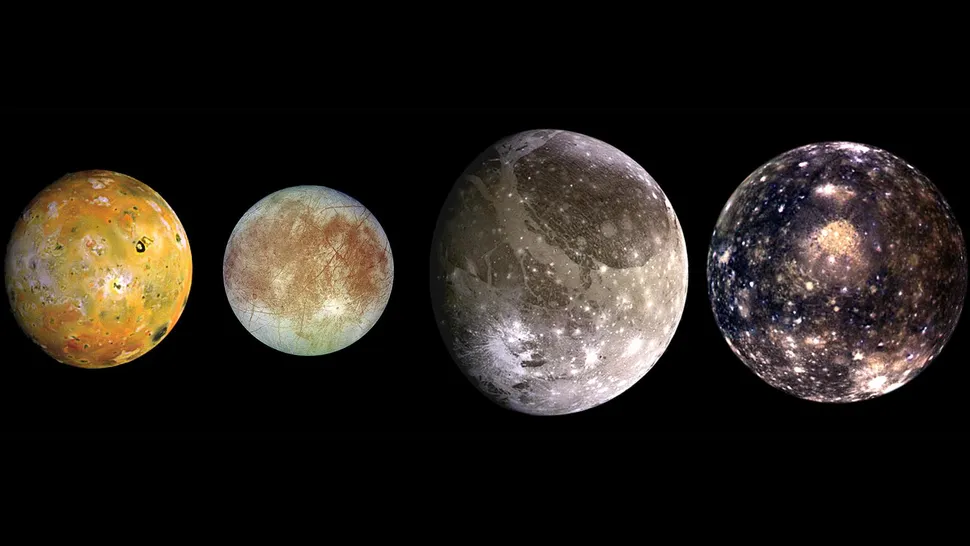
Jupiter and Saturn, the two largest planets in the Solar System, are known for their large and varied systems of moons. At present count, Jupiter has more than 100 moons, while Saturn has more than double that, with over 280 known satellites. However, Jupiter's system of satellites includes four large moons - Io, Europa, Ganymede, and Callisto - and this system contains the largest moon in the Solar System (Ganymede). Meanwhile, Saturn's system of satellites is dominated by one large moon (Titan), the second largest in the Solar System.
Since both planets are gas giants and are believed to have similar formation histories, the reason for this difference has long been a mystery to astronomers. This motivated a collaborative effort by researchers from China and Japan to create a physically consistent model that could explain multiple systems. By considering magnetic accretion, they showed that the formation of a magnetospheric cavity in a young gas giant's accretion disk can explain the differences between these two satellite systems.
The team was led by Yuri I. Fujii, a researcher at the Graduate School of Human and Environmental Studies at Kyoto University and the Graduate School of Science at Nagoya University. He was joined by Associate Professor Masahiro Ogihara from the State Key Laboratory of Dark Matter Physics at Shanghai Jiao Tong University and the Tokyo Institute of Technology, and Associate Professor Yasunori Hori of Okayama University and the Astrobiology Center in Mitaka, Japan. The paper detailing their findings was published on April 2nd, in Nature Astronomy.
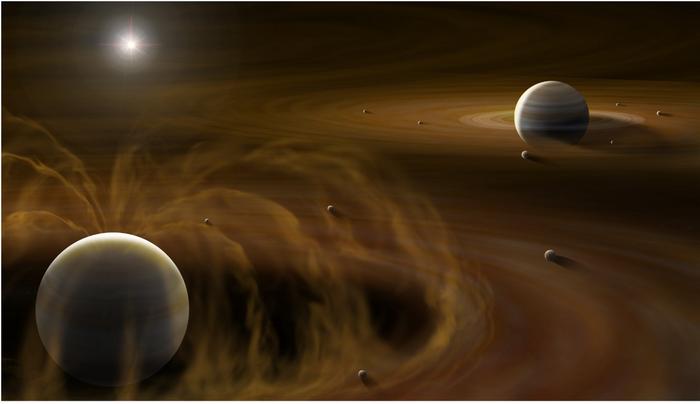 Artist’s impression of the simulations conducted in this research. Credit: Yuri I. Fujii/L-INSIGHT (Kyoto University)/Shinichiro Kinoshita
In recent years, scientists have been rethinking satellite-formation models, in large part due to studies on the role played by stellar magnetic fields. In this process, a planet's magnetic field governs how material surrounding it falls onto it and forms structures. "Testing planet formation theory is somewhat difficult because we have only our Solar System for reference, but there are multiple satellite systems close to us whose detailed characteristics we can observe," said Fujii.
To determine how the thermal properties and magnetic fields of Jupiter and Saturn have varied over time, Fujii and his colleagues performed numerical simulations on the interior structures of young gas giants. They also ran simulations of circumplanetary disks around both planets and of satellite formation and orbital migration using the PC cluster at the National Astronomical Observatory of Japan's (NAOJ) Center for Computational Astrophysics.
Their results showed that the difference between these two systems could be explained by the strength of the planet's magnetic fields. In Jupiter's case, its strong magnetic field (the strongest in the Solar System at 417 microteslas) created a magnetospheric cavity in the circumplanetary disk, which likely captured the moons Io, Europa, and Ganymede. In contrast, Saturn's magnetic field (21 microteslas) was too weak to form a cavity, so moons that were migrating could not survive in its disk.
These findings may also explain why Callisto does not share the characteristic orbital resonance of Io, Europa, and Ganymede (1:2:4). They also provide a foundation for future exoplanet studies, which include observations of exomoons and circumplanetary disks around young gas giants. Whereas gas giants that are similar in mass to Jupiter (or larger) are likely to evolve compact multi-moon systems, Saturn-like gas giants are most likely to form one or two large moons and several smaller ones. The team looks forward to expanding this theory to account for other satellite systems (Uranus and Neptune) and potential exomoon systems.
Further Reading: Kyoto University