Universe Today
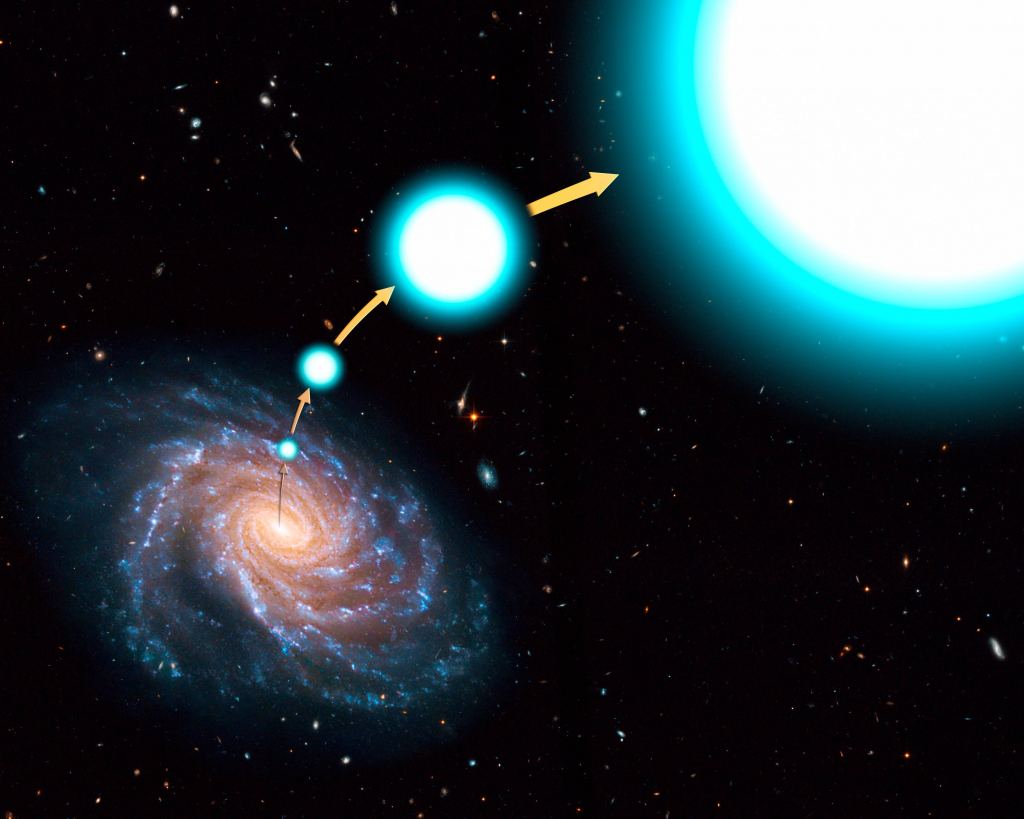
Ten undergraduate students from the University of Chicago made an astounding discovery using data from the Sloan Digital Sky Survey (SDSS). As part of their "Field Course in Astrophysics," they located one of the oldest stars in the Universe living in the Milky Way. The star, SDSS J0715-7334, is a low star located 79,256 light-years away. But here's where things truly get interesting: according to their findings, this star wasn't born in the Milky Way, but migrated here from another galaxy. The team is led by Professor Alex Ji, the deputy Project Scientist for SDSS-V, and graduate teaching assistants Hillary Andales and Pierre Thibodeaux.
The SDSS-V program began in 2020 and is the latest phase of the Survey's 25-year commitment to acquiring spectra of millions of objects in the Milky Way and beyond, to improve our understanding of how stars, black holes, and galaxies grow and evolve. The program relies on two telescopes in both hemispheres to provide full-sky coverage, including the 2.5-meter Sloan Foundation Telescope at Apache Point Observatory in New Mexico and the 100-inch du Pont Telescope at Las Campanas Observatory in Chile.
In Ji's class, the SDSS is embedded into the class curriculum, and the student team spent the first several weeks looking through its data for interesting stars. After examining several thousand candidates, they flagged 77 for follow-up observations using the Magellan Inamori Kyocera Echelle (MIKE) instrument on the Magellan telescopes at the Las Campanas Observatory. On the evening of March 21st, 2025, they found SDSS J0715-7334 and observed it for three hours.
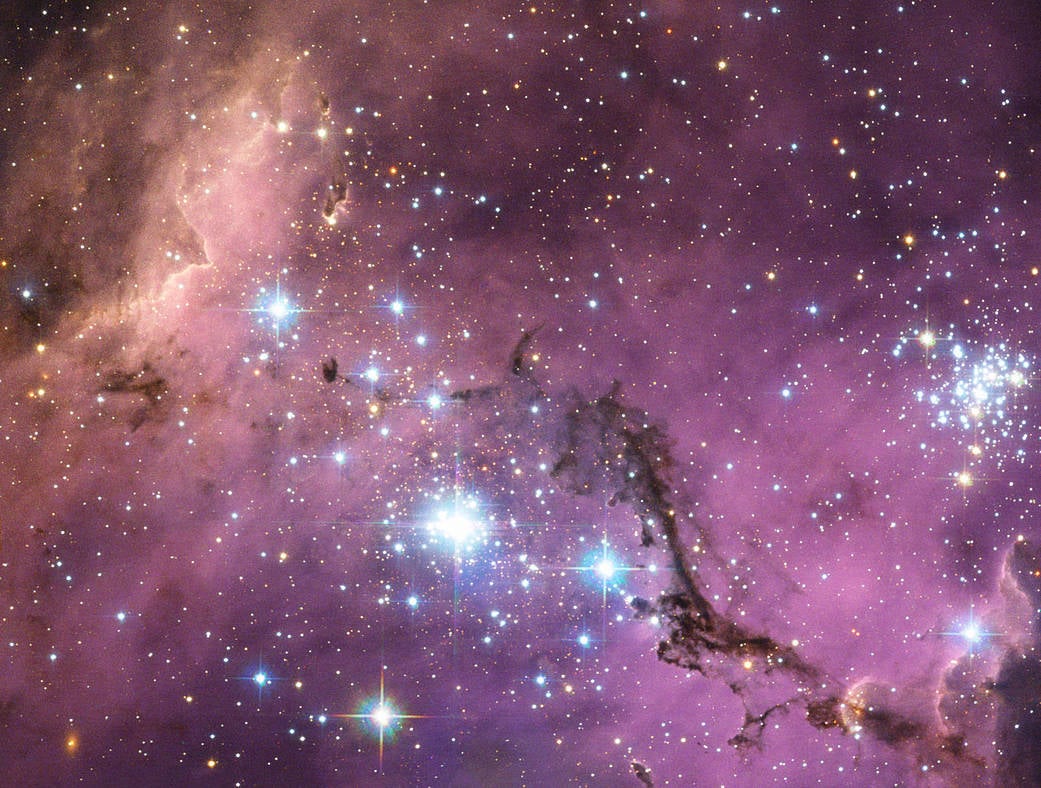 The Large Magellanic Cloud, a satellite galaxy of the Milky Way, as imaged from the Hubble Space Telescope. Credit: NASA/JPL-Caltech
From its composition, almost entirely hydrogen/helium, they determined that it is one of the oldest stars in the Universe. With only 0.005% of the metals found in stars like our own, SDSSJ0715-7334 has the lowest metallicity of any star yet observed in the Universe. These stars formed when the Universe was very young, after the first generation (Population III) of massive, short-lived (lasting only a few million years) stars reached the end of their lifespans and exploded as supernovae.
In the process, they shed their outer layers, creating heavier elements (such as carbon, oxygen, nitrogen, and metals) through the fusion of their hydrogen and helium. These elements were incorporated into the next generations of stars, Population II and I, which have higher levels of metal ("metallicity") in their composition. Astronomers use this to determine the age of stars in the Universe today. In the case of SDSS J0715-7334, it is an example of a Population II star that has managed to live this long because of its lower mass.
Analysis of SDSS J0715-7334's orbit also shows it formed in the Large Magellanic Cloud (LMC), one of the Milky Way's satellite galaxies, and migrated into the Milky Way billions of years ago. This led Ji and his students to nickname it "Ancient immigrant." "We found it the first night, and it completely changed our plans for the course," said Ji. "This ancient immigrant gives us an unprecedented look at conditions in the early universe. Big data projects like SDSS make it possible for students to get directly involved in these important discoveries."
The team also used data from the ESA's Gaia mission to determine the star's distance from the Sun and its motion through our galaxy. By tracing its motion back through the billions of years the star has existed, they traced its origin to the Milky Way's largest companion galaxy, the Large Magellanic Cloud (LMC). Further analysis of the star's spectrum also revealed that it contained very little carbon, providing further hints about the circumstances of its formation.
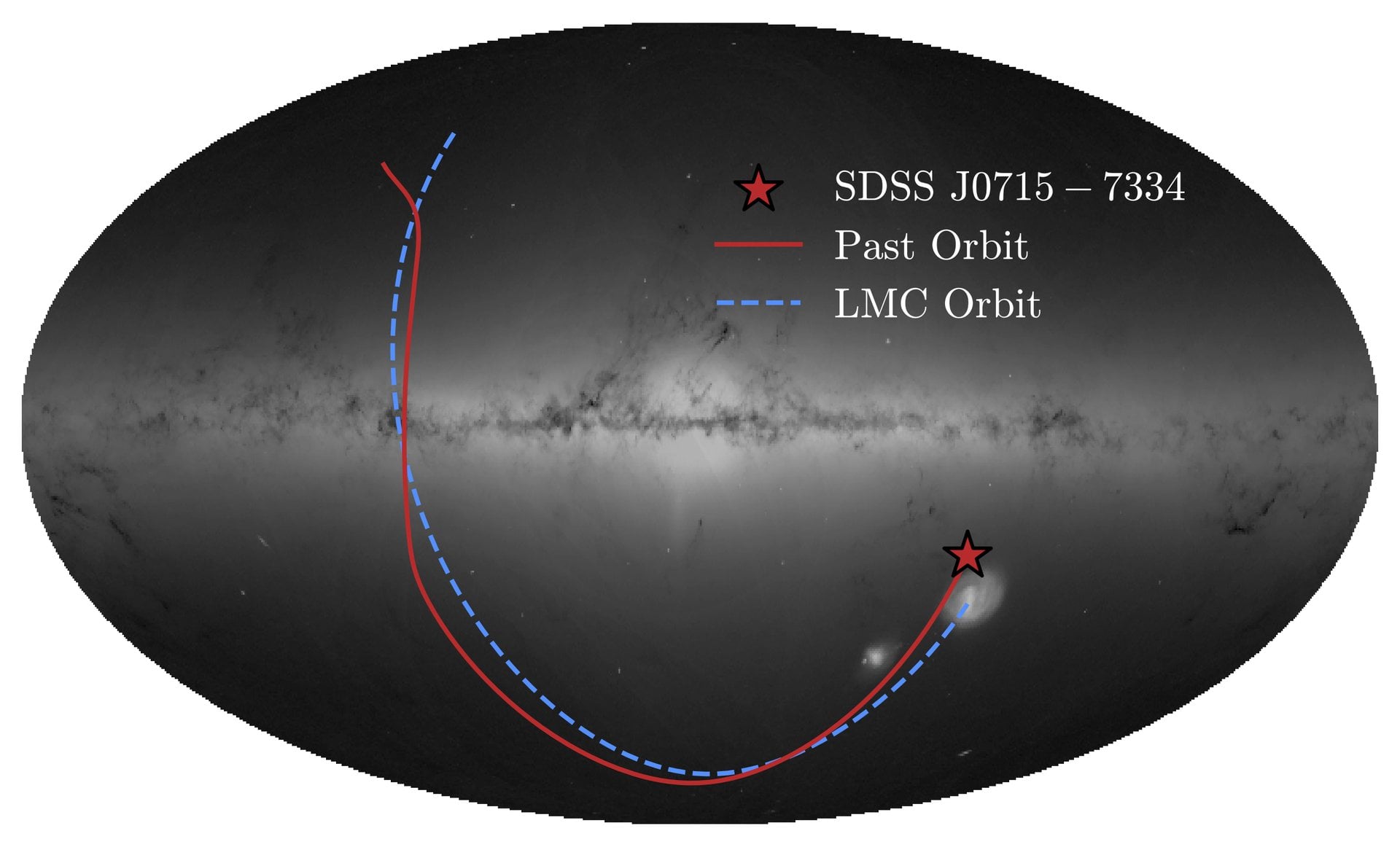 An image of our Milky Way galaxy with the position of the Ancient Immigrant star (SDSS J0715-7334) marked with a star symbol. Credit: Vedant Chandra/the SDSS collaboration/ESA
“The star has so little carbon that it suggests an early sprinkling of cosmic dust is responsible for making it,” said Ji. “This formation pathway has only been seen once before.” Ji refers to "the Methuselah star" (HD 140283), a Population II star located in the Milky Way's Halo about 1,000 light-years from Earth and the previous record holder for the oldest star in the Universe. As Ji summarized:
These students have discovered more than just the most pristine star. They have discovered their inalienable right to physics. Surveys like SDSS and Gaia make that possible for students of all ages everywhere on Earth, and this example shows that there is still plenty of room for discovery.
Further Reading: SDSS